When Do You Need Notarized Translation in Singapore? LingoExpress Guide for Clients
Of all the questions clients raise, "does this need to be notarized?" is the one that costs the most when answered wrongly. Reach too high and you pay for a notary step no authority asked for; reach too low and a file comes back weeks later requesting the seal you skipped. The honest position is that notarization is not a blanket requirement — it attaches to specific kinds of submissions. The aim of this checklist is to help you recognise which group your matter falls into before you commit, so the tier is settled at the start rather than discovered at the counter.
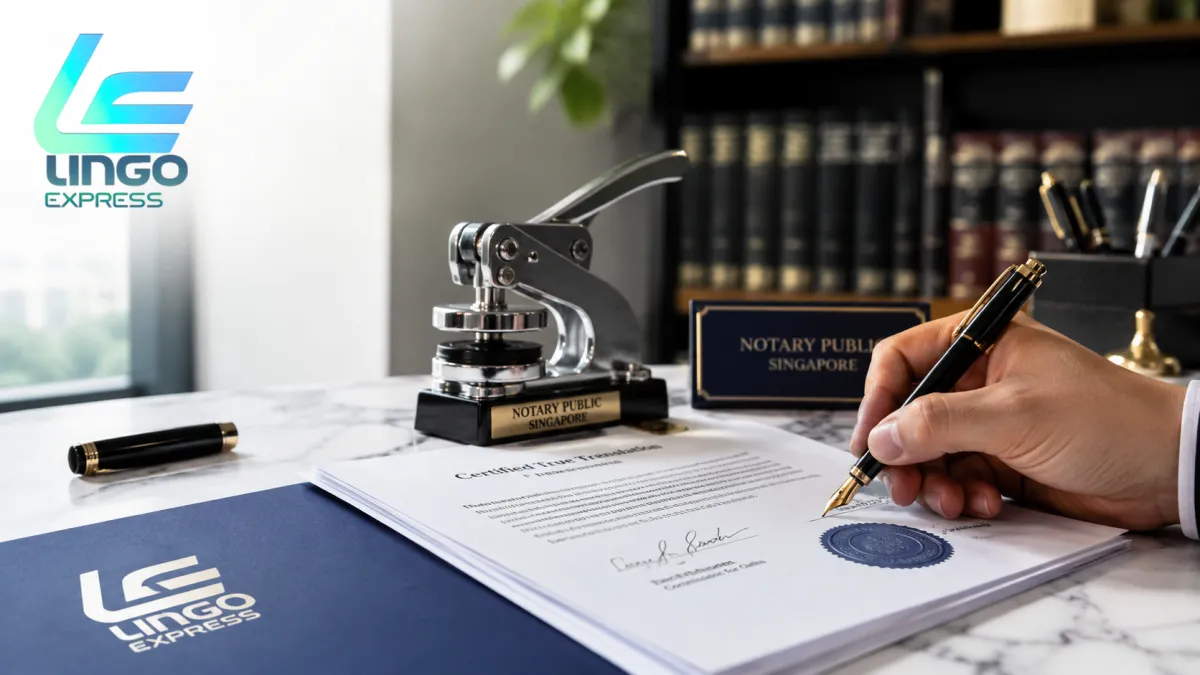
One definition to pin down first. A certified translation carries a signed accuracy statement from a qualified translator on company letterhead. A notarized translation adds a Singapore Notary Public who attests that the certification was properly made and signed — an official witness layered on top, not a re-translation. Whether your documents need that layer depends on who will receive them, which is exactly what the groups below sort out.
🪪 Group 1: PR & citizenship civil documents
This is where notarization is requested most. When the Immigration & Checkpoints Authority (ICA) assesses a permanent residence or citizenship case, it commonly expects the core civil records to be notarized on top of certification — though whether it applies to your exact documents is something to confirm against your own application page rather than assume.
- Birth certificates: For the main applicant and any children included. The source format matters — a Chinese "Medical Certificate of Birth" carries the neonatal name, both parents' ID numbers and the issuing hospital's red stamp; a Malaysian "Form A" under the Births and Deaths Registration Act 1957 shows the registration area, the parents' IC numbers and the registrar's stamp. Every field has to reappear in English before any notary step.
- Marriage certificates: Required where you apply with or sponsor a spouse. Watch how surnames are transliterated, because a mismatch against the passport is a frequent query.
- Divorce certificates or decrees: Needed where a prior marriage has ended — a Malaysian "Update of Marriage Record" from the National Registration Department, for instance, ties the order to a marriage registration number and the couple's IC details.
- Household registers: A Chinese "Resident Household Register" (hukou) establishes family composition across multiple stamped pages, all of which feed into the same civil-document set.
Notarization witnesses the certification; it does not fix the translation beneath it. So a hukou going forward for PR must already be complete — the household type (Agricultural or Non-Agriculture), the householder and household number on the cover, then each member's "Permanent Resident Registration Card" with relationship, ethnicity, place of origin, ID number, education and marital status, plus every Public Security Bureau seal rendered page by page. A notary's seal on top of a half-translated booklet still leaves a half-translated booklet.
⚖️ Group 2: Court & legal matters
Legal proceedings are the second setting where notarization is routinely expected, because a court needs assurance that a translated exhibit was certified by an identifiable, attested party. These documents lean toward the notarized tier far more often than everyday paperwork does.
- Documents filed as evidence: Foreign-language contracts, statements, or records submitted in a dispute, where the other side and the bench must both trust the rendering.
- Probate and inheritance papers: Wills, death certificates and family records used to settle an estate, where identity and relationships have to be established beyond doubt.
- Affidavits and statutory declarations: Sworn documents that already pass through a notary or commissioner, so a notarized translation sits naturally alongside them.
🌏 Group 3: Documents heading overseas
When a Singapore document is bound for a foreign government, embassy or university, notarization is usually only the first step — a further authentication often follows. Since Singapore joined the Apostille Convention, that layer is issued as an apostille by the Singapore Academy of Law (SAL), confirming the notary who signed is genuine and registered. The single most useful thing to know is that this chain almost always points outward: a document you will present abroad. For purely local submissions it rarely enters the picture, so reserve it for matters with a genuine overseas leg.
🚫 When certified-only is enough
Plenty of common submissions never need a notary at all, and assuming they do is a quiet way to overpay. Knowing the exceptions keeps your spending matched to your actual requirement.
- Employment and student passes: Supporting documents for an Employment Pass, S Pass or Student's Pass are generally accepted on certified translations alone.
- School, university and bank submissions: Enrolment paperwork and account-opening documents usually sit at the certified tier.
- Singapore-government documents in Chinese, Malay or Tamil: Records the Singapore government issues in any of the national languages are typically taken as-is, with no translation — and therefore no notarization — needed.
- Anything already in English: A certificate originally issued in English needs neither translation nor a notary step; submit it as it stands.
✅ Your pre-submission tick-list
Run through this before you commit to a tier or upload anything. If you can tick every line, you have matched your documents to what the receiving body genuinely needs.
- ✅ You have read the receiving authority's exact wording — "notarized", "certified", or simply "translated" — and taken it literally.
- ✅ You know the route — a routine pass tends to sit at certified, while PR, citizenship and court matters lean toward notarized.
- ✅ You have checked for an overseas leg, since a document used abroad may need an apostille on top of notarization.
- ✅ The underlying translation is complete — every field, stamp and seal rendered — before any notary step is added.
- ✅ Names match every passport in the set, with consistent spelling and transliteration throughout.
- ✅ You have skipped what needs no notary — certified-only submissions, English documents, and Singapore national-language official records.
- ✅ You have had your specific list reviewed so the tier is confirmed once, not corrected later.
Because every client's circumstances differ, the safest move is to have your documents and the application they are for assessed before work starts — so nothing essential is missed and nothing unnecessary is notarized. LingoExpress can usually flag whether your documents are likely to need notarization, arrange it with a Notary Public in the same job, and give you a transparent quote once it has seen the set and its purpose.
📣 Contact LingoExpress for a free quote!
📧 Email: [email protected]
🌐 Website: https://lingoexpress.com.sg