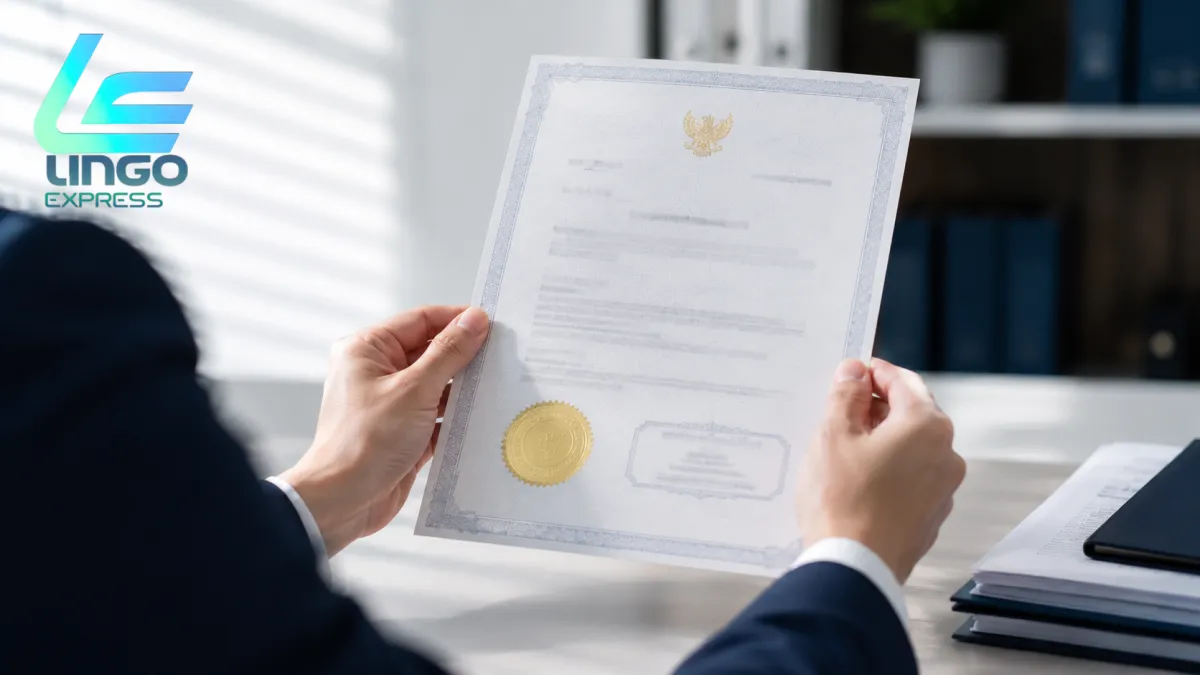
Urgent Indonesian Document Translation: What to Prepare Before Requesting a Quote
Urgency and accuracy usually pull in opposite directions — and on an official Indonesian document headed for a Singapore authority, accuracy cannot be the thing that gives way. The good news is that most of what slows an urgent job down happens before a translator starts: missing pages, illegible scans, uncertainty about names, no clear deadline. Get those out of the way up front and a rush job stops being a scramble. This guide walks through what shapes the cost of urgent Indonesian translation and exactly how to prepare so your quote is fast and your turnaround is honest.
🔍 Why there is no flat "urgent" price
A single rush rate would be convenient and misleading in equal measure. A one-page Indonesian birth extract with a handful of fields is a very different task from a multi-page academic transcript dense with subjects, or a notarised deed thick with official seals. Charging both the same would mean overcharging the simple job and undercharging the complex one.
A reputable provider looks at the actual document and prices to the work it contains, then adds for speed on top of that. Which is why an accurate number always follows you sharing the files — anyone quoting a firm "urgent" figure before seeing your documents is either padding for safety or setting you up for a surprise later.
📄 The factors that shape an urgent quote
Several things combine to set the effort behind an urgent Indonesian translation. Knowing them helps you read a quote with confidence and see where, if anywhere, your deadline could flex to your advantage.
Document type and complexity. A short, standard certificate is straightforward; a document thick with tables, codes, or specialised legal terminology is not. An Indonesian akta (deed), with its formal notarial language, or a transcript with a dense grid of subjects, takes careful work so every line lands correctly.
Length, word count, and seals to render. It is not just the page count but how much sits on each page. Indonesian civil and legal documents often carry official stamps, registration numbers and a notary's mark — and every seal and signature must be described in the translation, since an untranslated stamp reads as an incomplete document. More seals genuinely means more work.
Certification tier. A certified translation comes with a signed statement of accuracy from the translator or agency. A notarised translation is that work taken further and witnessed by a Singapore Notary Public — commonly required for PR and citizenship, though you should confirm what your case needs. For documents bound for use overseas, authentication by the Singapore Academy of Law or an apostille is a separate step again. Each added tier is more handling on top of the base.
Turnaround and urgency. This is the factor you control. A standard timeline gives the team room to translate, check and certify properly. Compressing that into a same-day or next-day job means rearranging schedules and prioritising your file ahead of others, and that priority handling carries a premium. If your deadline has any give at all, naming it honestly can soften the urgency loading.
- An Indonesian birth certificate (akta kelahiran) is a relatively standard layout — child's and parents' names, place and date of birth, the registering office (Dinas Kependudukan) and a stamp — usually lighter work, but every field and the seal must still be rendered.
- An Indonesian academic transcript carries a grid of subjects, credits (SKS) and grades that has to line up exactly with the original — the table drives the work, not the page count.
- An Indonesian notarial deed (akta notaris) spans multiple pages of formal legal language and several seals and signatures — more pages, more terminology, and more stamps all add to the effort.
- A marriage or divorce record ties names and identity numbers to a registering authority, so every name must reconcile against passports and every seal be accounted for.
The pattern holds even under time pressure: a tidy single-field certificate is lighter than a multi-page deed thick with seals, and a plain page is lighter than one ruled into a dense table. That is precisely why the figure follows the file, and why preparation speeds everything up.
📋 What to prepare before you ask for a quote
When the clock is running, a little preparation on your side is the difference between a quote in minutes and a day lost to back-and-forth. Have these ready when you make contact:
- Clear, complete scans of every page. Legible images or PDFs — including the reverse where stamps or signatures appear — let the team see exactly what they are working with. Crisp scans at 300 DPI or higher avoid the single most common cause of urgent-job delay.
- The passport spelling of every name. Indonesian names can be romanised more than one way; giving the exact passport spelling for yourself and any family members up front means the translation matches your travel documents and no query arises later.
- The receiving authority and purpose. Tell them who the translation is for — ICA, an employer, a university, a bank, or use overseas. The recipient determines whether certification alone is enough, or notarisation, or further authentication is in play.
- Your real deadline. State the actual date and time you need it. An honest deadline lets the quote reflect a priority timeline accurately — and occasionally reveals you have more room than you feared, sparing you a rush premium.
With those four things in hand, LingoExpress returns a transparent, itemised quote once it has seen the document and the purpose — so even under pressure you see what each step covers rather than a single opaque "urgent" sum.
🌏 How to keep an urgent job sensible
Keeping a rush job reasonable is rarely about hunting the lowest sticker. It is about not paying for things your situation does not call for, and removing the friction that drives a premium up.
- Match the certification tier to the need. Confirm with the receiving authority whether certified suffices before adding a Notary Public step. Notarisation is commonly required for PR — but for many submissions certified alone is accepted. Confirm for your case rather than paying for a layer you may not need under time pressure.
- Bundle related documents. If several Indonesian documents are due together — a family's certificates, say — submitting them as one set is more efficient to handle than trickling them in, which matters most when time is short.
- Send everything in one go. The fastest jobs are the ones where every page, name spelling and instruction arrives at the start. Partial submissions are what turn a one-day turnaround into three.
✅ What a transparent urgent quote gives you
A fair, itemised quote from a provider that stands behind its certification protects you even on a tight deadline. You see the base translation, any notarisation, any further authentication, and the priority handling broken out as separate lines — so nothing is buried in a single rushed number. That is the standard LingoExpress works to: a clear breakdown, accurate work, and certification an authority can trust, delivered to the deadline you actually need.
If your Indonesian document needs to travel further afield, note that steps like SAL authentication or an apostille generally apply only when a document is bound for use overseas, not for local Singapore submissions. Mention the destination country when you ask, and the team can flag whether any of that applies — and price it openly if it does, before the clock costs you anything.
📣 Contact LingoExpress for a free quote!
📧 Email: [email protected]
🌐 Website: https://lingoexpress.com.sg