The Complete Indonesian Document Translation Guide for Singapore Applicants India and Indian Language Document Translation
Two of the largest communities building lives in Singapore arrive with paperwork from Indonesia and from across India, and both face the same starting point: a certificate that is perfectly valid at home but unreadable to a Singapore officer until it is in English. Whether you are enrolling a child, registering a marriage, applying for a pass or assembling a residency file, the foreign-language original cannot stand alone. The English translation is the version that gets assessed — so understanding what it must contain is worth the time before you commission it.
This guide pulls together the document types that come up most from both regions, the components an English rendering has to preserve, and the steps from scan to accepted submission.
📘 What "certified translation" means for these documents
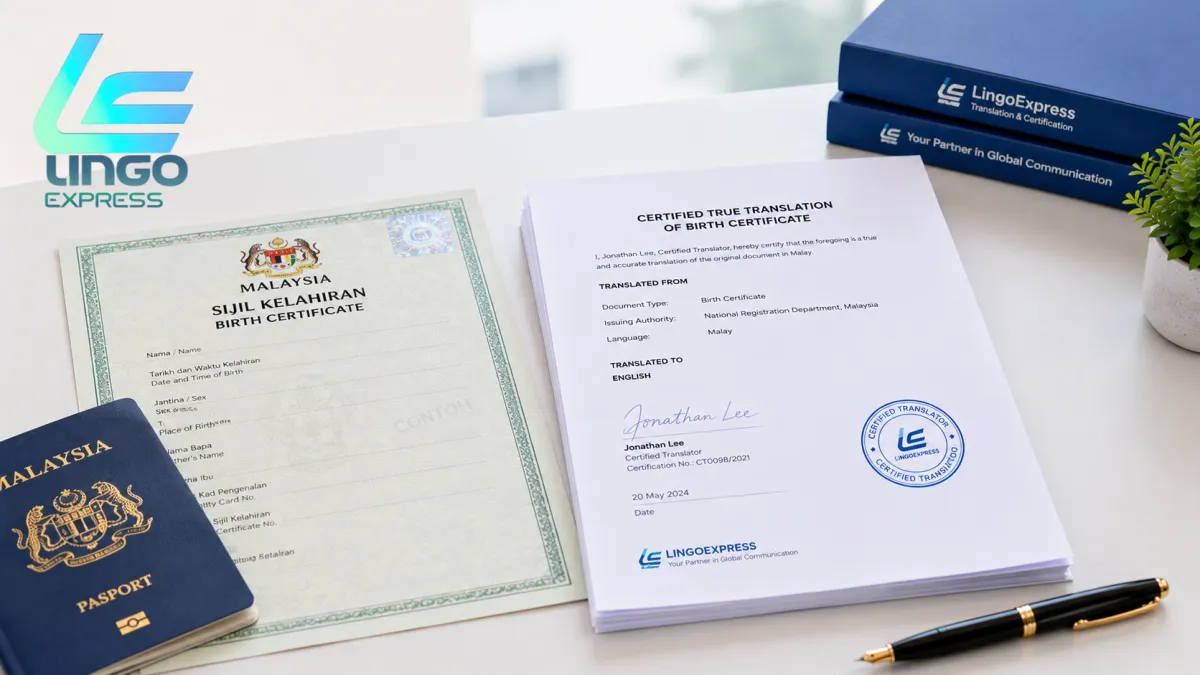
A certified translation is a complete, faithful English rendering of your original, backed by a signed statement from a qualified translator confirming its accuracy. It is not a summary and not a paraphrase — every field, stamp and annotation on the source has to appear. For Indonesian and Indian-language records this matters more than usual, because both carry dense official detail: registration numbers, issuing authorities, and seals that an officer will look for line by line. A certified rendering from LingoExpress is issued on company letterhead with a named translator behind it, so the receiving office can see exactly who stands accountable for the work.
🌏 Why the detail matters in Singapore
Singapore authorities assess foreign documents closely because so much downstream eligibility rests on them. A birth certificate proves a family link; an academic record proves a qualification; a marriage certificate establishes a spousal relationship. An officer cross-checks names, dates and identity numbers across the whole file and against your passport. A translation that is incomplete, or that romanises a name inconsistently, gets the application held — not because the underlying document is wrong, but because the version in front of the officer does not reconcile. Indian languages add a particular wrinkle: the same name can be transliterated several ways from scripts like Devanagari, Tamil or Gurmukhi, so consistency with your passport is decisive.
- An Indonesian birth certificate (Akta Kelahiran) records the child's name, date and place of birth, the parents' details, and the issuing civil registry office (Dinas Kependudukan dan Catatan Sipil) with its registration number and official stamp.
- An Indian educational certificate carries the awarding board or university, the candidate's name and roll number, the subjects and marks or grades, and the institutional seal — often alongside text in both a regional language and English.
- A marriage certificate from either region shows both parties' names and identity details, the registration authority and the official seal that validates the record.
Each of those elements, including every seal and registration number, has to be rendered or noted in the translation. An untranslated stamp reads as a missing piece, and a missing piece is what turns "submitted" into "held pending resubmission".
🗂️ The documents that come up most
Across both regions, the recurring sets fall into a few groups:
- Civil records: birth, marriage and divorce certificates, and sometimes a family card such as the Indonesian Kartu Keluarga, which establishes household composition much as a register does.
- Academic documents: degree certificates, mark sheets and transcripts from Indian boards and universities, and Indonesian school and tertiary certificates, all needing faithful rendering of grades and awarding bodies.
- Supporting evidence: police clearances, affidavits, and employment or income letters not already issued in English.
Indian-language work spans Hindi, Tamil, Punjabi, Bengali, Telugu, Malayalam and more; Indonesian work centres on Bahasa Indonesia. LingoExpress handles all of these regularly, so the source formats are familiar whichever region issued yours.
🧭 The process, scan to submission
- Scan each original in colour at 300+ DPI, full page, so every seal and registration number is legible.
- Confirm what the receiving body needs — a certified translation, and for some routes a notarised one too.
- Send the documents to LingoExpress for a transparent quote and turnaround, with notarisation arranged if your case calls for it.
- Provide the passport spelling of every name so the romanisation is consistent across the whole set.
- Review the draft, then receive the certified translation formatted to mirror the original.
- Submit the translation alongside the original to the authority or institution.
✅ What you receive and a closing word on tiers
A certified translation from LingoExpress arrives on company letterhead with a signed certification statement from a qualified translator, formatted to mirror the original so an officer can read the two side by side. For most submissions that certified tier is the complete answer. Where a route reaches into PR or citizenship, notarisation by a Singapore Notary Public is sometimes added on top — commonly required for those cases, though best confirmed against your own application rather than assumed. Send your documents with the name of what you are filing, and the right scope can be settled before anything is signed or sealed, so you neither fall short nor pay for a layer the authority never asked for.
📣 Contact LingoExpress for a free quote!
📧 Email: [email protected]
🌐 Website: https://lingoexpress.com.sg