The Complete Chinese Document Translation Guide for Singapore Applicants Indonesia Document Translation
Applicants arriving from mainland China, Taiwan or Hong Kong tend to carry some of the most structurally demanding documents a Singapore officer will ever read. It is not just a matter of converting Mandarin into English; a Chinese civil record packs an extraordinary amount of identity data, official terminology and seals onto each page, often spread across a booklet. This guide explains what these documents contain, why Singapore agencies scrutinise them so closely, and how the certified-translation step keeps your file moving.
📘 What "Chinese document translation" really covers
The phrase sounds like a single service, but in practice it spans a family of very different records, each with its own layout and its own pitfalls. A birth certificate behaves nothing like a household register, and a driving licence nothing like an academic transcript. Treating them all the same is where applicants go wrong. A certified translation has to honour the particular structure of each document — the fields it carries, the seals stamped on it, and the way those elements are arranged — not simply convert the visible sentences. The same Chinese characters can also carry different official meanings depending on the document they sit in, which is another reason format-awareness matters as much as language fluency.
🧾 The key documents and what they contain
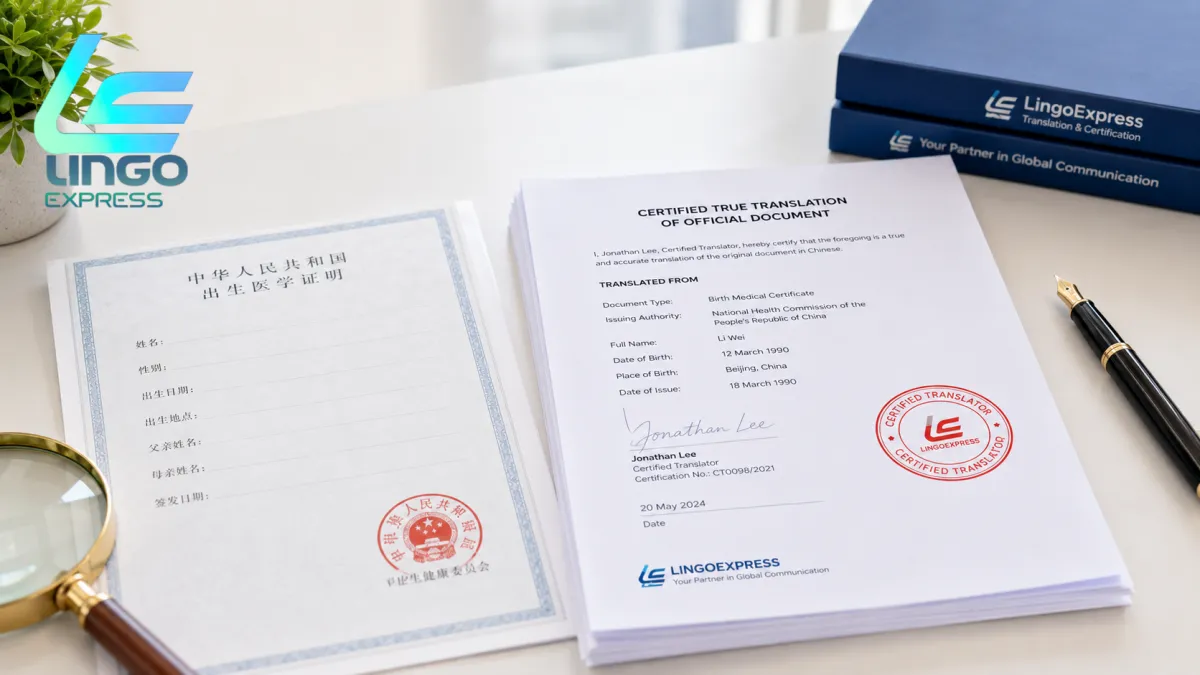
Below are the Chinese records that most often reach the LingoExpress desk for Singapore use. Each element listed has to reappear in the English version — including every seal, because an untranslated stamp reads as a missing piece of the document.
- A "Medical Certificate of Birth" carries the neonatal name, gender, gestational age, birth weight and length, both parents' nationality and ID numbers, the issuing hospital, and a red hospital stamp with a certificate number.
- A "Resident Household Register" (hukou) states the household type (Agricultural or Non-Agriculture), the householder and household number, then a per-person "Permanent Resident Registration Card" with relationship, ethnicity, place of origin, ID number, education and marital status — the whole booklet stamped with Public Security Bureau seals.
- A Chinese driving licence shows the licence number, class (such as C1D), the Traffic Police / Public Security Bureau issuer, a class-code table running A1 to P, and a supplementary page with renewal dates.
Marriage certificates and academic transcripts round out the set, the transcripts being especially table-heavy. With a hukou in particular, the translation must cover every page and every seal — not just the cover sheet — or the document is treated as incomplete.
🏙️ Why Singapore agencies read them so closely
So much downstream eligibility rests on these records that an officer cross-checks them line by line. A hukou establishes family composition; a birth certificate fixes parentage; a marriage record confirms a relationship a whole application may depend on. The Immigration & Checkpoints Authority (ICA) reconciles names, dates and ID numbers across the entire set, looking for any field that fails to line up from one document to the next. A Chinese driving licence presented for conversion is read against the issuer's class table, where a misread class code can change what you are licensed to drive. One inconsistent transliteration — a surname rendered two ways across two certificates — is enough to hold the file while an officer works out whether the documents describe the same person.
🔧 How the translation process works
Getting a Chinese document set ready for Singapore follows a clear sequence — and the dense, multi-page nature of these records makes each step matter more.
- Scan every page in colour at 300 DPI or higher — including each interior page of a hukou booklet — so every seal and ID number is legible.
- Give the passport spelling of every name, since romanised Chinese names are the single biggest source of mismatches.
- Confirm what your application needs: a certified translation for most uses, and for PR or citizenship commonly a notarised one as well (confirm for your case).
- Send the set to LingoExpress for a quote, noting which application each document supports so the scope is right from the start.
- Review the draft against the originals, then receive the certified — and where required notarised — translation, formatted to mirror the Chinese layout.
✅ What a finished translation gives you
A certified translation from LingoExpress comes on company letterhead with a signed certification statement from a qualified translator, declaring it a true and accurate rendering of the original — the form Singapore authorities expect to see. Because the Chinese source formats are familiar, the household-register seals, the birth-certificate fields and the licence class tables are handled the way an officer wants them. Where your route requires notarisation by a Singapore Notary Public, that is arranged within the same job, so a dense multi-page Chinese file is dealt with end to end rather than across two providers.
📣 Contact LingoExpress for a free quote!
📧 Email: [email protected]
🌐 Website: https://lingoexpress.com.sg