The Complete Academic Document Translation Guide for Singapore Students MOM Work Pass, HR and Employment Documents
Academic and employment paperwork is the quiet backbone of two of the most common journeys into Singapore: studying here, and working here. A university admissions office wants to see exactly what you studied and how you scored; the Ministry of Manpower (MOM) and HR teams want to confirm the qualifications and history behind a pass application. When those documents were issued in Mandarin, Bahasa, Tamil, Korean or any other language, the original alone will not do — you need a certified English translation that an assessor can take at face value.
This guide explains what counts as an academic or employment document for these purposes, why the category is unusually unforgiving of loose translation, and how to move from a stack of foreign certificates to a set an admissions officer or HR reviewer accepts without a second request.
🎓 What this category covers
"Academic and employment documents" is a wider net than it first sounds. On the study side it spans degree scrolls, diplomas, academic transcripts and school-leaving certificates. On the work side it reaches employment letters, service records, income statements and HR confirmations that substantiate your career history. What unites them is that each one makes a factual claim — a grade, a title, a date of service — that a Singapore institution or employer will rely on, and that reliance is only as sound as the translation carrying it.
📐 Why academic translation is unusually exacting
Academic language is technical and institution-specific in a way that resists casual rendering. A degree classification, an honours distinction, a grade on a national scale — these are terms of art, not phrases to paraphrase by feel. Translate a grade band loosely and you may understate or overstate the qualification you actually earned; render a degree title imprecisely and an assessor cannot map it to its local equivalent. The whole value of the document is its precision, so the translation has to preserve that precision rather than approximate it.
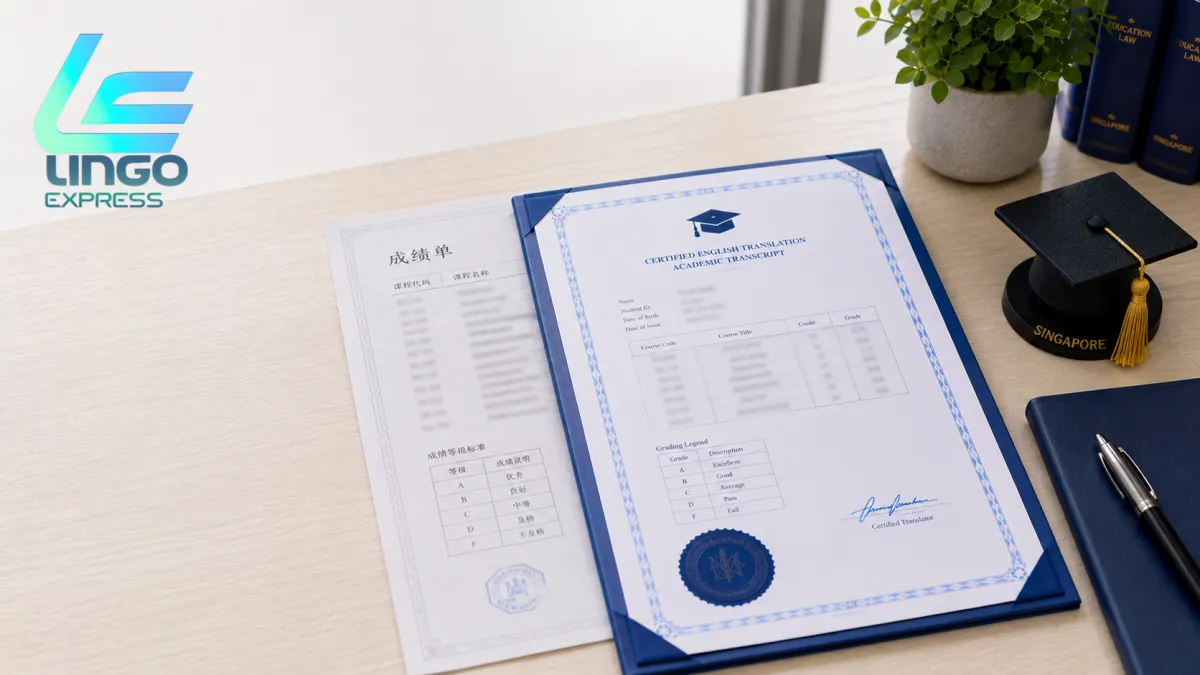
A Malaysian SPM — formally the "Malaysian Certificate of Education", issued through the Ministry of Education Malaysia's Examinations Syndicate — carries the candidate's name, IC and index number, the school, and a subject-by-subject grade table set against a GCE standard, with grades such as 8E and a legend running A+ down to G. Each subject name, each grade, the awarding body and the grade legend all have to carry across exactly, so an assessor can place the qualification correctly rather than misread a grade band. Transcripts work the same way: they are the most layout-heavy documents you will submit, and the translation should mirror the original's table structure column for column.
🏫 Where these documents are used in Singapore
The destination decides the emphasis. Students applying to schools, polytechnics and universities lead with transcripts, diplomas and school-leaving certificates, often assessed against frameworks the Ministry of Education (MOE) and institutions recognise. Work pass applicants and the HR teams filing on their behalf lean on degree certificates plus employment and income evidence for MOM. In both worlds the baseline requirement is a certified translation; some routes or institutions may ask for more, which is why reading the specific checklist matters before you commit.
🧭 How the process works
Turning foreign academic and employment records into an accepted English set follows a clear path.
- Gather and scan every page in full colour at 300 DPI or higher — both sides of a transcript, the grade legend, any embossed seal or watermark.
- Confirm the requirement with the institution or HR team — certified translation, and whether anything beyond that applies to your route.
- Send the set to LingoExpress for a quote, noting whether it is for study admission or a work pass so the scope is set correctly.
- Supply the passport spelling of your name and confirm any prior name, so the translation reconciles with your identity documents.
- Review the draft for grades and titles, then receive the certified translation formatted to mirror the original layout.
⚠️ Where applicants slip
A handful of recurring errors account for most rejected academic sets, and all of them are avoidable with care up front.
✅ What you receive
A certified academic or employment translation from LingoExpress comes on company letterhead with a signed statement from a qualified translator attesting that the English version faithfully renders the original — the format Singapore institutions, MOM and HR teams expect. Transcripts and certificates are formatted to mirror the source so an assessor can lay the two side by side and follow them line for line. Send through your documents and say whether they are for study or work, and you will get a clear quote and turnaround before any work starts.
📣 Contact LingoExpress for a free quote!
📧 Email: [email protected]
🌐 Website: https://lingoexpress.com.sg