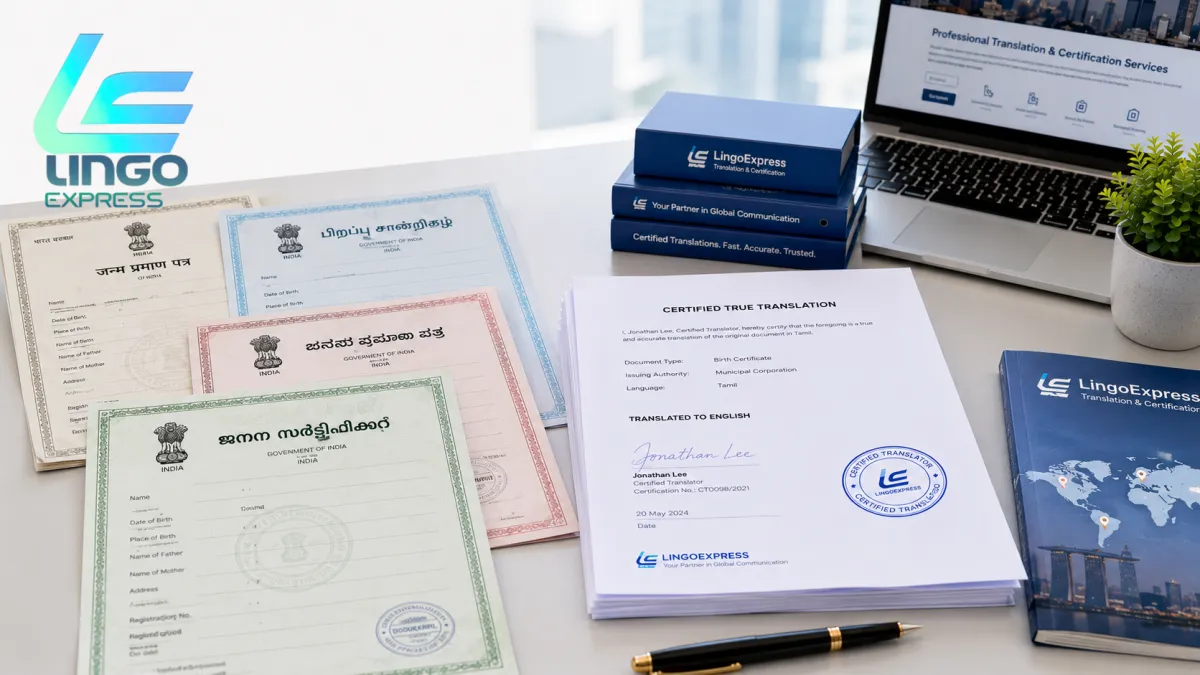
Punjabi to English Certified Translation in Singapore
Singapore is home to a long-established Punjabi community, and families continue to move between Punjab and the city for work, study, marriage and residence. The documents that come with them are frequently issued in Punjabi, written in the Gurmukhi script — a writing system quite distinct from the Latin alphabet, which is precisely why an accurate, certified translation is needed before any Singapore office can read and accept the record. This service exists to bridge that gap cleanly.
👥 Who needs this service
The need usually arises the moment a Punjabi document has to be presented to a Singapore institution. You might be sponsoring a spouse and need a Punjabi marriage record translated; enrolling a child and needing a birth certificate rendered into English; supporting a work pass with the Ministry of Manpower (MOM); or submitting civil records to the Immigration & Checkpoints Authority (ICA) for a residence application. In each case the receiving body works from the English translation, so its completeness and accuracy directly affect how your application is received.
It also matters that Punjabi documents can reach Singapore from more than one origin. A certificate may have been issued in the Indian state of Punjab, but Punjabi-language and Gurmukhi-script records also travel from the wider Punjabi diaspora, and the issuing authority and layout shift accordingly. A translator working from the source needs to read the document on its own terms — recognising which registering body produced it and how its fields are arranged — rather than forcing it into a single assumed template. That source-level familiarity is what keeps a translation faithful to the record actually in front of you.
📄 What the service covers
Punjabi documents carry the same depth of detail as records in any other language — names, official numbers, registering authorities and seals — and every one of those elements has to appear in the English version, not just the headline information.
- Civil records — birth, marriage and death certificates issued by a district authority in Punjab, each carrying registration numbers, the registering office and an official seal.
- Educational documents — school certificates, mark sheets and degree records, where subject names, grades and the awarding board must all carry across faithfully.
- Legal and personal papers — affidavits, declarations and name-change documents, often dense with formal phrasing and official stamps that must be rendered or noted.
Every stamp and signature is part of what makes the document authoritative. A translation that conveys the names but leaves a district seal or an official annotation undescribed reads as incomplete to the officer comparing it against the Gurmukhi original.
Educational records deserve particular care. Mark sheets and certificates from a school board or university are layout-heavy, with subjects, grades and credit lines set out in a grid, and an assessor in Singapore needs to read the qualification you genuinely hold. The translation should follow that table structure faithfully rather than compressing it into prose, so the grades line up against their subjects and the awarding board is named exactly as it appears — the difference between a record an officer can verify at a glance and one that invites a query.
📋 How it works
The path from a Punjabi original to a submission-ready English translation is short and predictable.
- Scan the original in colour at a high resolution, full page, so every seal and number stays legible.
- Send it to LingoExpress for a quote and turnaround, noting which Singapore authority will receive it.
- Provide the passport spelling of each name — transliteration from Gurmukhi can vary, so the translator needs your travel-document version to keep names consistent.
- Confirm the tier you need — a certified translation for many uses, and for PR or citizenship commonly a notarised one too (verify for your case).
- Review the draft, then receive the certified translation formatted to mirror the original.
🖋️ Certified, and notarised where required
A certified translation covers the majority of everyday needs — work passes, enrolment, banking. For permanent residence and citizenship, a notarised translation, in which a Singapore Notary Public attests to the certification, is commonly expected on top, though whether it applies to your specific documents is best confirmed against your application rather than assumed. LingoExpress can scope the right tier and arrange notarisation in the same job, so you deal with one provider instead of two.
✅ What you receive
A Punjabi-to-English certified translation from LingoExpress arrives on company letterhead with a signed certification statement from a qualified translator, declaring the English version a true and accurate rendering of the original — the format Singapore authorities expect to see. The layout mirrors the source so an officer can follow the two side by side, every seal and signature is accounted for, and where your matter calls for it, notarisation is arranged alongside. With documents in Indian and South Asian languages crossing this desk regularly, the Gurmukhi source is familiar ground.
📣 Contact LingoExpress for a free quote!
📧 Email: [email protected]
🌐 Website: https://lingoexpress.com.sg