Marriage Certificate Translation Guide for Singapore Applications
Your marriage certificate is one of the most consequential single pages in any family-based application. It is the document that establishes a spousal relationship — and a spousal relationship is what an entire dependant, residence or sponsorship case can rest on. When that certificate was issued in Mandarin, Bahasa, Tamil or another language, the original alone will not do; you need a certified English translation that an officer can read line for line against your other documents. This guide explains what marriage certificate translation involves, why Singapore authorities scrutinise it, and how to get from your original to an accepted version.
💍 What "marriage certificate translation" actually means
It is more than swapping words from one language to another. A proper marriage certificate translation reproduces the entire document — names, dates, place of registration, the registering authority, witnesses, and every stamp or seal — in English, then attaches a signed statement from a qualified translator certifying that the rendering is true and complete. The certified statement is what turns a piece of translated text into a document an authority will treat as evidence. Without it, even a flawless translation carries no official weight.
🏛️ Why it matters so much in Singapore
Singapore authorities cross-reference your marriage certificate against everything else in the file. The Immigration & Checkpoints Authority (ICA) uses it to verify a spousal link for residence and dependant applications; the Registry of Marriages (ROM) may require a translated foreign certificate in certain registration scenarios. Because a name or date that does not reconcile across documents is one of the fastest ways to get a file queried, the marriage certificate has to align perfectly with the passports and the birth certificates already in the application. The cost of a mismatch here is rarely money — it is weeks added to a timeline.
📄 The components that must appear in the English version
Foreign marriage certificates vary in layout, but they share a core set of elements — and every one of them has to survive into the translation, including the parts that are not strictly text.
- Both spouses' full names in the original script and romanised form, rendered to match each passport exactly.
- Date and place of marriage, plus the registering authority and any certificate or registration number.
- Official seals and the registrar's signature, given as bracketed notes such as [Official seal: civil registry] rather than left as untranslated marks.
- Any annotations added later — for instance a recorded name change — since these can be exactly what an officer is checking.
A frequent source of trouble is surname transliteration: the same Chinese or Indian surname can be romanised more than one way, and if the certificate spells it differently from the passport, the translation should note the variant so an officer is not left guessing whether two documents describe the same couple.
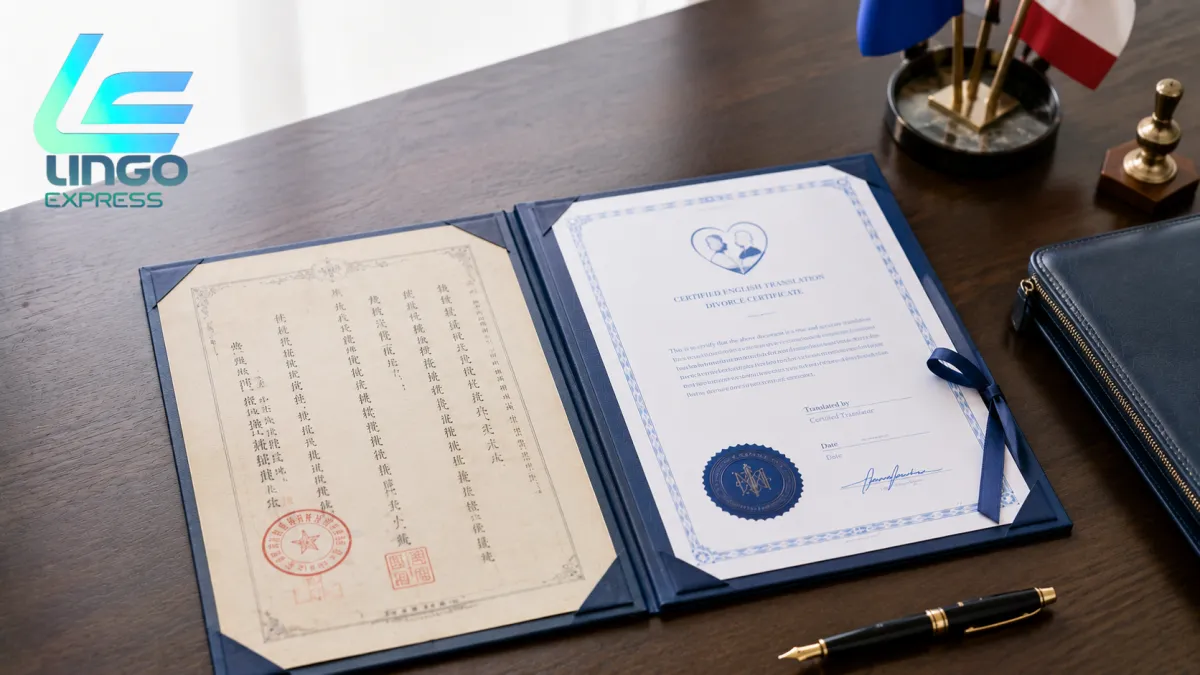
Marital history adds another layer some applicants overlook. If either spouse was previously married, the file may also need a translated divorce or annulment record to establish that the current marriage is valid — and those documents carry their own registry detail, such as a court reference, an order date and a marriage registration number, all of which must cross into English. A marriage certificate read in isolation can look complete; read alongside an application that asks about prior unions, it sometimes needs a companion document to tell the full story without gaps an officer would have to chase.
🧭 How the process works
- Scan the certificate in full colour at 300+ DPI, capturing the whole page and the reverse if anything is printed there, so every seal is legible.
- Confirm what your application requires — a certified translation, and for PR or citizenship commonly a notarised one too.
- Send it to LingoExpress for a quote, noting the application it supports, so the scope matches the authority that will receive it.
- Supply the passport spelling of both spouses' names, so the translation lines up with your travel documents and the rest of your file.
- Review the draft, then receive the certified translation formatted to mirror the original, with notarisation arranged in the same job where your case calls for it.
✅ What you can expect
A certified marriage-certificate translation from LingoExpress arrives on company letterhead with a signed certification statement from a qualified translator confirming the English version is a true and accurate rendering of the original — the format Singapore authorities expect. Marriage certificates from China, Malaysia, Indonesia, India, Vietnam and well beyond are part of the regular workload, so the source format is recognised on sight rather than puzzled over. Where notarisation by a Singapore Notary Public is part of your route, it is coordinated alongside the translation so you are dealing with one provider, not two, under whatever deadline your application sets.
📣 Contact LingoExpress for a free quote!
📧 Email: [email protected]
🌐 Website: https://lingoexpress.com.sg