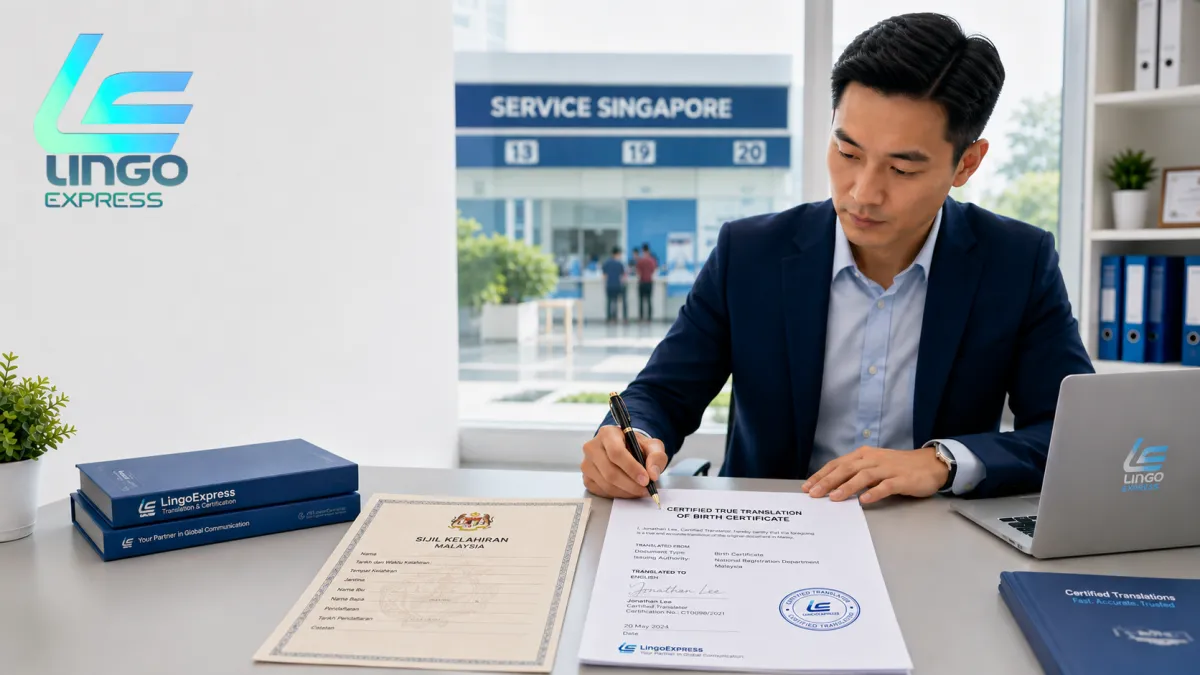
Malaysian Document Translation Cost Guide in Singapore
Malaysian documents are among the most common a Singapore translator sees — JB families, cross-border workers, students, and couples all bring them in. So it is natural to want a simple price up front. But Bahasa Malaysia documents range from the genuinely simple to the genuinely intricate, and pricing them all the same would mean overcharging some applicants and undercharging others. This guide breaks down what actually shapes the figure, so you can read any quote with confidence.
🔍 Why there is no single flat price
A flat rate sounds convenient, but it would misprice the work. A one-page Form A with a handful of fields is a very different task from a multi-page divorce order from the High Court, or a long academic transcript spanning years of subjects. Charging both the same would mean one applicant subsidising the other.
A reputable provider instead looks at the actual document and prices to the work it contains. That is why an accurate number follows you sharing the files — anyone quoting a firm amount before seeing your documents is either padding for safety or setting up a surprise later.
📄 The factors that shape your cost
Several things combine to set the effort behind a Malaysian document translation. Understanding them helps you see where a quote comes from — and where you might trim without cutting corners.
Document type and complexity. A standard certificate is straightforward; a document thick with tables, codes, or legal terminology is not. An SPM certificate's grade grid, or a court order's clauses, takes careful work to render so every line tracks the original.
Length, word count, and seals to render. It is not just how many pages you hand over, but how much sits on each. A page packed with fine print, tables, and official stamps carries far more than a sparse certificate. Every seal and signature has to be described too — an untranslated stamp reads as an incomplete document — so the number of seals genuinely adds to the work.
Certification tier. A certified translation comes with a signed statement of accuracy from the translator or agency. A notarised translation is that work taken a step further and witnessed by a Singapore Notary Public — notarisation is commonly required for PR, though you should confirm what your specific case needs. For documents bound for use overseas, authentication by the Singapore Academy of Law or an apostille is a separate step again. Each tier is more handling, sitting on top of the base translation.
Language pair. Bahasa Malaysia into English draws on a deep pool of qualified linguists, which keeps it efficient. Where a Malaysian document also contains passages in Mandarin, Tamil, or Jawi script, the added complexity can affect the work. The breadth of languages a provider handles matters here, and LingoExpress covers a wide range.
Turnaround and urgency. A standard timeline in business days gives the team room to translate, check, and certify properly. Compressing that into a same-day or next-day rush means rearranging schedules, and that priority handling carries a premium. If your deadline has any give, a normal turnaround is the gentler option.
Volume. A single certificate is one job; a full family set — birth certificates, marriage certificate, SPM results, and more — is a different scale. Submitting related documents together is usually more efficient to handle than trickling them in one at a time.
- A "Form A" birth certificate (Births and Deaths Registration Act 1957) has a relatively standard layout — registration area and sub-district, parents' IC numbers and occupations, and a registrar's stamp — so it is usually lighter work.
- An SPM certificate — the "Malaysian Certificate of Education" from the Ministry of Education's Examinations Syndicate — carries a grid of subjects and grades against a GCE standard that must line up exactly with the original; the table drives the work, not the page count.
- A Malaysian "Update of Marriage Record" / divorce order from the High Court, issued via JPN, includes the petition number, date of order, and both parties' ICs — denser legal text that takes more care.
- A household or family record with several members and multiple seals adds entries and stamps, all of which add to the effort.
The pattern is clear: a tidy single-field Form A is lighter than a dense SPM table or a multi-clause court order. That is exactly why the figure follows the file rather than a fixed menu.
📋 How to get an accurate, itemised quote
The fastest route to a number you can rely on is to give the team what it needs to assess the job. A little preparation turns a rough estimate into a precise, itemised quote.
- Send clear, complete scans. Legible images or PDFs of every page, including the back where the registrar's stamp or signatures appear, let the team see exactly what they are working with — and avoid back-and-forth that slows you down.
- Name the purpose and the receiving authority. Tell them who it is for — ICA, the Ministry of Manpower (MOM), a university, a bank, or use overseas. The intended recipient determines whether certification alone is enough, or notarisation, or further authentication.
- State your deadline. Sharing when you need the documents lets the quote reflect a standard or a priority timeline honestly, with no surprises.
With those three things in hand, LingoExpress returns a transparent, itemised quote once it has seen the document and the purpose — so you see what each step covers rather than one opaque sum, and know exactly what you are approving before any work begins.
🌏 How to keep your cost sensible
Keeping costs reasonable is rarely about hunting for the lowest sticker. It is about not paying for things your situation does not call for.
- Match the certification tier to the need. Confirm with the receiving authority whether certification suffices before adding a Notary Public step. Notarisation is commonly required for PR — but for many submissions to MOM, schools, or banks, certification alone is accepted. Confirm for your case rather than paying for a step you may not need.
- Bundle related documents. Submitting a full family set together is usually more efficient to handle than sending them piecemeal.
- Avoid the rush where you can. If your timeline has any give, a standard turnaround sidesteps priority handling. Planning ahead is often the simplest saving available.
✅ What a transparent quote gives you
A fair, itemised quote from a provider that stands behind its certification protects you from paying twice. You see the base translation, any notarisation, and any further authentication broken out as separate lines, so nothing is buried. That is the standard LingoExpress works to: a clear breakdown, accurate work, and certification an authority can trust.
If your Malaysian documents need to travel further than Singapore, note that steps like SAL authentication or an apostille generally apply only when a document is bound for use overseas, not for local submissions. Mentioning the destination when you ask for a quote lets the team flag whether any of that applies — and price it openly if it does.
📣 Contact LingoExpress for a free quote!
📧 Email: [email protected]
🌐 Website: https://lingoexpress.com.sg