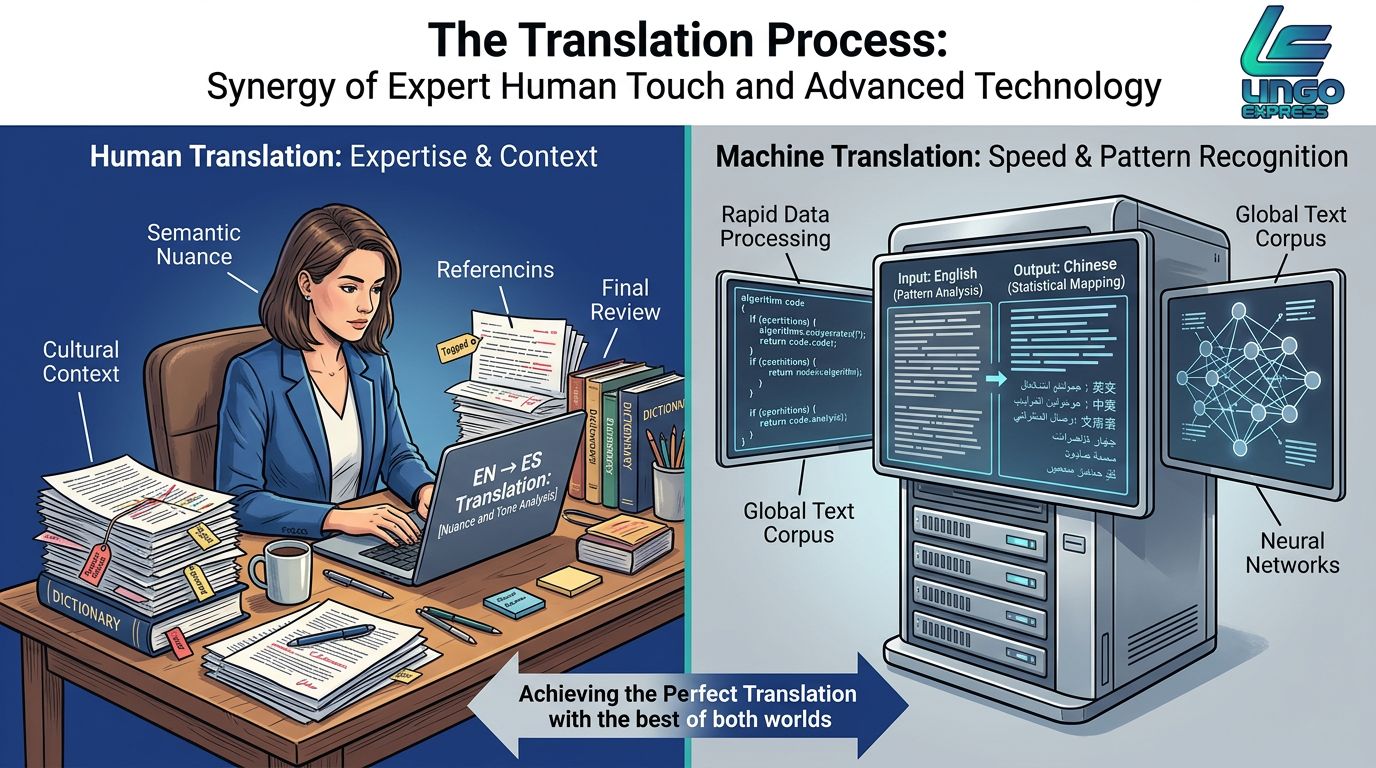
Machine Translation vs Government-Accepted Translation
When a foreign-language certificate needs to become English for an official purpose, it is tempting to paste it into a translation app and be done in seconds. The output often looks plausible — and that is precisely the trap. The question is not whether software can produce English words; it is whether the resulting document carries the accuracy and accountability a government office requires. Those are two very different standards, and confusing them costs applicants time they did not plan to lose.
🤖 What machine translation actually is
Machine translation is a statistical engine predicting the most likely rendering of a phrase from patterns in its training data. It is genuinely useful for getting the gist of an article or a casual message, and modern systems read fluently. But it has no awareness of legal consequence, no eye for an official seal, and — crucially — no one who signs to vouch for the result. It will confidently transliterate a name a defensible-but-wrong way, silently ignore a stamp it cannot interpret, and flatten a structured table into loose prose. Nobody is answerable for any of it, which is exactly why no authority treats raw software output as a valid translation.
🏛️ What a government-accepted translation is
A government-accepted translation is a certified translation: a complete, faithful rendering produced by a qualified human translator and issued with a signed statement of accuracy on company letterhead. That statement names a real entity and a real signatory who attest the translation is true to the original — so the receiving officer knows exactly who is accountable. The translator preserves every field, reproduces tables as tables, and renders each seal and stamp in its proper place rather than dropping what software cannot parse.
📊 Side by side: the two approaches
Lay the two against the questions that decide whether a document is usable, and the gap is hard to miss.
| Machine Translation | Government-Accepted (Certified) | |
|---|---|---|
| Who stands behind it | No one — software output, unsigned. | A named qualified translator and a registered agency. |
| Seals & stamps | Usually ignored or omitted. | Each rendered in place with a bracketed note. |
| Names & layout | Phonetic guesses; tables flattened to prose. | Matched to your passport; structure mirrored. |
| Accepted by authorities | No. | Yes — the recognised format for official use. |
🧭 Which one do you actually need?
The honest dividing line is the purpose. If you are reading a foreign news article, sketching out a rough understanding of a letter, or chatting across a language barrier, a machine translation is perfectly fine — use it freely. But the moment a document is going to an authority — the Immigration & Checkpoints Authority (ICA) for a pass or PR matter, the Ministry of Manpower (MOM) for a work pass, a university, a bank, or a court — you need a certified translation that an officer can rely on and trace to a signatory. There is no in-between tier where unsigned software output quietly passes muster.
⚠️ The hidden cost of guessing wrong
The danger with machine output is that its errors are quiet. A misread date or a name that does not match your passport will not announce itself; you discover it only when the file comes back, the timeline resets, and you are starting over weeks later. For a PR, citizenship, or visa matter, that delay is the real price of treating a draft as a final document. A certified translation removes the guesswork because a qualified person has checked it and put their name to it.
There is a second, subtler cost worth naming. Even when machine output happens to be word-accurate, it still arrives with no certification an authority can rely on — no letterhead, no statement of accuracy, no signatory. So a "perfect" free translation is not actually usable for an official purpose; you would still have to commission a certified version, having gained nothing from the first attempt except a false sense that the job was handled. Starting with the correct standard saves that wasted lap entirely, and it spares you the harder-to-undo damage of a rejection sitting on your application record while a deadline ticks down.
If your document is bound for an official desk, start from the standard that desk requires. Send your scans to LingoExpress with the receiving authority named, and you receive a certified translation built to be accepted the first time — not a fast draft you will have to redo.
📣 Contact LingoExpress for a free quote!
📧 Email: [email protected]
🌐 Website: https://lingoexpress.com.sg