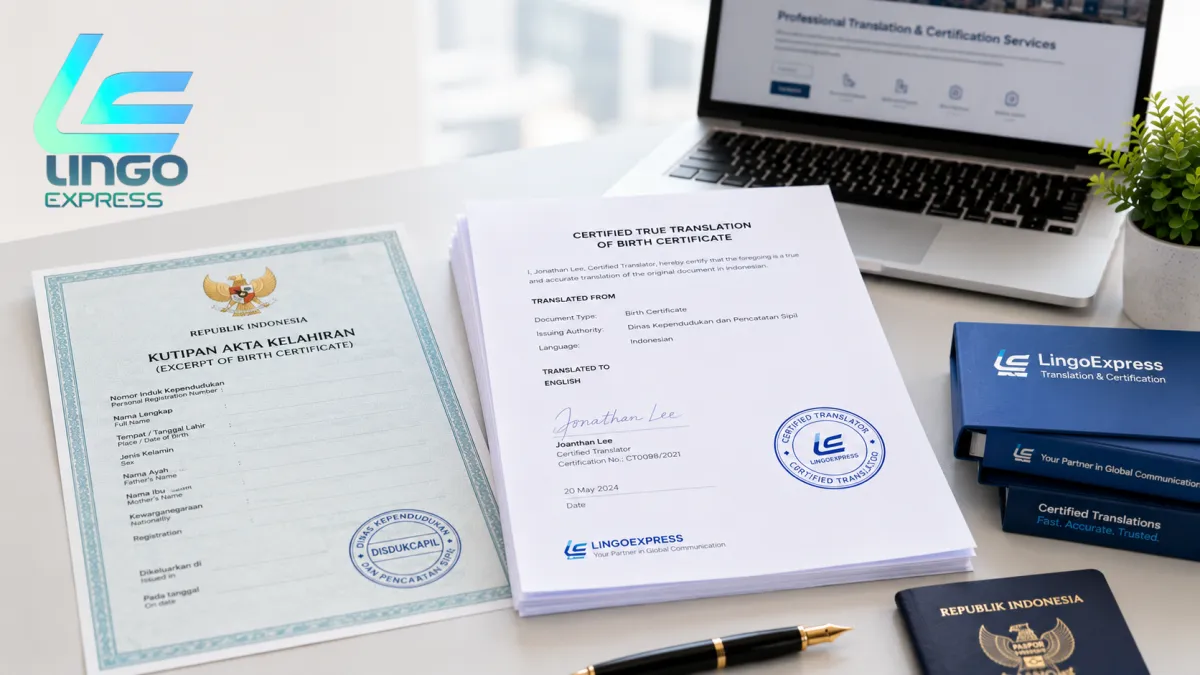
Kartu Keluarga Translation for Singapore Family Applications
If you are an Indonesian national building a family-based application in Singapore — a Dependant's Pass for a spouse, a Long-Term Visit Pass for a parent, a place at school for a child, or a Permanent Residence file for the household — the Kartu Keluarga sits near the centre of it. It is the document that proves your family unit on paper. And because it is issued entirely in Bahasa Indonesia, you cannot submit it on its own: a Singapore officer needs an accurate English version they can read against the original. This is the service that produces exactly that, and the page below explains who needs it, what it covers, and how it runs.
👪 Who needs a Kartu Keluarga translation
The family card earns its place whenever an application turns on relationships rather than on you alone. In practice that covers a wide span of situations Indonesian families in Singapore meet regularly.
- Dependant's Pass applications, where the card helps evidence a spouse or child's link to the pass holder.
- Long-Term Visit Pass sponsorships for a parent or other relative, where the household relationship is the basis of the application.
- Permanent Residence files for a family, where the Immigration & Checkpoints Authority (ICA) reviews civil documents to establish family composition.
- School enrolment, where a child's place in the family unit may need to be shown to a school or the Ministry of Education (MOE).
📄 What the translation covers
A Kartu Keluarga is densely structured, and every element on it has to reappear in the English version — leaving anything out makes the document read as incomplete. The service renders the whole card, not just the headline names.
The card carries a unique family card number (Nomor Kartu Keluarga) and the head of household's name, then a row for every member listing their full name, NIK (national ID number), gender, place and date of birth, religion, education, occupation, and — crucially — their relationship to the head of the family (SHDK). The reverse records each person's parents and details of marriages. The whole document is issued under the local Dukcapil (civil registration office) with its signatures, the issuing date and place, and official stamps. Every one of those fields, and every stamp, is rendered in the English translation.
The relationship column and the NIK numbers do the heavy lifting in a family application, so they have to be rendered precisely — a relationship mislabelled or an ID number mis-keyed is exactly the kind of detail an officer cross-checks against your other documents.
It also matters that the card is rendered as a faithful tabular record rather than collapsed into a loose summary. An officer reviewing a family file wants to lay the English version beside the Indonesian card and trace each row across — head of household, spouse, each child — without losing the structure that makes the relationships clear at a glance. A translation that flattens the grid into a paragraph forces that officer to reconstruct the family for themselves, which is precisely the friction a clean rendering removes. Keeping the layout intact is part of what makes the document usable, not merely accurate.
📚 The documents that travel with it
A Kartu Keluarga rarely arrives alone. A family file usually pairs it with other Indonesian civil records, and translating the set together keeps names and dates consistent across all of them.
- Akta Kelahiran — the Indonesian birth certificate, for the main applicant and any children.
- Akta Perkawinan / Buku Nikah — the marriage certificate or marriage book, where a spouse is involved.
- Akta Perceraian — the divorce certificate, where a previous marriage has ended.
- KTP — the national identity card, where individual identity needs to be shown.
🧭 How the service works
The path from a scanned card to a submission-ready translation is straightforward when the steps run in the right order.
- Scan the full card in colour at 300+ DPI, front and back, so every member row, NIK and stamp is legible.
- Confirm what your application needs — a certified translation is the baseline, and PR or citizenship files commonly add notarisation, which you should verify for your route.
- Send the card and any related records to LingoExpress for a quote, naming the application they support.
- Provide the passport spelling of every name so each family member's name matches their travel document exactly.
- Review the draft, then receive the certified translation formatted to mirror the original card — with notarisation arranged in the same job where it is required.
✅ What you receive
A certified translation from LingoExpress is delivered on company letterhead with a signed certification statement from a qualified translator, declaring the English version a true and accurate rendering of the Indonesian original — the form ICA and other Singapore authorities expect. Where your application calls for it, notarisation by a Singapore Notary Public is coordinated in the same engagement, so you are not managing two providers against one deadline. Having handled the Kartu Keluarga and its companion documents alongside records from across the region — part of 45+ languages and 30+ countries — the source format is familiar, and the family details are treated with the care a household application deserves.
📣 Contact LingoExpress for a free quote!
📧 Email: [email protected]
🌐 Website: https://lingoexpress.com.sg