Indian Document Translation for Singapore Applications: A Complete Guide
If you have moved from India to Singapore — for work, study, marriage, a Dependant's Pass or Permanent Residence — at some point an officer will ask you to support your application with paperwork issued back home. India is unusual in one respect that trips up many applicants: there is no single national language on its certificates. A birth record from Tamil Nadu can be in Tamil, one from West Bengal in Bengali, one from Maharashtra in Marathi, and one from Delhi in Hindi or English. What a Singapore authority needs from each of them is the same: an accurate, complete English version it can read with confidence.
🔍 What "Indian document translation" actually means here
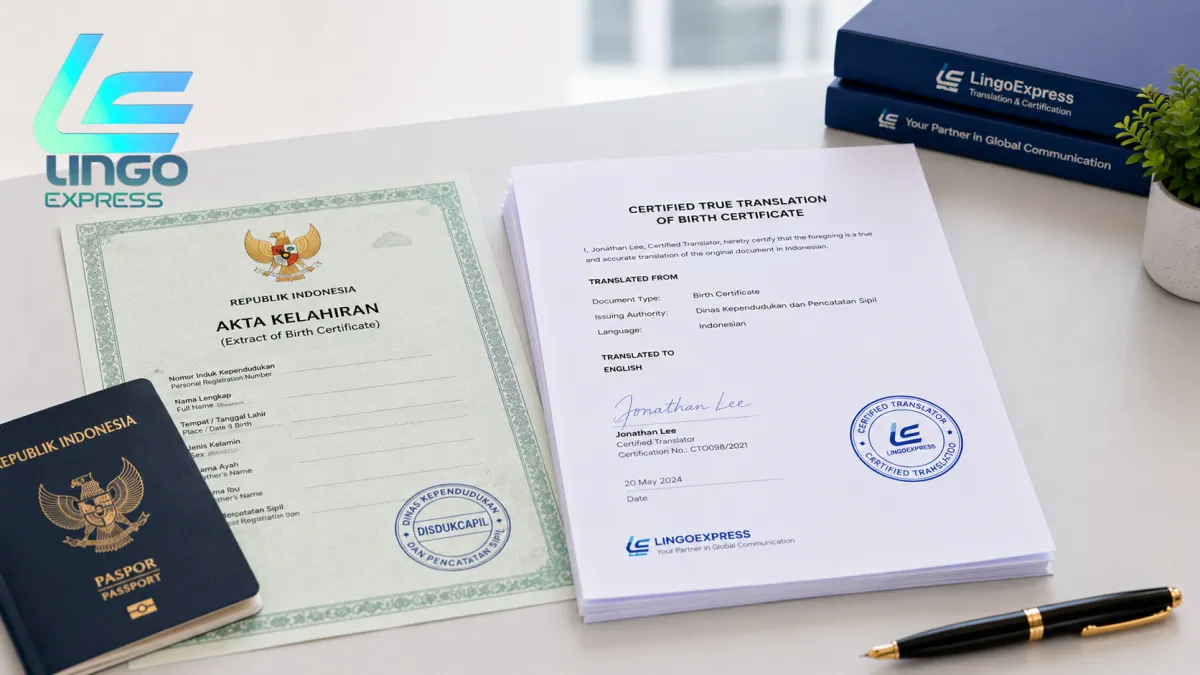
Translation in this context is not a loose paraphrase. A certified translation reproduces the source document faithfully in English — every name, date, registration number, official heading, signature line and seal — and is accompanied by a signed statement from a qualified translator confirming it is a true and accurate rendering of the original. That statement, on company letterhead and dated, is what turns a piece of text into a document an authority will treat as evidence. A loose summary, a friend's informal translation, or a machine output without certification does not meet that bar.
Because Indian documents span so many scripts and state formats, the translator also has to recognise what each field is. A registration district, a sub-registrar's office, an examination board, a roll number — these have to be identified correctly and carried into English, not guessed at. That is where working with a provider like LingoExpress, which sees these formats often, removes a lot of risk.
📄 The Indian documents Singapore applicants most often need translated
Different applications call for different paperwork, but a handful of Indian documents come up again and again. Each carries its own set of details that all have to survive the move into English.
- Birth certificate (issued under the Registration of Births and Deaths Act by a municipal corporation or panchayat): the child's name, date and place of birth, both parents' names, the registration number and date, and the registrar's seal and signature.
- Marriage certificate (registered with the Marriage Registrar, or under the relevant marriage act): both spouses' names, ages, the date and place of marriage, the registration number and the issuing authority's stamp.
- Degree, diploma and mark sheets from a university or board: candidate name, the qualification, the awarding institution, roll/enrolment number, and the subject-and-marks table that an officer reads line by line.
- Police Clearance Certificate and other identity-linked records, where the named person and the issuing office must read consistently against the rest of your file.
Notice the recurring theme: numbers, names and seals. Every one of those elements — including a stamp that appears only in the regional script — has to be rendered or clearly described in the English version. A seal that is left untranslated reads, to a reviewing officer, as an incomplete document.
📋 Where these translations are used in Singapore
The destination shapes the requirement. A certified English translation of your Indian documents may be needed when you lodge a Permanent Residence or citizenship application with the Immigration & Checkpoints Authority (ICA), when you register a marriage, when you enrol a child in school, or when an employer or professional body asks you to evidence your qualifications. Each authority decides what it will accept, but the common denominator is an English version that reconciles cleanly with your passport and your other paperwork.
🌏 The multi-language quirk — and the bilingual exception
Because Indian records are issued at the state and municipal level, the same type of certificate can look completely different depending on where it was issued. A Kerala document may be in Malayalam, a Punjab one in Punjabi, a Karnataka one in Kannada. There is no need to know in advance which board or district format yours follows — that recognition is part of the translator's job, and LingoExpress works across these regional formats routinely.
There is one helpful exception. A number of Indian certificates are already issued in English or are printed bilingually with English alongside the regional language. If your document is genuinely complete in English, it generally does not need translating at all — what it may still need is certifying or notarising, depending on the application. The safest move is to have the document looked at first, rather than assume one way or the other.
🛠️ How the process works, end to end
In practice the path from an Indian original to a submission-ready English document is straightforward when you take it in order. Start by scanning each document in colour at 300 DPI or higher, full page, so every seal, signature and registration number is legible. Confirm what your specific application requires — a certified translation, and for matters such as PR or citizenship often a notarised one on top (this is commonly requested, so confirm what applies to your case). Send the scans for an itemised quote and turnaround. Provide the passport spelling of every name involved, so the English version matches your travel document character for character. Review the draft, then receive the certified — and where needed notarised — translation, formatted to mirror the layout of the original.
✅ What you receive
A certified translation comes on company letterhead with a signed certification statement from a qualified translator declaring the translation a true and accurate rendering of the original — the format Singapore authorities expect. The certification reads, in essence: "We, LingoExpress, a professional translation service provider, hereby certify that the attached document(s) have been translated by our team of qualified and professional translators…", signed and dated by a named translator. Where your application calls for notarisation by a Singapore Notary Public, it can be arranged within the same job, so you are not coordinating two separate providers. The result is an English version that mirrors your Indian original — every field, every number, every seal — ready to be read alongside the document it was made from.
📣 Contact LingoExpress for a free quote!
📧 Email: [email protected]
🌐 Website: https://lingoexpress.com.sg