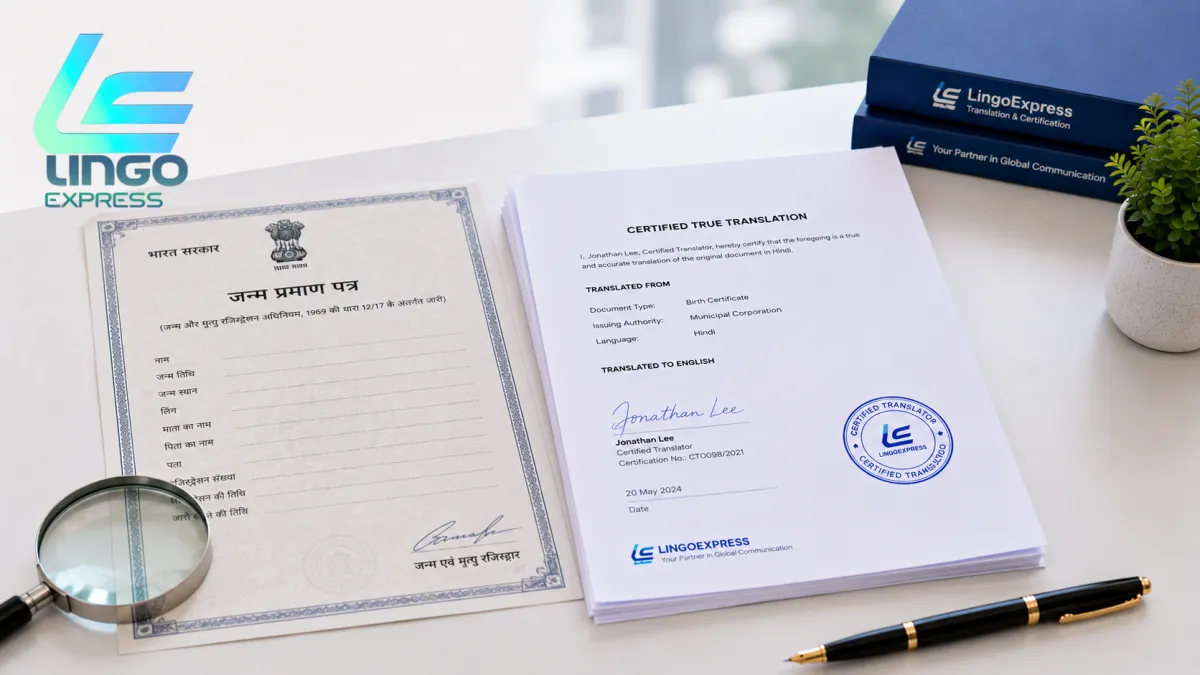
Indian Document Translation Cost Guide in Singapore
India is one of the most linguistically diverse countries on earth, and that diversity shows up the moment you ask what a translation will cost. A Hindi marriage certificate, a Tamil transcript, a Malayalam birth record and a Punjabi affidavit are four different jobs, even before you account for length or seals. If you have searched for a single "per document" price and come away none the wiser, that is why. This guide walks through the factors that genuinely shape the cost, so you can read any quote with confidence and understand exactly what you are paying for.
🔍 Why a flat price would mislead you
A single fixed price sounds appealing, but it would only ever be right by accident. A one-page birth certificate with a handful of fields is a far lighter task than a multi-year academic transcript ruled into a dense grid of subjects and marks, or an affidavit thick with legal phrasing and notarial stamps. Charge both the same and you overcharge one while undercharging the other.
A reputable provider instead looks at the actual document and prices to the work it holds. That is why an accurate number always follows you sharing the files — anyone quoting a firm amount before seeing your documents is either padding for safety or setting up a surprise later.
📄 The factors that shape your cost
Several things combine to determine the effort behind a certified translation of an Indian document. Understanding them helps you read a quote with confidence and see where you might trim without cutting corners.
Which Indian language it is in. This is the first big variable. Documents may come in Hindi, Tamil, Telugu, Malayalam, Bengali, Punjabi, Marathi, Gujarati, Kannada and more — and the pool of qualified linguists differs from language to language. A widely-handled language draws on a deeper bench than a less common one, and that naturally affects what the work costs. The breadth a provider covers matters here, and LingoExpress handles a wide range of South Asian languages.
Document type and complexity. A short, standard certificate is straightforward; a document dense with tables, legal terminology or specialised vocabulary is not. A degree transcript with a long grid of papers and grades, or a court affidavit with defined terms, takes careful work so every line maps faithfully to the original.
Length, word count, and seals to render. It is not only how many pages you hand over, but how much sits on each. A page packed with fine print, tables and official stamps carries far more than a sparse certificate. Every seal, signature and registration mark has to be described in the translation too — an untranslated stamp reads as an incomplete document — so the number of marks genuinely adds to the work.
Certification tier. A certified translation comes with a signed statement of accuracy from the translator or agency. A notarised translation is that certified work taken a step further and witnessed by a Singapore Notary Public — commonly required for PR and some family applications, though you should confirm what your specific case needs. For documents bound for use overseas, authentication by the Singapore Academy of Law or an apostille is a separate step again. Each added tier is more handling, so it sits on top of the base translation cost.
Turnaround and urgency. A standard timeline measured in business days gives the team room to translate, check and certify properly. Compressing that into a same-day or next-day rush means rearranging schedules, and that priority handling carries a premium. If your deadline has any give, a normal turnaround is the gentler option on your budget.
Volume. A single certificate is one job; a full application set — birth certificate, marriage certificate, educational records and supporting affidavits — is a different scale. Submitting related documents together is usually more efficient to handle than trickling them in one at a time.
- A birth or marriage certificate in a single Indian language is usually a contained task — but every field, plus the registrar's seal and any registration number, still has to be rendered, never skimmed.
- An academic transcript carries a dense table of papers, marks and credit values that must line up cell for cell with the original — the grid is what drives the work, not the page count.
- An affidavit or legal declaration mixes formal legal phrasing with notarial and court stamps, so it is heavier than its length suggests.
- A document in a less commonly requested language draws on a smaller pool of specialists, which is a real factor in the effort behind it.
- A multi-document family set spanning several certificates and several languages is a larger job than any single sheet within it.
The pattern is consistent: a tidy single-field certificate is lighter than a table-heavy transcript or a stamp-laden affidavit, and a common language is lighter to source than a rare one. That is precisely why the figure follows the file rather than a menu.
📋 How to get an accurate, itemised quote
The fastest route to a number you can rely on is to give the team what it needs to assess the job. A little preparation on your side turns a rough estimate into a precise, itemised quote.
- Send clear, complete scans. Legible images or PDFs of every page, including the back where stamps or signatures appear, let the team see exactly what they are working with — and crisp scans avoid the back-and-forth that slows you down.
- Name the language and the purpose. Tell them which Indian language the document is in and who the translation is for — ICA, the Ministry of Manpower, a university, a bank, or use overseas. The recipient determines whether certification alone is enough, or notarisation, or further authentication.
- State your deadline. Sharing when you need the documents lets the quote reflect a standard or a priority timeline honestly, with no surprises later.
With those three things in hand, LingoExpress returns a transparent, itemised quote once it has seen the document and the purpose — so you see what each step covers rather than one opaque sum, and know exactly what you are approving before any work begins.
🌏 How to keep your cost sensible
Keeping the cost reasonable is rarely about hunting for the lowest sticker. It is about not paying for things your situation does not call for.
- Match the certification tier to the need. Confirm with the receiving authority whether a certified translation suffices before adding a Notary Public step. Notarisation is commonly required for PR — but for many submissions to the Immigration & Checkpoints Authority (ICA), the Ministry of Manpower, schools or banks, certification alone is accepted. Confirm for your case rather than paying for a step you may not need.
- Bundle related documents. Submitting a family's certificates and transcripts together is usually more efficient to handle than sending them piecemeal.
- Avoid the rush where you can. If your timeline has any give, a standard turnaround sidesteps priority handling — planning ahead is often the simplest saving available.
✅ What a transparent quote gives you
A fair, itemised quote from a provider that stands behind its certification protects you from paying twice. You see the base translation, any notarisation, and any further authentication broken out as separate lines, so nothing is buried. That is the standard LingoExpress works to: a clear breakdown, accurate work across India's many languages, and certification an authority can trust.
If your documents need to travel further afield, note that steps like Singapore Academy of Law authentication or an apostille generally apply only when a document is bound for use overseas, not for local Singapore submissions. Mentioning the destination country when you ask for a quote lets the team flag whether any of that applies — and price it openly if it does.
📣 Contact LingoExpress for a free quote!
📧 Email: [email protected]
🌐 Website: https://lingoexpress.com.sg