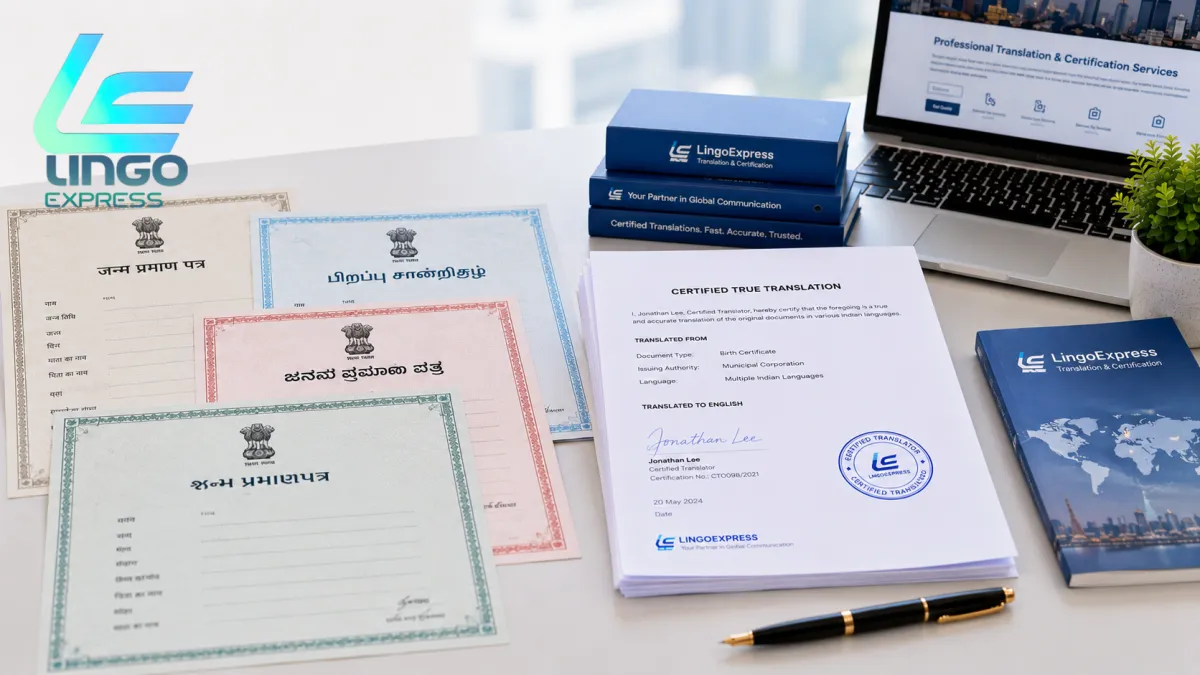
Indian Document Translation Checklist for Singapore PR Applicants
India's documentation is unusually varied: a single applicant might hold a birth certificate in one state language, a marksheet in another, and a marriage certificate in English — all genuine, all official. That mix is exactly what makes a Singapore PR file tricky to assemble, because the Immigration & Checkpoints Authority (ICA) needs every non-English document accompanied by a certified translation, and for PR it expects that translation to be complete and faithful, backed by a signed statement of accuracy.
One definition to fix first. A certified translation carries a signed accuracy statement from the provider. For PR and citizenship, ICA commonly also wants key civil documents notarised by a Singapore Notary Public — though whether that applies to your exact records is best confirmed against your own application page rather than assumed.
🪪 Category 1: Identity & Civil Documents
These records establish who you are and how your family connects, so they sit at the core of the application. They are also where small inconsistencies — a name spelled one way on a state-language certificate and another on your passport — cause the most queries, so every name and date must line up with your travel document first.
- Birth certificate: Needed for the main applicant and any children included. Indian birth certificates are issued by the local municipal or panchayat authority and may be in a state language; the registration details, parents' names, and the issuing authority's seal all have to reappear in English, with names mirroring the passport exactly.
- Marriage certificate: Required if you apply with or sponsor a spouse. Watch transliteration of surnames closely — a mismatch between the certificate and the passport is among the most frequent reasons an officer raises a query.
- Divorce decree: Needed where a previous marriage has ended, to clarify your current status and any custody arrangements affecting dependants. Court decrees are often dense and must be rendered in full.
- Aadhaar or other identity records: Where requested as supporting identity, any non-English text and the issuing details need translating, with the number reproduced precisely.
- Affidavit / name-change deed: Essential where a name on your documents differs from your passport. This is the linking record that stops a file being flagged for a "name mismatch" an officer cannot otherwise resolve.
A Tamil or Telugu birth certificate may render a name phonetically in a way that produces several defensible English spellings. Only one of them — the spelling printed in your passport — is correct for the file. The same name then has to appear identically on the marriage certificate, the children's birth certificates, and the educational records. A translator who matches every instance to the passport keeps the whole set internally consistent, which is exactly what an officer cross-checks.
🎓 Category 2: Educational Documents
Your qualifications speak to your economic contribution, so this set rewards care. Indian academic records are often detailed and institution-specific — degree titles, division or class of pass, percentage and grade systems — and should be rendered faithfully rather than loosely paraphrased, so an assessor reads the qualification you actually hold. This is one of the sets LingoExpress handles most often for skilled-employment applicants.
- Degree certificates: Bachelor's, master's and doctoral awards. Some are issued in a regional language and still need an English rendering even where instruction was in English.
- Marksheets and transcripts: The subject-by-subject record of marks, often semester by semester. These are the most layout-heavy documents you will submit, so the translation should mirror the original's table structure column for column to make cross-checking straightforward.
- School-leaving certificates: Tenth and twelfth standard certificates from the relevant state or central board. The subject names, marks, and awarding board all need to carry across precisely so the qualification is placed correctly.
📎 Category 3: Supporting Documents
Beyond identity and education, ICA may ask for supplementary evidence — and these are the documents most likely to arrive covered in official stamps, seals, and registration numbers from an Indian authority. Every one of those marks needs to be translated or noted, not left as an untranslated smudge on the page.
- Police clearance certificate: Increasingly requested to confirm good standing. Where issued in a regional language it must be translated in full, including any official disclaimers printed on it.
- Employment and income letters: Letters from Indian employers, service records, or income statements that substantiate your work history when they are not already in English.
- Family or relationship records: Documents establishing family composition where requested — every page and seal rendered, not just the first sheet.
🚫 Exceptions: What You Do NOT Need to Translate
Not everything in your folder needs a translator, and translating a document ICA already accepts is wasted effort. Two exceptions are worth knowing before you gather the file.
- Indian documents already issued in English: Many Indian certificates, degrees, and police clearances are issued directly in English. If yours is, submit it as-is — no translation needed.
- Singapore-government documents in Chinese, Malay or Tamil: Official documents issued by Singapore authorities in any of the national languages are generally accepted without an English translation. Note this covers Singapore-issued Tamil documents — an Indian Tamil certificate still needs translating.
One distinction that trips applicants up: notarisation and legalisation are not the same step. For documents you submit to ICA inside Singapore, a notarised certified translation is typically the ceiling of what is asked. Authentication by the Singapore Academy of Law (SAL) or an apostille generally applies to documents heading overseas, not to a local PR file. If your matter has an overseas leg, confirm the apostille genuinely belongs in the chain before paying for it.
✅ Your Pre-Submission Checklist
Run through this final tick-list before you upload anything to the e-PR portal. It captures the quality checks that keep an Indian document set clean on first review — the same checks the LingoExpress team applies before delivering a PR set. If you can tick every line, your translations are submission-ready.
- ✅ Names match your passport on every translated document, with consistent transliteration of regional-language names throughout.
- ✅ Every stamp, seal and signature is translated or noted, with nothing on the original left unaccounted for.
- ✅ The layout mirrors the original so an officer can lay the two side by side — this matters most for multi-semester marksheets.
- ✅ Each translation is certified with a signed statement of accuracy — and notarised where your application calls for it.
- ✅ Scans are clear and high-resolution (300 DPI or higher), legible, and complete with no cropped edges.
- ✅ You have kept all original documents safe, as ICA may ask to sight the originals during processing.
- ✅ You have skipped translations you do not need — English-issued Indian documents stay exactly as they are.
Because each applicant's mix of languages and documents differs, the safest move is to have your specific list reviewed before you start — so nothing essential is missed and nothing already in English is needlessly translated. LingoExpress has prepared PR document sets for applicants from across India and the region, and gives you a transparent quote once it has seen your documents and the application they are for.
📣 Contact LingoExpress for a free quote!
📧 Email: [email protected]
🌐 Website: https://lingoexpress.com.sg