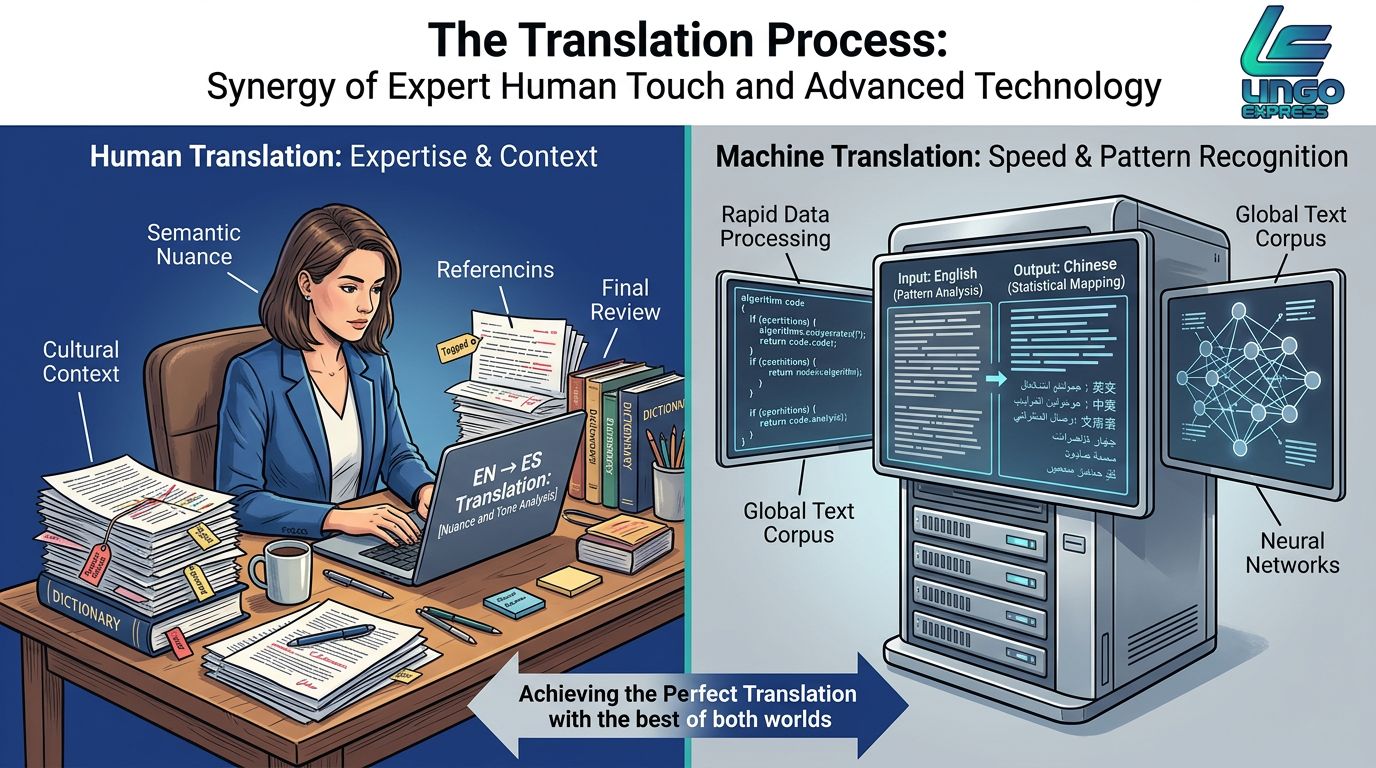
Human Translation vs AI Translation for Official Documents
Machine translation has come a long way, and for understanding a menu or the rough sense of an email it is genuinely impressive. So it is reasonable to ask whether you still need a human for your birth certificate, transcript, or court document. The honest answer turns less on raw language quality and more on what an official submission actually demands. This comparison sets the two approaches against the things that decide acceptance, so you can choose with your eyes open rather than on a hunch.
🤖 What AI translation does well — and where it stops
An AI engine converts text between languages in seconds and is free or cheap to use, which makes it excellent for getting the meaning of something quickly. Where it stops is in the places official documents live. It does not weigh which of several defensible spellings of a name matches your passport. It can misread a faint scanned seal, invent a plausible-sounding rendering when a field is unclear, and quietly flatten a structured table into prose. Most importantly, it cannot put a name and a signature behind the result — and it cannot tell you it got something wrong.
🧑💼 What a human certified translation adds
A qualified human translator does the linguistic conversion too, but wraps it in judgement and accountability. They match every name to your travel document, recognise the format of the source, render each seal in its correct position, preserve a table as a table, and flag anything genuinely illegible rather than guessing. Then they certify the work — a signed statement of accuracy that an authority treats as a person vouching for the document.
📊 Side by side: the things that decide acceptance
Here is how the two approaches line up against the criteria that actually determine whether an official body accepts your translation.
| What matters | AI Translation | Human Certified Translation |
|---|---|---|
| Accuracy under scrutiny | Strong on common phrasing; unreliable on names, seals, and ambiguous fields. | Checked field by field, with names matched to your passport. |
| Accountability | No named person stands behind the output. | A named translator signs a statement of accuracy. |
| Seals & formatting | Often skips stamps and flattens tables into prose. | Every seal noted; tables kept as tables, mirroring the source. |
| Handles unclear input | May invent a plausible rendering with no warning. | Flags illegible marks rather than guessing. |
| Accepted by authorities | Generally not, for official certified submissions. | Yes — the certified format authorities expect. |
🧭 Which one do you actually need?
Match the tool to the stakes. If you simply want to understand what a foreign document says for your own reference, an AI tool is a perfectly sensible starting point and costs almost nothing. But the moment that document is going to a body such as the Immigration & Checkpoints Authority (ICA), the Ministry of Manpower (MOM), a university, or a court, the requirement shifts to a certified translation a human stands behind. There is no contradiction in using AI for understanding and a human for submission — they answer different questions.
🧪 Why "fluent" is not the same as "correct"
The thing that makes machine output so persuasive is also what makes it risky for official use: it reads confidently even when it is wrong. An engine produces smooth, grammatical English whether or not it correctly identified a faint seal, picked the spelling that matches your passport, or understood a field unique to a foreign certificate. There is no visible signal that something slipped — the sentence simply looks finished. A human translator, by contrast, treats uncertainty as information: a mark they cannot read is flagged rather than smoothed over, and a name with several possible romanisations is checked against your travel document instead of guessed.
This gap matters most on exactly the documents people most want to shortcut. A driving licence carries a class-code table that has to be reproduced accurately; a household register lists each person on a separate card with an ID number that must reconcile across the family's papers. These are precisely the structured, detail-dense places where confident-but-wrong output does the most quiet damage — and where a person applying judgement, and signing their name to the result, earns their place.
✅ The takeaway
AI translation is a fine assistant and a poor substitute for the part that counts. For anything official, you want a human who applies judgement to names, seals, and structure, and who certifies the result so an authority can trust it. Across 45+ languages and documents from 30+ countries, LingoExpress delivers certified translations on letterhead with a named signatory, and arranges notarisation where your case calls for it — confirm what your specific submission requires, and the right approach usually becomes obvious.
📣 Contact LingoExpress for a free quote!
📧 Email: [email protected]
🌐 Website: https://lingoexpress.com.sg