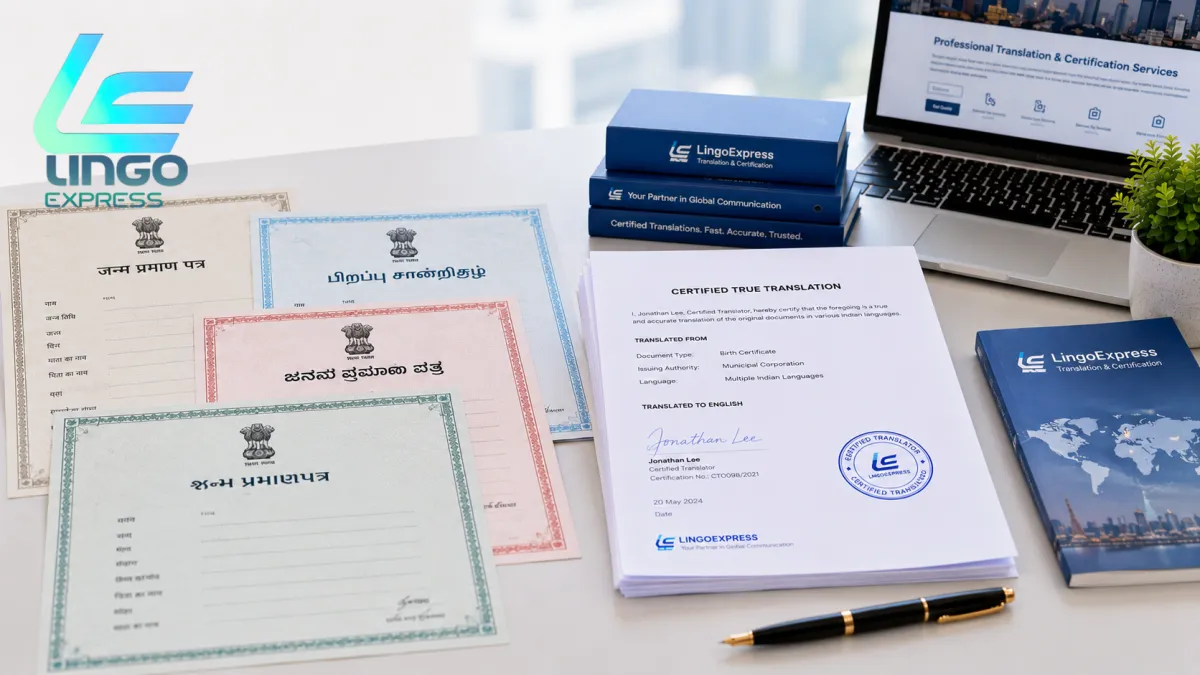
How to Translate Indian Academic Certificates for Work Pass Applications
Most Indian universities issue their degree parchment and statements of marks in English, and when that is the case you can usually submit them as-is. But plenty of applicants hold documents that are bilingual, partly in a regional script, or issued entirely in Hindi or a state language — a provisional certificate stamped in Devanagari, a marksheet from a state board, a diploma from a regional polytechnic. The moment any part of the record is not in English, an assessor reviewing your Ministry of Manpower (MOM) application needs a faithful English version before your qualification can be verified.
This guide takes you from the documents on your shelf to a submission-ready set, grounded in the kinds of academic records that pass across a translator's desk — so you know what an assessor is looking for and where applications tend to stumble.
🔍 Why your qualifications get read so carefully
A work pass is, at its core, a judgement about what you can do — and your education is a large part of that picture. Whether an application is weighed against salary thresholds, a points framework, or a straightforward eligibility check, the qualification you claim has to be the qualification the paperwork proves. An assessor cross-references the degree title, the awarding institution and the dates against the rest of your file. If a translated certificate is vague about what was awarded, or if the name on it drifts from your passport, the safe outcome for the officer is to pause and ask, and that pause is measured in weeks.
📄 What a complete academic translation has to carry
An Indian academic record is rarely a single clean line of text. Degree certificates carry formal convocation language, the university's name in full, a register or serial number, the date conferred, and an embossed or printed institutional seal. Marksheets and consolidated statements of grades add a dense grid: subject by subject, semester by semester, with marks, maximum marks, credits and a final classification. Every one of those elements has to appear in the English version.
- A degree certificate with the university name, the degree and discipline, the class or division awarded, a certificate or register number, the date of convocation, and the Vice-Chancellor's or Registrar's signature beneath the institutional seal.
- A consolidated marksheet ruled into a subject-and-marks table — papers, marks obtained against maximum marks, any credit or grade-point column, and the overall result — where the table is what carries the meaning, not just the heading.
The seal and the signature are not background decoration. A translation that renders the body text but leaves the embossed university seal as an unexplained blur reads as incomplete — the very thing an assessor flags.
📋 The step-by-step process
- Gather the full set — the degree certificate plus every supporting marksheet or transcript. A degree without its statement of marks often raises a follow-up request, so send them together.
- Scan each page in colour at 300 DPI or higher, full page, so the seal, the fine print and every grade cell stay sharp and legible.
- Confirm what your pass route expects — for most work pass submissions a certified translation is what is asked for; check your own application page rather than assume.
- Send the scans to LingoExpress for a quote, with the documents and the purpose, and you receive a transparent, itemised quote and a turnaround.
- Give the passport spelling of your name exactly as it appears on your travel document, so a regional-language name is romanised to match rather than re-spelled phonetically.
- Review the draft, then receive the certified translation formatted to mirror the original — table for table, seal in place.
🌏 The quirks that catch Indian applicants
A few patterns recur with Indian academic records. Names are the first: a single legal name romanised one way on a state-board certificate and another way on a passport is enough to prompt a query, and initials that expand differently across documents add to the confusion — so the passport spelling rules every page. The second is the gap between a provisional certificate and the final degree; if you are submitting a provisional, make sure it is clearly translated as such. The third is the sheer table-density of a multi-semester marksheet, where a column quietly dropped in translation changes the record. LingoExpress also handles records from across South Asia — Bangladesh, Nepal, Sri Lanka and beyond — so a regional script or an unfamiliar grading scheme is familiar territory.
✅ What you receive
A certified translation from LingoExpress arrives on company letterhead with a signed certification statement from a qualified translator, declaring that the translation is a true and accurate rendering of the original — the form Singapore authorities expect to see attached to a foreign-language qualification. Where a particular submission asks for more, notarisation by a Singapore Notary Public can be arranged in the same job, though for most work pass applications a certified translation is the level required. Confirm the requirement for your route, send your scans, and you can have the right scope settled before any work begins.
📣 Contact LingoExpress for a free quote!
📧 Email: [email protected]
🌐 Website: https://lingoexpress.com.sg