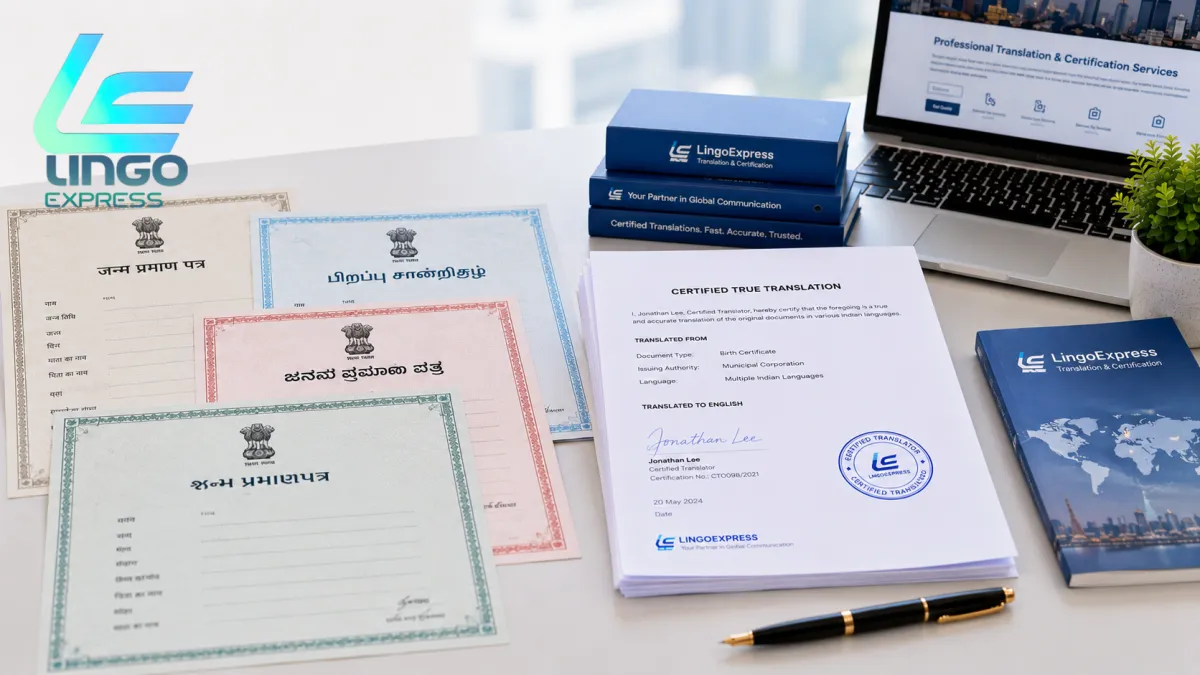
How to Translate Indian Academic Certificates for Singapore Admissions
Plenty of Indian education documents are already issued in English, and where that is true you simply submit them as they are. The friction starts with the records that are not: a state-board marksheet printed in a regional script, a degree parchment in a vernacular language, a migration certificate carrying a bilingual seal that an officer cannot fully read. For those, an institution will ask for a certified English version before it processes your file — and "certified" means complete and faithful, not a casual summary.
This walkthrough takes your documents from scan to submission, grounded in the kind of academic records translators actually handle, so you can see what an admissions assessor is checking and where applications tend to stumble.
🔍 Why admissions offices read these documents so carefully
An academic record is the evidence behind an offer. It tells the institution what you studied, how you performed, and whether the qualification maps onto the level you are applying for. Because an offer of a place rests on that reading, an assessor cross-checks your name, your grades and the awarding body — and if the translation is incomplete, inconsistent or hard to reconcile with the original, the whole application waits. A school admitting under the framework of the Ministry of Education (MOE), or a university with its own admissions standards, has every reason to be exact.
📄 What a complete academic translation includes
Indian credentials carry far more than a name and a final grade, and each element has to surface in the English version. The exact fields shift between boards, universities and states, which is why a translator who recognises the source format is worth seeking out.
- A state-board marksheet typically lists the candidate's name and roll number, the school and centre, a subject-by-subject grid of marks and maximums, the result division or grade, and the board's printed seal with a serial number.
- A degree certificate or provisional certificate shows the conferring university, the programme and class awarded, the year of the convocation, and a registrar's signature and embossed seal.
- A consolidated marksheet or transcript spans every semester, so the grading legend, credit values and any honours notation all have to carry across exactly as printed.
Each of those marks — the board seal, the university embossment, even a handwritten correction initialled by an official — has to be rendered or described in the translation rather than skipped. An untranslated seal reads, to an assessor, as a document that was never finished.
📋 The step-by-step process
- Scan each certificate and marksheet at 300+ DPI, in colour and full-page, so every grade cell, seal and serial number stays legible.
- Confirm what the institution actually wants — a certified English translation, and whether the original or an attested copy needs to be sighted alongside it.
- Send the files to LingoExpress for a quote, with the programme you are applying to, so the scope and turnaround are clear from the start.
- Give the passport spelling of your name — and note any difference between the name on your certificate and the one on your passport, so it can be handled correctly.
- Review the draft against your originals, checking that grades and the grading legend read true, then receive the certified translation formatted to mirror the source.
- Submit to the school or university with the original documents alongside the translation.
🌏 The quirks worth knowing for Indian records
India's education landscape is unusually varied — multiple central and state boards, hundreds of universities, and several regional scripts — so two applicants from neighbouring states can present documents that look nothing alike. Names are a frequent pressure point: the same name can appear with initials expanded on one document and abbreviated on another, or with a father's name folded into the full name on a marksheet but not on a passport. Subject names and the grading legend also need to travel intact, because an assessor places your qualification by reading them. LingoExpress also handles records from across the wider region — Bangladesh, Nepal, Sri Lanka and beyond — so the source format is rarely unfamiliar.
✅ What you receive
A certified translation from LingoExpress arrives on company letterhead with a signed certification statement from a qualified translator, declaring the English version a true and accurate rendering of the original — the format Singapore institutions expect to see. Where an admissions route additionally calls for notarisation, that step is arranged in the same job, so you are not coordinating two providers under a deadline. Confirm with your institution whether notarisation applies to your case before you assume it does.
📣 Contact LingoExpress for a free quote!
📧 Email: [email protected]
🌐 Website: https://lingoexpress.com.sg