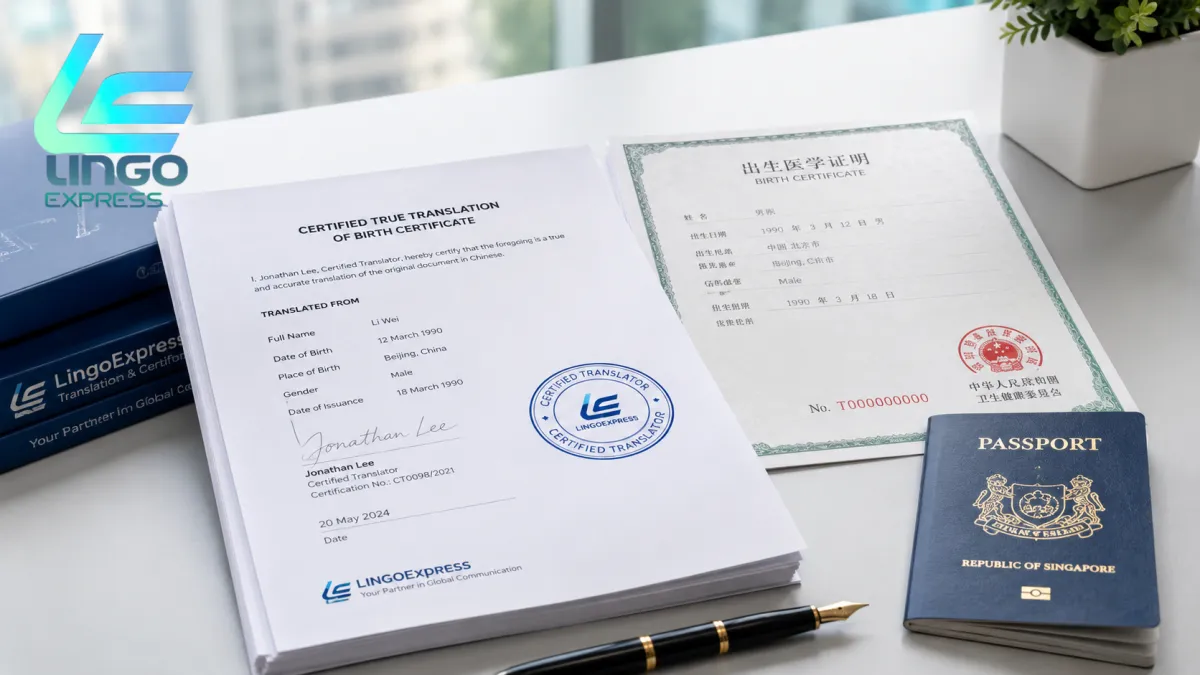
How to Match Names Across Passports, Birth Certificates and Translations for ICA
Of all the reasons an application is held for clarification, a name that does not reconcile is among the most frustrating — because the underlying facts are perfectly correct, yet an officer cannot prove on paper that three documents describe the same person. A surname romanised one way on a birth certificate, another way in a passport, and a third way in a marriage record turns a routine review into a query. This guide shows you how to head that off before you submit, working from the documents a translator actually sees rather than abstract advice.
🔍 Why a single letter can stall an application
The Immigration & Checkpoints Authority (ICA) cross-references identity across every document you file. Your passport is the anchor — the name printed there is, for the purpose of your application, your legal name in English. When a translated certificate spells that name differently, the officer is left with two plausible identities and no document that bridges them. They cannot simply assume the two are the same person; they have to ask. That request adds a cycle of weeks, and on a Permanent Residence or citizenship timeline those weeks compound.
The trap is that every spelling can be defensible on its own. A Mandarin name can be romanised through Hanyu Pinyin, an older dialect transliteration, or a parent's personal preference recorded decades ago — and all of them are "correct" in isolation. Only one of them matches your passport, and that is the only one ICA treats as correct for your file.
📄 Where names actually live on your documents
Names are not confined to a single line at the top of a certificate. They are scattered through fields, and every instance has to be matched — not just the headline entry. Knowing where they hide is half the battle.
- A Chinese "Medical Certificate of Birth" names the newborn, both parents, and pairs each parent with a nationality and an ID or passport number — so a single certificate carries three names that must each reconcile elsewhere.
- A Malaysian "Form A" birth certificate lists the father's and mother's names alongside their IC numbers and occupations, plus the registration area — names and identifiers that have to agree with the parents' own documents.
- A Chinese "Resident Household Register" (hukou) repeats every family member's name on their individual Permanent Resident Registration Card, so the same person's spelling has to stay identical across several pages.
Notice the pattern: a name almost never appears once. It recurs across fields, across pages, and across documents — and the consistency has to hold everywhere, not just where the officer happens to look first.
📋 The step-by-step way to keep every name aligned
Reconciling names is not guesswork; it is a short, deliberate process. Follow it in order and you remove the ambiguity before a translator ever begins.
- Gather every passport in the application first. Yours, your spouse's, your children's — the bio page of each. These are your single source of truth for English spelling.
- List each person's authoritative spelling exactly as printed: full name, the order of given and family names, hyphens, spaces and any diacritics. This short list becomes the reference the whole job is built against.
- Flag every name that differs on an original certificate — an old transliteration, a maiden name, a dropped middle character — so nothing is discovered mid-translation.
- Hand the passport scans and the spelling list to LingoExpress together. The translator then matches the original's name to your passport rather than improvising a phonetic guess.
- Identify any genuine name change — marriage, deed poll, a legally altered spelling — and supply the linking document, because that is what explains a difference an officer would otherwise query.
- Review the draft against your reference list, checking every instance of every name across every page before the certified copy is finalised.
🌏 When the documents genuinely disagree
Sometimes the difference is real and cannot be smoothed over by careful transliteration — a woman's maiden name on her birth certificate versus her married name on a passport, or a name legally changed years after a certificate was issued. The answer is never to quietly "correct" the original in translation; that would misrepresent the source document. Instead, the translation faithfully reflects what each document says, and a separate linking record — a marriage certificate, a deed poll, an official name-change document — is provided to bridge the gap. That linking document is what lets an officer follow the trail from one name to another without raising a flag.
This is also why supplying context up front matters. A translator who knows a maiden-to-married change is in play can render both documents accurately and note the connection, rather than leaving an officer to puzzle over an unexplained discrepancy. LingoExpress handles certificates from China, Malaysia, Indonesia, India, Vietnam and beyond, so the kinds of naming differences each origin throws up are familiar territory.
✅ Your name-consistency tick-list
Before anything goes to ICA, run this short check across the whole bundle. If you can tick every line, your names will read as one consistent identity rather than several:
- ✅ Your name matches your passport character for character on every translated document, in the same given-then-family order.
- ✅ Each family member's name is consistent across the birth certificate, marriage record and any household register — same spelling on every page.
- ✅ Parents' names and their ID numbers reconcile between a child's birth certificate and the parents' own documents.
- ✅ Any real difference is explained by a linking document — a marriage certificate, deed poll or name-change record — not silently altered.
- ✅ The translation reflects the original faithfully, with naming differences noted rather than smoothed over.
- ✅ One authoritative spelling per person has been agreed and applied throughout the entire set.
Because each family's paperwork carries its own quirks, the safest move is to have the full set checked for consistency before you submit. A certified translation from LingoExpress arrives on company letterhead with a signed statement of accuracy from a qualified translator — and, where your application calls for it, notarisation by a Singapore Notary Public is arranged in the same job, so your names stay aligned and your file stays moving.
📣 Contact LingoExpress for a free quote!
📧 Email: [email protected]
🌐 Website: https://lingoexpress.com.sg