How Much Does Notarized Translation Cost?
"How much for a notarized translation?" is a fair question with an unsatisfying-but-honest first answer: it depends on the document. Notarization is not a single fixed add-on stamped onto a fixed translation rate — it is a second layer of professional work sitting on a first, and the cost of each layer tracks the effort the document demands. Once you see what actually moves the figure, any quote becomes readable, and you can tell a fair one from a number plucked out of the air.
🔍 Why notarization is two costs, not one
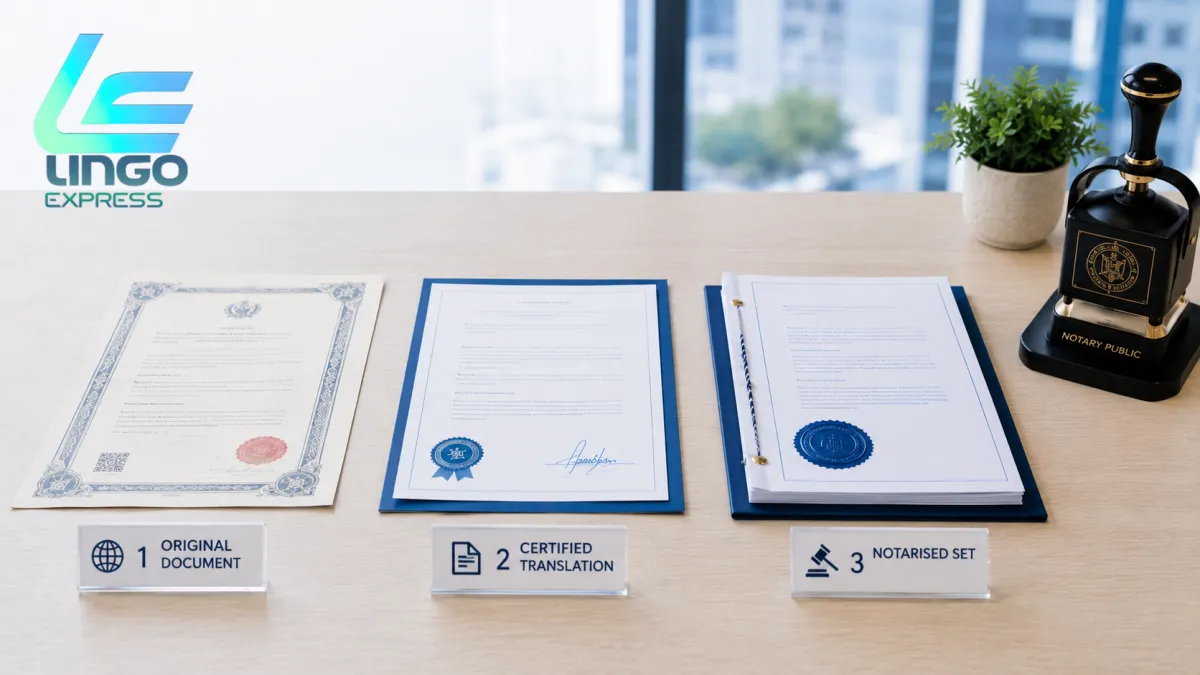
It helps to picture a notarized translation as a stack. At the base is the certified translation: a qualified translator renders the document and signs a statement of accuracy. On top sits the notarial layer: a Singapore Notary Public verifies the translator's identity, witnesses that signed certification, and applies the notarial seal. Two distinct pieces of professional work, each with its own effort behind it — which is precisely why a notarized job costs more than a certified one, and why neither layer has a single universal price.
It also explains why anyone quoting a firm notarization figure before seeing your documents is guessing. The base translation has to be scoped first; the notary step then follows from how many documents and what kind. A number that arrives before the files do is either padded for safety or setting up a later surprise.
📄 The factors that shape your cost
Several things combine to set the effort behind a notarized translation. Knowing them helps you read a quote and see where you might trim without cutting corners.
The translation underneath. Everything starts with the document itself. A short, standard certificate is light work; a multi-page record dense with tables, codes and official seals is not. Because notarization sits on a certified translation, a heavier base translation lifts the whole stack — the notary layer doesn't erase the work beneath it.
Length, density and seals to render. It is not just page count but how much sits on each page. A sheet packed with fine print, tables and official stamps carries far more than a sparse one. Every seal and signature has to be described in the translation too — an untranslated stamp reads as incomplete — so the number of seals genuinely adds to the work before a notary is even involved.
How many documents need notarizing. The notarial layer scales with the number of documents passing under it. Notarizing a single birth certificate is one thing; a full set of civil records for a PR file is another. This is the part of the cost most directly tied to the notary step rather than the translation.
Language pair and how rare it is. Common pairs such as Chinese, Malay or Tamil into English draw on a deep pool of qualified linguists. Less common combinations — Burmese, Khmer, Vietnamese, Japanese, Korean or various European languages — rely on a smaller pool of specialists, which naturally affects the base translation cost. LingoExpress covers a wide span of languages, which matters here.
Turnaround and urgency. A standard timeline in business days gives room to translate, check, certify and then coordinate the notary properly. Compressing that into a rush means rearranging two professionals' schedules, and priority handling carries a premium. If your deadline has any give, a normal turnaround is the gentler option — notarization in particular needs an appointment, so lead time helps.
- A Chinese "Medical Certificate of Birth" packs neonatal details, both parents' nationality and ID numbers, the issuing hospital and a red hospital seal onto one sheet — compact, but every field and the stamp must be rendered before notarization.
- A Malaysian "Form A" birth certificate follows a relatively standard layout — registration area, parents' IC numbers, registrar's stamp — usually lighter base work.
- A Chinese "Resident Household Register" (hukou) spans multiple pages, lists several family members and carries several Public Security Bureau seals — more pages, more entries, more stamps, all adding to the translation effort beneath the notary layer.
- A Malaysian "Update of Marriage Record" (divorce) from the JPN — with a petition number, date of order, the High Court and both parties' ICs — is the kind of civil document a notarized translation is often requested for.
📋 How to get an accurate, itemised quote
The fastest route to a number you can rely on is to give the team what it needs to scope both layers. A little preparation turns a rough estimate into a precise, itemised quote.
- Send clear, complete scans. Legible images of every page, including the back where stamps or signatures sit, let the team see exactly what the base translation involves and how many documents go to the notary.
- Name the purpose and receiving authority. Tell them who the translation is for — whether it is ICA for PR, a court, ROM, or use overseas. The recipient is what tells you whether notarization is genuinely needed, or whether certification alone would do.
- Confirm whether notarization is actually required. Notarization is commonly required for PR and citizenship and for some legal matters — but not for everything. Check the requirement before adding the layer, so you don't pay for a step your case never asked for.
- State your deadline. Because the notary step needs an appointment, sharing your timeline lets the quote reflect a standard or priority schedule honestly.
With those in hand, LingoExpress returns a transparent quote with the base translation and the notarization broken out as separate lines — so you see what each layer covers rather than one opaque sum, and approve it knowingly.
🌏 How to keep the cost sensible
Keeping a notarized job reasonable is rarely about chasing the lowest sticker — it is about not paying for layers your situation doesn't call for.
- Notarize only what needs it. Confirm which documents truly require notarization before sending the whole stack to the notary. For many submissions to ICA, MOM, schools or banks, a certified translation is accepted on its own — so a supporting letter may not need the layer its accompanying birth certificate does.
- Bundle related documents. Sending a family's civil records together is usually more efficient to handle, and to notarize, than trickling them in one at a time.
- Mind the apostille question. If a document is heading overseas, authentication by the Singapore Academy of Law or an apostille is a separate step again — relevant only for foreign use, rarely for local submissions. Mention the destination so it is priced openly if it applies, and skipped if it doesn't.
The principle underneath all of it: pay for the right layers, not the most layers. Send your documents with the application you are filing, and the LingoExpress team can confirm whether notarization belongs in the chain and quote each step openly before any work begins.
📣 Contact LingoExpress for a free quote!
📧 Email: [email protected]
🌐 Website: https://lingoexpress.com.sg