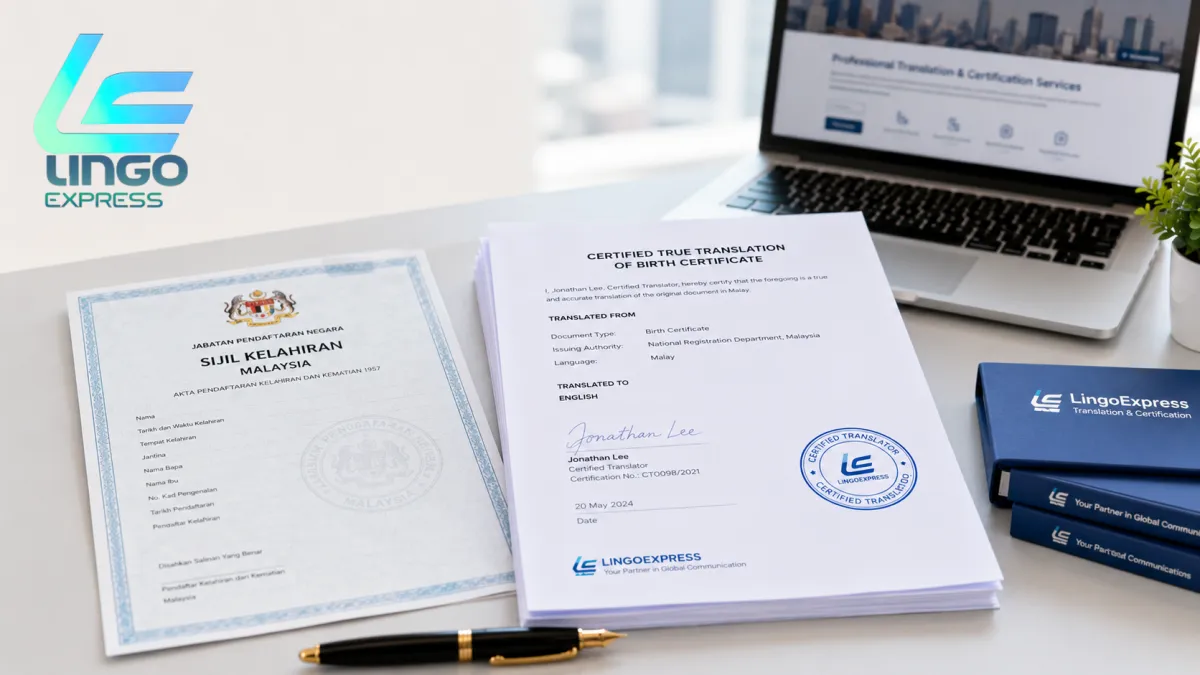
How LingoExpress Helps Malaysians Prepare Documents for Singapore Agencies
Of all the nationalities crossing into Singapore, Malaysians are among the most frequent — and the paperwork feels deceptively simple. You read English, your IC is partly in English, and Malay is a recognised Singapore language. So it surprises a lot of people when a department asks for a certified translation of a document they assumed was "already understandable." The catch is that an agency does not assess readability; it assesses whether a qualified translator has formally rendered and certified every field on the page.
This guide walks you through the Malaysian documents that come up most, the quirks that trip applicants, and how the certified-translation step actually fits into a clean Singapore submission — grounded in the records that pass across the LingoExpress desk day after day.
🗂️ The Malaysian documents that come up most
Malaysian records carry a particular structure, and each one hides at least one detail that an inattentive translation will fumble. Knowing the anatomy before you submit saves you a round trip.
- Your birth certificate is "Form A" under the Births and Deaths Registration Act 1957, showing the registration area and sub-district, your father's and mother's IC numbers and occupations, and the registrar's signature and stamp — all issued through the registration system.
- Your SPM is the "Malaysian Certificate of Education", carrying your name, IC and index number, the school, and a subject-and-grade table set against a GCE standard with grades such as 8E and a legend running A+ to G.
- A divorce record (often an "Update of Marriage Record") shows the petition number, the date of the court order, the High Court, both spouses' names and IC numbers, and the original marriage registration number.
Each stamp, each IC number, each registrar mark has to reappear in the English version. A translation that paraphrases the grade legend, or quietly skips the registrar's seal, reads as incomplete the moment an officer lays it beside the original.
🏢 Where these land in Singapore
The destination decides how strict the check is. A Form A translation might go to the Immigration & Checkpoints Authority (ICA) for a Long-Term Visit Pass or PR file, where every parental IC number is cross-read against your other records. An SPM or transcript might go to a polytechnic, a university, or the Ministry of Manpower (MOM) in support of a work pass, where the grading scale has to map cleanly onto something an assessor recognises. A divorce order might be needed at the Registry of Marriages (ROM) before a remarriage. Same applicant, different counters, different tolerances.
🛠️ How the process runs
Preparing a Malaysian document set for Singapore is less about volume and more about sequence — getting the right tier, the right names, and the right scans in the right order.
- Scan every page in colour at 300 DPI or higher, edge to edge, so each IC number, grade and registrar stamp is sharp.
- Note the passport spelling of every name — yours, your parents', a spouse's — because IC romanisation and passport spelling do not always agree.
- Confirm what your specific Singapore agency wants: a certified translation for most uses, and for PR or citizenship commonly a notarised one on top (worth confirming for your route).
- Send the set to LingoExpress for a quote, with a line on which application each document supports, so the scope is matched before any page is signed.
- Review the draft against your originals, then receive the certified — and where required notarised — translation, formatted to mirror the Malaysian layout.
⚠️ The Malaysia-specific traps
A handful of issues recur almost exclusively with Malaysian files. The grade legend on an SPM, for instance, must be carried across in full — an assessor needs to know what an 8E or a particular band actually means, not just see the letter. Bilingual Malay-English forms tempt people to submit them untranslated, but the certified rendering still has to cover the Malay portions and every stamp. And the assumption that "Malay is a Singapore language, so I can skip translation" is the single most common reason a Malaysian applicant gets sent back.
✅ Why a certified rendering settles it
A certified translation from LingoExpress arrives on company letterhead with a signed certification statement from a qualified translator, declaring the work a true and accurate rendering of the original — the form Singapore agencies expect. Because the Malaysian source formats are familiar, the registrar stamps, IC fields and grade legends are handled the way an officer wants to see them. Where your route calls for notarisation by a Singapore Notary Public, that step is arranged in the same job, so you are not coordinating two providers across the Causeway. Send the documents with the application you are filing, and the correct scope is confirmed before anything is sealed.
📣 Contact LingoExpress for a free quote!
📧 Email: [email protected]
🌐 Website: https://lingoexpress.com.sg