How Accurate Are LingoExpress Translations for Legal Documents?
When the document on your desk is a court order, a contract or a sworn statement, "accurate enough" is not a phrase you can live with. A single mistranslated clause can change an obligation; a transposed date or a misread name can unravel an argument. So it is the right question to ask of any provider before you hand over a legal file: how accurate is the work, really, and how do you know? The honest version of that answer is not a marketing slogan — it is a description of the process, the people, and the safeguards behind the translation. Here is how that looks in practice.
⚖️ What does "accuracy" actually mean for a legal document?
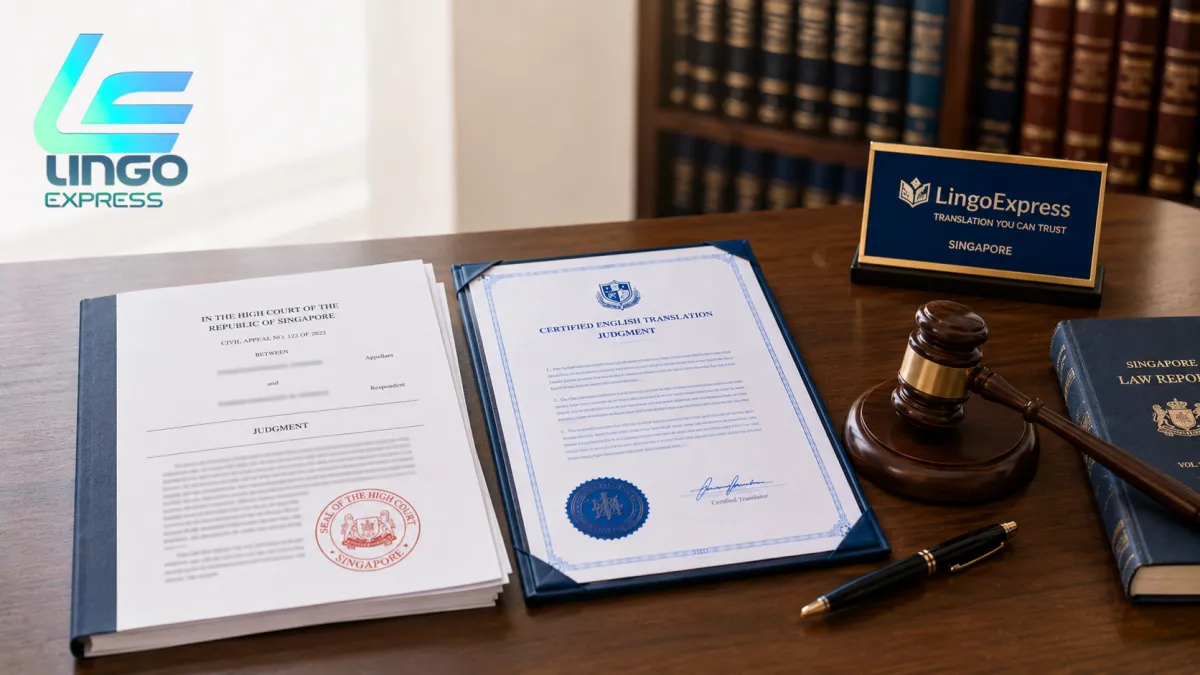
Accuracy in legal translation is not the same as a smooth-reading paraphrase. It means the English version carries the precise legal effect of the source: the parties named correctly and consistently, the dates and monetary figures exact, the defined terms kept stable throughout, and the clause structure preserved so an obligation reads as an obligation and a condition as a condition. It also means nothing is invented and nothing is dropped — a seal, a signature block, a handwritten margin note and an official stamp all have to appear, usually as a bracketed description such as [Court seal]. A translation that polishes the prose but blurs a term has failed at the one thing legal work cannot afford to lose.
🔎 How is that accuracy actually checked?
The safeguard that matters most is human: qualified translators who work in the relevant language pair and understand legal phrasing, rather than a raw machine pass pushed straight out the door. Beyond the translation itself, a careful provider builds in a review stage — checking names and numbers against the source, holding terminology consistent across a multi-page document, and confirming that every stamp and signature on the original has been rendered.
✍️ Why the signed certification is part of the accuracy story
Accuracy you cannot trace is hard to trust. That is why a certified legal translation from LingoExpress is issued on company letterhead (registered UEN 53491103W) with a formal statement of accuracy. It reads in substance: "We, LingoExpress, a professional translation service provider, hereby certify that the attached document(s) have been translated by our team of qualified and professional translators…" — followed by the named translator and the date. Putting a real entity and a named signatory behind the work is itself an accuracy safeguard: someone identifiable stands accountable for what the page says. Where your matter calls for it, notarisation by a Singapore Notary Public can be arranged on top, adding an official witness to that certification.
📌 What can affect accuracy on your side?
A good chunk of accuracy is set before translation even begins, and it depends partly on what you supply. A faint or cropped scan forces guesswork on a handwritten figure; an unexplained name variation across documents creates a discrepancy no translator can silently resolve. You can protect the outcome by sending a clear, complete, high-resolution scan of the full page, confirming the passport spelling of every name involved, and flagging any context that matters — a preferred rendering of a company name, or a known inconsistency between two records. The more the translator can see and confirm, the tighter the result.
🤔 So how accurate, in plain terms?
The plain answer: accurate enough to stand up to the side-by-side scrutiny a legal document attracts — names and numbers reconciled, terms held consistent, seals and signatures all present, and a named professional certifying the result. That is a meaningfully different standard from a quick automated draft, and it is the standard a court, a regulator or an opposing party will hold your translation to.
If you have a legal document that needs translating, the most useful next step is to let LingoExpress see it — type, language, length and the authority it is destined for — so the right scope and any notarisation can be confirmed before work starts, and you get a transparent quote against the actual file rather than a guess.
📣 Contact LingoExpress for a free quote!
📧 Email: [email protected]
🌐 Website: https://lingoexpress.com.sg