Hindi to English Certified Translation in Singapore: Common Use Cases
India is a multilingual country, and the paperwork shows it. A degree may be printed in English while the supporting transcript carries Hindi headings; a birth record from one state arrives bilingual, while a record from another is in Devanagari script throughout. That inconsistency is exactly why a blanket assumption — "Indian documents are usually in English" — gets people into trouble. The deciding factor is never the country; it is the language actually printed on your page, and whether a Singapore officer can read every field of it.
Below are the situations where a Hindi-to-English certified translation comes up most often, what each document tends to contain, and the small details that decide whether a submission clears on the first attempt.
🪪 Immigration and civil records
The single largest source of Hindi translation requests is family and immigration paperwork. When you file with the Immigration & Checkpoints Authority (ICA) for a Dependant's Pass, Long-Term Visit Pass, Permanent Residence or citizenship, any civil document not already in English has to be accompanied by a certified translation. For Hindi-language records that usually means birth certificates, marriage certificates, and occasionally an affidavit of relationship issued before a notary back home.
These documents carry weight because the whole family link rests on them. A birth record establishes parentage; a marriage record establishes a spousal claim. An officer reads each name, date and registration number against your passport and your other filings, so the translation has to reproduce all of it — including any seal, registrar signature or office stamp printed in Hindi at the foot of the page.
💍 Marriage registration and family matters
Couples registering a marriage in Singapore, or relying on a marriage solemnised in India, frequently need the Indian certificate rendered into English for the Registry of Marriages (ROM). The same is true when a prior marriage has to be accounted for: a divorce decree or a court order in Hindi may be requested to clarify current marital status. The risk point here is almost always the name — Indian names romanise in several ways, and a spelling on the certificate that drifts from the passport is one of the most common reasons a file gets queried.
🎓 Education and professional qualifications
Students and skilled professionals form the next big group. School-leaving certificates, mark sheets, degree parchments and academic transcripts often mix English with Hindi, and an institution or assessor needs the whole record legible in English to place the qualification correctly. Academic documents are the most layout-heavy of all — dense grade tables, subject codes, board names — so a faithful translation mirrors the original's table structure rather than collapsing it into loose prose. A degree title or grading band that is paraphrased carelessly can misrepresent the qualification you actually hold.
Professional licences and registration certificates fall into the same bucket when a body in Singapore needs to verify a credential earned in India. LingoExpress handles these academic and professional sets regularly, so the formatting conventions are familiar territory.
💼 Employment and business documents
Work-related paperwork is the quieter but steady use case. Employment letters, service records, salary statements and experience certificates issued in Hindi may need translating when an employer or a Singapore authority such as the Ministry of Manpower (MOM) verifies a candidate's history. On the commercial side, partnership deeds, powers of attorney and company records drafted in Hindi sometimes need an English version for a transaction or filing here. These documents lean on precise terminology, so a translator who renders the meaning rather than swapping words one for one is what keeps them usable.
🧭 Getting a Hindi document accepted
Whatever the use case, the path is the same. Start with a clear, full-colour scan so no stamp or handwritten annotation is lost. Confirm what the receiving authority actually requires — a certified translation for most uses, with notarisation by a Singapore Notary Public commonly layered on for PR and citizenship, though you should verify that against your own application rather than assume it. Then send the document to be quoted, supplying the passport spelling of every name involved.
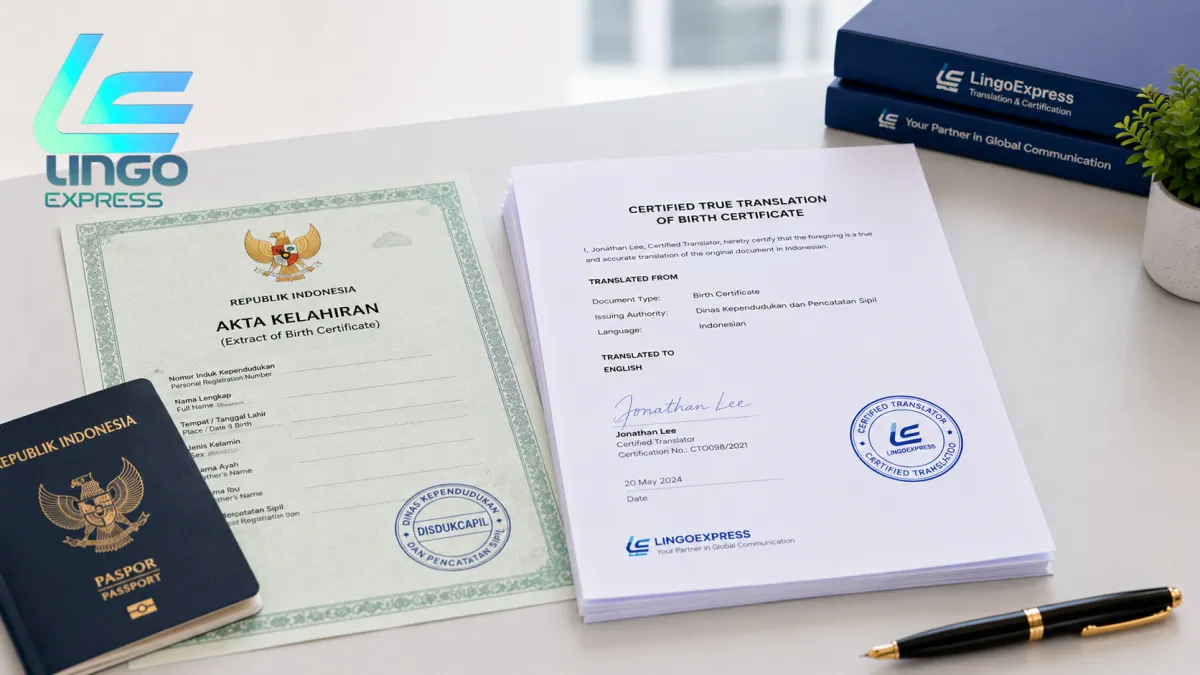
A certified Hindi-to-English translation from LingoExpress arrives on company letterhead with a signed certification statement from a qualified translator, attesting that the English version is a true and accurate rendering of the Hindi original — the format Singapore authorities expect. Where your case calls for notarisation, that step is arranged within the same job, so you are not coordinating two providers for one document.
📣 Contact LingoExpress for a free quote!
📧 Email: [email protected]
🌐 Website: https://lingoexpress.com.sg