Does notarized translation guarantee acceptance?
It is an understandable assumption. Notarisation carries an official seal, a sworn witness, a formal-looking endorsement — surely that is the stamp of approval that clears your document for any counter in Singapore. Yet applicants are sometimes surprised when a notarised translation is still queried or sent back. Understanding why means seeing exactly what the notary's seal does, and does not, certify.
🖋️ What does notarisation actually certify?
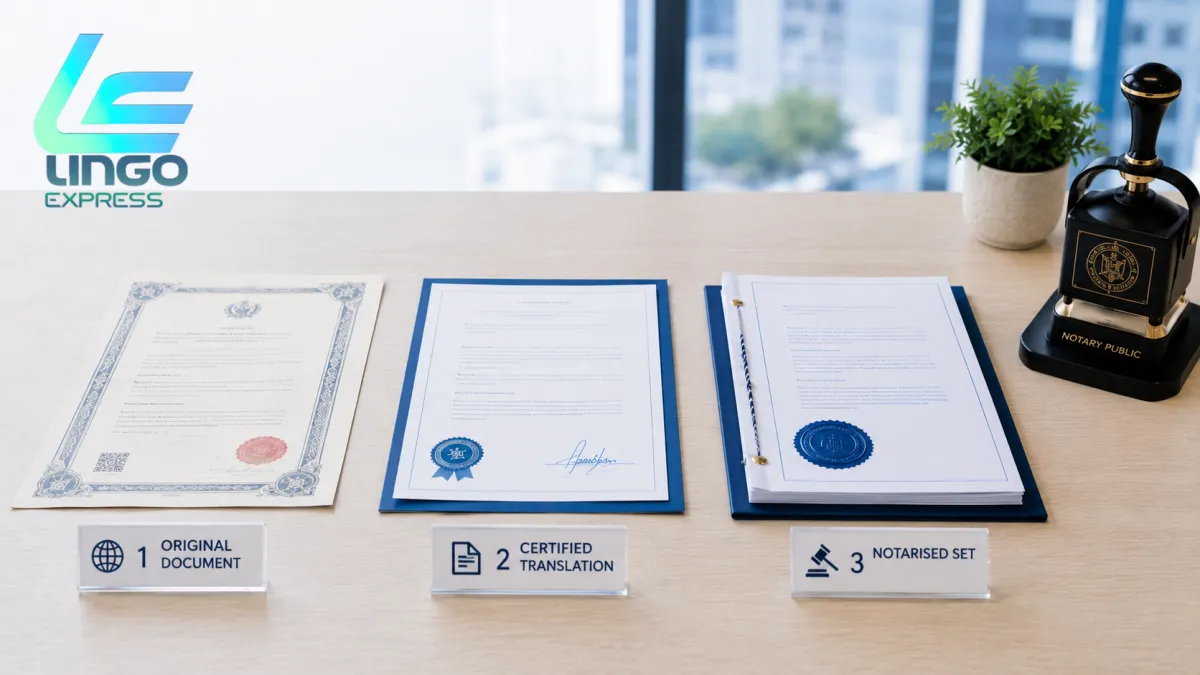
This is the heart of the misunderstanding. When a Singapore Notary Public notarises a translation, they are attesting that the certification was properly made — typically that they verified the translator's identity and witnessed the signed declaration of accuracy, then applied the notarial seal. What the notary is not doing is re-reading the source document and confirming, word by word, that the translation is faithful. The accuracy still belongs to the translator who signed the certification underneath. Notarisation adds an official witness to that signature; it does not replace or re-audit the translation work itself.
None of this means notarisation is pointless — quite the opposite. Where an authority specifically asks for a notary's attestation, a notarised translation is exactly the right tier, and skipping it would get your document turned away. The point is narrower: notarisation answers the question "was this certification properly witnessed?", not "is this translation correct and complete?". Those are two different assurances, and acceptance depends on both being true. Reaching for the seal while leaving the translation unchecked simply strengthens one half of a chain that fails at the other.
📄 So why might a notarised document still be questioned?
Because the things that most often trip up a submission live in the translation, not the notarial layer. A seal sits on top of whatever it endorses — if the work beneath has a gap, the seal travels right over it.
- A name on the translation that reads slightly differently from the passport — a frequent issue with romanised Chinese or Indonesian names — invites an officer to ask whether the certificate and the applicant are the same person.
- A red hospital stamp on a Chinese "Medical Certificate of Birth", or a registrar's seal on a Malaysian Form A, left undescribed in the English version, so the document reads as incomplete.
- A multi-page record such as a household register where only the cover page was rendered and later pages with their Public Security Bureau seals were skipped.
None of those is something a notary's seal repairs. They are caught only by complete, accurate translation done before the document is ever sent for notarisation.
It helps to picture the order in which a document is built. The translation is produced and certified first; notarisation, where required, comes afterwards and sits on top. By the time a notary attests to the certification, the accuracy of the rendering is already fixed — the seal does not reach back and revise it. That is why a flaw introduced at the translation stage survives notarisation untouched, and why the most reliable way to protect acceptance is to get the rendering complete and passport-matched before the notarial step is ever booked.
🧭 Did you even need notarisation in the first place?
A second, quieter question is worth asking: was notarisation the right tier at all? For a great many everyday uses — work passes, school enrolment, opening a bank account — a certified translation is the complete answer, and notarising it adds cost without adding what the authority asked for. Notarisation is commonly expected for permanent residence and citizenship cases through the Immigration & Checkpoints Authority (ICA), but "commonly" is not "always", and the requirement can differ by route. Matching the tier to the receiving body's own checklist matters more than reaching for the most official-looking option.
📊 What genuinely drives acceptance
If notarisation is not the guarantee, what is? In practice, acceptance turns on a handful of fundamentals that are decided long before any seal is applied.
| Factor | Why it decides acceptance |
|---|---|
| Completeness | Every field, stamp, seal and annotation rendered or noted — nothing on the original left unaccounted for. |
| Name consistency | Spelling and order match the passport across every document in the file. |
| Faithful accuracy | A true rendering of the source, signed by a qualified translator on letterhead. |
| Correct tier | Certified, notarised or apostille — matched to what the receiving authority requires. |
The reassuring part is that all of this is controllable. When the translation is built correctly from the start — complete, passport-matched, mirroring the original — and notarisation is added only where the authority genuinely asks for it, your document is in the strongest position acceptance allows. LingoExpress prepares certified translations on company letterhead with a signed statement from a qualified translator, and arranges notarisation in the same job where your case calls for it — so the seal sits on top of work that was already sound. Final acceptance always rests with the receiving authority, but a complete, correctly scoped translation gives you every advantage going in.
📣 Contact LingoExpress for a free quote!
📧 Email: [email protected]
🌐 Website: https://lingoexpress.com.sg