Do Malaysian Documents Still Need Translation If They Contain English?
It is one of the most reasonable questions a Malaysian applicant asks. You glance at your birth certificate or your SPM result slip, you see plenty of English on the page, and you wonder why anyone would ask you to translate a document you can already read. The confusion is understandable — and the answer turns on a distinction that is easy to miss until an officer points it out.
❓ Why does a bilingual document still need translating?
Because the English you see is usually the template, not the content. On a typical Malaysian certificate, the printed labels appear in both Bahasa Melayu and English — but the information filled into those fields, the official remarks, and the registrar's stamps are frequently in Malay alone. A receiving officer in Singapore cannot accept a document where the name, the place, the marital note or the seal is only legible in another language. "Mostly English" is not the bar; "entirely readable in English" is.
Think of it from the officer's side. They are cross-checking your details against your passport and your other filings. If even one entry — a sub-district, a remark, a stamped annotation — sits in Malay, that field is a blind spot, and a single blind spot is enough to hold the file.
📄 Which Malaysian documents does this affect?
The pattern shows up across the most commonly submitted Malaysian records. These are the ones where applicants most often assume English is enough and find it is not.
- A Malaysian birth certificate ("Form A", Births and Deaths Registration Act 1957) issued via the National Registration Department (JPN) carries bilingual labels, but the registration area and sub-district, the father's and mother's occupations, and the registrar's remarks and stamp are commonly entered in Bahasa Melayu.
- An SPM ("Malaysian Certificate of Education") from the Ministry of Education's Examinations Syndicate prints subject names and a grade table — and the surrounding declarations, conditions and official wording often appear in Malay.
- A marriage or divorce record (an "Update of Marriage Record" through JPN) tends to keep the substantive entries — court details, dates of order, status notes — in Malay.
In each case the English labels lull you into thinking the work is done, while the entries that actually matter to an officer remain untranslated.
🏛️ Are there documents that genuinely don't need translating?
Yes — and it is worth knowing them so you don't pay to translate something that is already accepted. If a Malaysian document was issued entirely in English, with every field, note and stamp in English, it can usually go in as-is. Some newer or specially issued records are fully English, and certain corporate or institutional letters are drafted in English from the start. The test is simple: scan the whole page, edge to edge, and ask whether anything at all — including the smallest stamp — is in Malay. If the answer is no, you are likely clear.
🧾 What kind of translation does Singapore expect?
When a translation is needed, a casual or self-made version will not do. Singapore authorities expect a certified translation — a complete, faithful English rendering backed by a signed statement of accuracy from a qualified translator. For Permanent Residence and citizenship filings with the Immigration & Checkpoints Authority (ICA), a notarised translation is commonly requested on top — though whether that applies to your exact documents is something to confirm against your own application page rather than assume. For everyday uses such as enrolment or employment paperwork, the certified tier is frequently the complete answer.
✅ So what should you do with your document?
Don't guess from the amount of English on the page. Take a clear, full-colour scan, note down the exact application you are filing, and have the document assessed — that is faster and cheaper than discovering mid-process that a stamp needed rendering. If a translation is required, supply the passport spelling of every name so the English version reconciles perfectly with your travel documents.
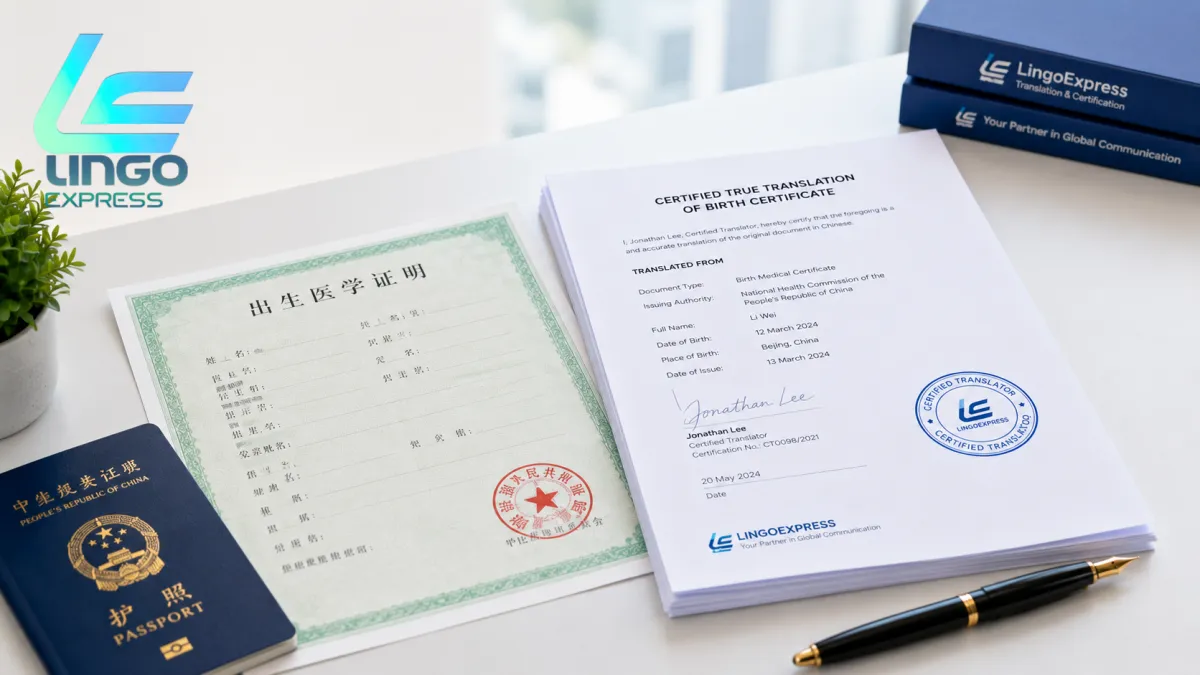
A certified translation from LingoExpress comes on company letterhead with a signed certification statement from a qualified translator, formatted to mirror the original so an officer can lay the two side by side. Because Malaysian document formats — Form A, SPM, JPN records — are familiar territory, you get a clear answer on whether yours needs translating and a transparent quote once it has been seen.
📣 Contact LingoExpress for a free quote!
📧 Email: [email protected]
🌐 Website: https://lingoexpress.com.sg