Do I Need Translation for a Malaysian Birth Certificate in Singapore?
This is one of the most common questions Malaysian families ask when they start a Singapore application, and the honest answer is "sometimes" — which is unsatisfying until you understand why. Malaysia changed how it prints civil documents over the decades, so two people holding what they both call a "birth certificate" can be holding quite different pages. Whether you need a translation comes down to what is actually on yours and what the receiving authority requires. Let us work through it question by question.
📄 Isn't a Malaysian birth certificate already in English?
Partly. The standard Malaysian birth certificate is Form A, issued under the Births and Deaths Registration Act 1957 through the National Registration Department (JPN). Certificates printed in recent decades carry their field labels in both Bahasa Malaysia and English, so at a glance they look bilingual. The catch is that the labels being bilingual does not make the entries bilingual. The place of birth, the parents' occupations, a registrar's handwritten note, or a correction stamped in the margin are frequently in Malay only — and those are exactly the parts an officer needs to read.
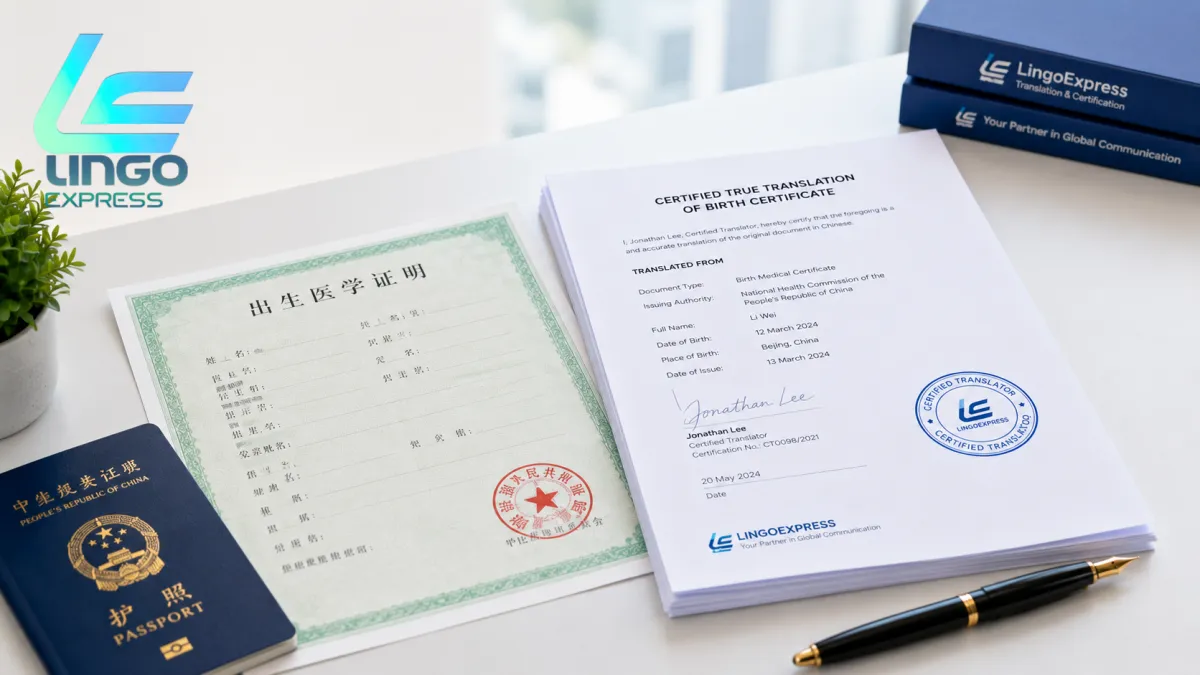
A Malaysian birth certificate shows the registration area and sub-district, the child's particulars, and both the father's and mother's full names, IC numbers and occupations. It carries the registrar's signature and an official JPN stamp, and older copies often include handwritten entries or a margin annotation. The printed labels may be bilingual, but those handwritten and Malay-only entries are the elements most likely to need translating — and an officer cannot simply skip past them.
🗓️ Does the age of my certificate matter?
It often does. Certificates issued in the 1970s and 1980s were commonly printed entirely in Bahasa Malaysia, with no English on the page at all — and those almost always need a full certified translation. Certificates from later years lean more bilingual, but as above, the data and any handwritten remarks can still be Malay-only. As a rule of thumb: the older the certificate, the more likely you need a translation, and the less you should assume the bilingual labelling covers you. If you are unsure which generation of certificate you hold, that is the moment to have it looked at rather than guessed.
There is a second wrinkle that the age question hides. Some applicants hold an extract or a recently reprinted copy issued by JPN rather than the original certificate, and the two can present differently — a reprint may carry a fresh issue date and updated bilingual formatting even when the underlying record is decades old. What matters for your submission is not when the record was first created but what is legible, in English, on the actual page you intend to hand in. Read your own copy field by field rather than relying on the year of your birth as a shortcut, because the version in your hand is the version the officer will assess.
🏢 What does the Singapore authority actually require?
The destination sets the bar. For an application to the Immigration & Checkpoints Authority (ICA) — a Dependant's Pass, a Long-Term Visit Pass, Permanent Residence or citizenship — anything not in English must be accompanied by a certified English translation. A school enrolment, a bank account opening, or a work-pass matter handled by another agency may state the same requirement in its own words. The principle is consistent: if the officer reviewing your file cannot read a field, it needs to be in English. When in doubt, read the requirement printed on your own application page and take it literally.
📝 Do I also need it notarised?
For many everyday uses, a certified translation is the complete answer. For permanent residence and citizenship, ICA commonly expects key civil documents — birth, marriage and divorce certificates — to be notarised by a Singapore Notary Public on top of the certification, although whether that applies to your specific documents is best confirmed against your own application rather than assumed. Notarisation adds an official witness to the certification; it does not replace the need for the translation to be accurate in its own right. Where your route calls for it, LingoExpress arranges the notarial step in the same job.
✅ The simplest way to be sure
Rather than weighing up whether your certificate counts as "English enough," send a clear colour scan to LingoExpress with a note on which application it is for. You will get a straight answer on whether a translation is needed at all, and if it is, a certified version on company letterhead with a signed statement of accuracy from a qualified translator, formatted to mirror the original Form A. Malaysian documents are among the most frequent the team handles, so the call is usually quick — and you avoid both paying for a translation you did not need and submitting a certificate that turns out to have a Malay-only gap.
📣 Contact LingoExpress for a free quote!
📧 Email: [email protected]
🌐 Website: https://lingoexpress.com.sg