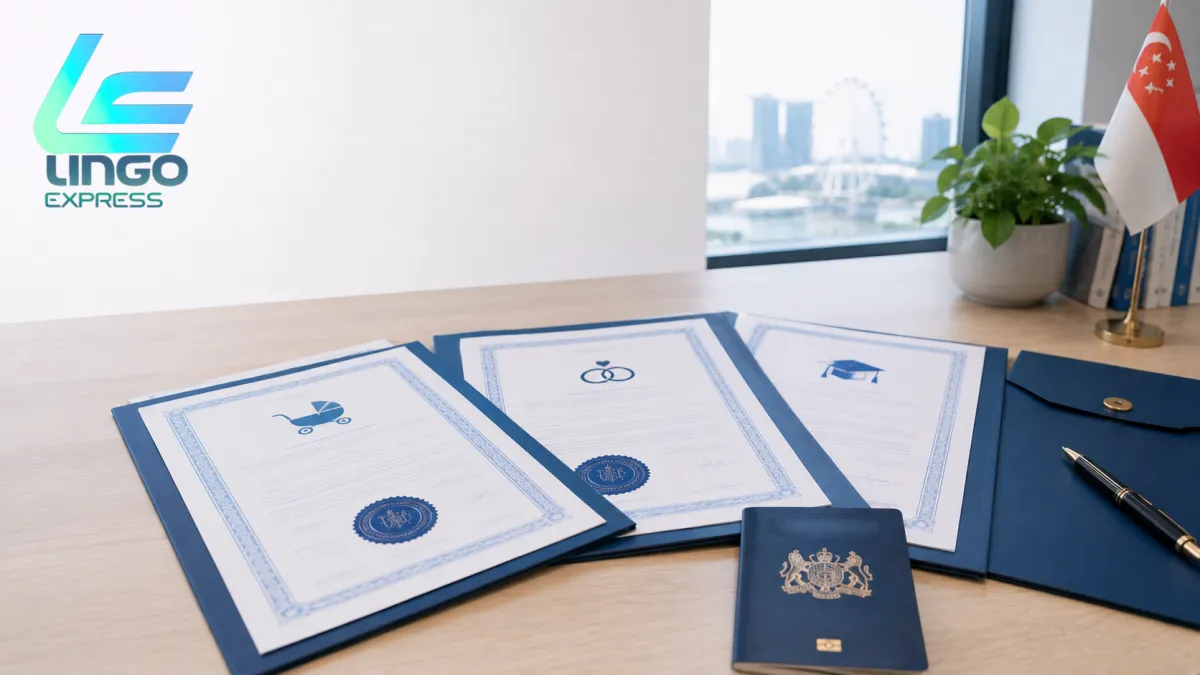
Cost Guide for Citizenship Applications in 2026
Applying for Singapore citizenship in 2026 means assembling a fuller, more personal stack of documents than almost any other submission — and if your civil records were issued abroad, translating them is part of the budget. The trouble is that "how much does translation cost?" has no single answer, because no two citizenship files weigh the same. This guide breaks down what actually shapes that figure, so you can read any quote with confidence and plan the translation step without nasty surprises.
🔍 Why there's no flat citizenship price
One applicant submits a single birth certificate and a marriage certificate. Another submits those plus a multi-page household register, two children's birth records, an academic transcript, and a police clearance — each in a different language. Charging both the same would mean overcharging the first and undercharging the second. A reputable provider prices to the documents in front of it, which is exactly why an accurate number follows you sharing the files rather than preceding it.
Anyone quoting a firm citizenship-set figure before seeing your documents is either padding for safety or setting up a surprise later. The realistic path is a quick look at the actual stack, then an itemised quote against it.
📄 The factors that shape your cost
Several things combine to determine the effort behind a citizenship translation set. Understanding them helps you read a quote and see where you might trim without cutting corners.
How many documents are in the set. Citizenship is document-heavy by nature — civil records for you and often a spouse and children. The size of the bundle is the first lever on the total, simply because each item is a separate piece of work.
Document density and complexity. A short, standard certificate is straightforward; a document thick with tables, codes or specialised terms is not. A household register listing several family members, or a transcript with a dense grid of subjects, takes careful work so every entry lines up with the original.
Seals and stamps to render. It is not only how many pages you hand over, but how much sits on each. Every seal and signature has to be described in the translation — an untranslated stamp reads as an incomplete document — so a page crowded with official marks genuinely adds to the work.
Certification tier. A certified translation carries a signed statement of accuracy. A notarised one is that work taken further and witnessed by a Singapore Notary Public — and for citizenship, notarisation of key civil documents is commonly required, though you should confirm what your specific case needs. Each added tier is more handling, sitting on top of the base translation.
Language pairs in the set. Common pairs such as Chinese, Malay or Tamil into English draw on a deep pool of qualified linguists. Rarer combinations — Burmese, Khmer, Nepali, or various European tongues — rely on a smaller pool of specialists, which naturally affects cost. A family file often spans more than one pair, and LingoExpress covers a wide range.
Turnaround. A standard timeline in business days gives the team room to translate, check and certify properly. Compressing that into a rush means rearranging schedules, and priority handling carries a premium. If your timeline has give, a normal turnaround is the gentler option.
- A Chinese "Resident Household Register" (hukou) spans multiple pages, lists several family members on individual registration cards, and carries Public Security Bureau seals throughout — more pages, more entries and more stamps all stack up.
- A Chinese "Medical Certificate of Birth" packs neonatal details, both parents' nationality and ID numbers, the hospital and a red seal onto one sheet — compact, but every field and the stamp must be rendered.
- A marriage certificate is usually a tidier layout, though names and dates must reconcile exactly with the rest of the set, which is where the care goes.
- A Malaysian "Form A" birth certificate is a relatively standard layout — registration area, parents' IC numbers, registrar's stamp — generally lighter than a dense multi-page record.
The pattern is consistent: a tidy single-field certificate is lighter than a multi-page register thick with seals, and a plain page is lighter than one ruled into a dense table. That is precisely why the figure follows the file.
📋 How to get an accurate, itemised quote
The fastest route to a number you can rely on is to give the team what it needs to assess the set. A little preparation turns a rough estimate into a precise, itemised quote.
- Send clear, complete scans of every document. Legible images or PDFs of each page, including backs where stamps or signatures sit, let the team see exactly what they are working with — and crisp scans avoid back-and-forth.
- Say it's for a citizenship application to ICA. Naming the Immigration & Checkpoints Authority (ICA) and the route lets the quote reflect the certification tier your case is likely to need, including whether notarisation belongs in the chain.
- List the whole family set at once. Quoting the full bundle together — your records plus a spouse's and children's — is more accurate and usually more efficient than trickling documents in one at a time.
- State your deadline. Sharing when you need the documents lets the quote reflect a standard or priority timeline honestly, with no surprises later.
With those in hand, LingoExpress returns a transparent, itemised quote once it has seen the documents and the application — base translation, any notarisation, broken out as separate lines, so you see what each step covers rather than one opaque sum.
🌏 How to keep your cost sensible
Keeping a citizenship translation budget reasonable is rarely about chasing the lowest sticker. It is about not paying for things your situation does not call for.
- Skip what doesn't need translating. Documents already in English, and Singapore-government documents in Chinese, Malay or Tamil, are generally accepted as-is — translating them is wasted spend.
- Confirm the tier before adding a notary step. Notarisation is commonly required for citizenship civil documents, but verify it against your application page rather than assuming it for every item in the stack.
- Bundle the family set and avoid the rush. Submitting related documents together is more efficient, and a standard turnaround sidesteps priority handling where your timeline allows.
If any document in your matter is also bound for overseas use, note that authentication by the Singapore Academy of Law or an apostille is a separate step that generally applies only to documents leaving Singapore, not to a local citizenship file — so mention the destination when you ask for a quote and the team can flag whether it applies. After years of preparing certified and notarised document sets for families across the region, the LingoExpress team can usually point you to the right scope on first read.
📣 Contact LingoExpress for a free quote!
📧 Email: [email protected]
🌐 Website: https://lingoexpress.com.sg