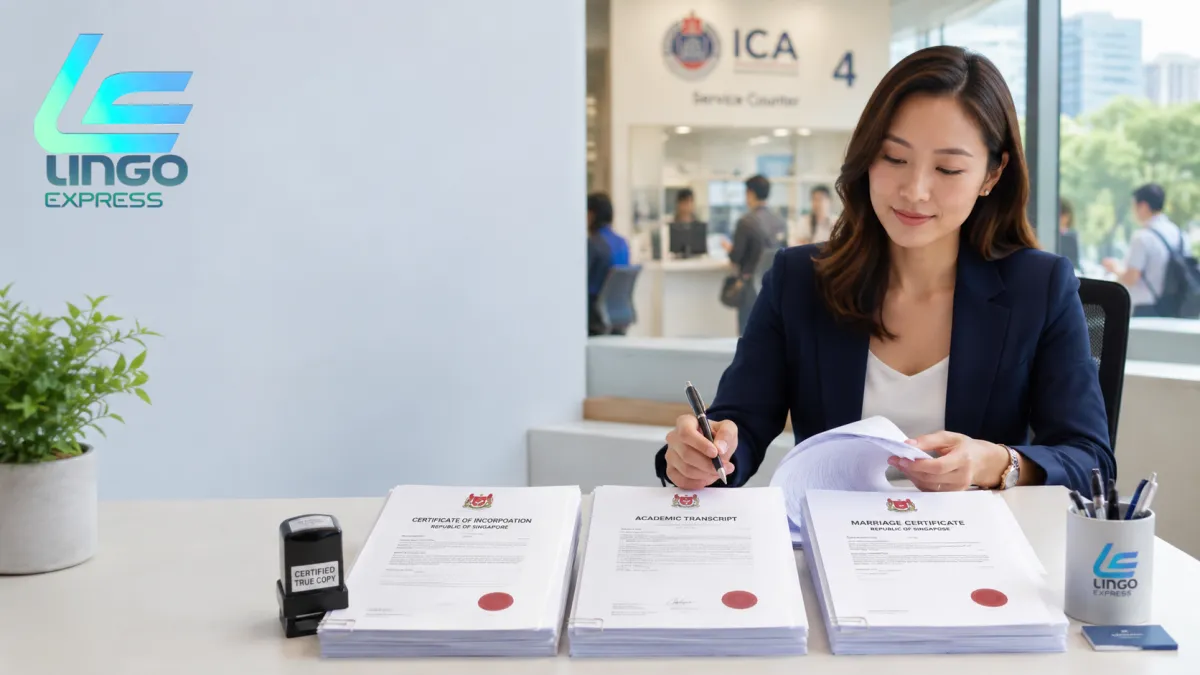
Complete Guide to ICA Applications in Singapore
If you have started an immigration matter in Singapore, you have met the Immigration & Checkpoints Authority (ICA) — the agency that sits at the centre of who may enter, reside in and become a citizen of the country. Its application portals are methodical, and that methodical streak is precisely why preparation matters: an officer is working through a checklist, and the cleanest path through is to meet each item exactly as written. This guide explains what ICA applications involve and where translation, often an afterthought, quietly decides the pace of the whole thing.
🏛️ What ICA actually handles
ICA's remit spans the full arc of staying in Singapore. At one end are passes that let a family member or visitor remain — the Dependant's Pass for spouses and children, the Long-Term Visit Pass for wider family. In the middle sits Permanent Residence, the step from temporary to settled status. At the far end is citizenship, the most consequential application of all. Each tier asks for more, and asks for it to be more thoroughly substantiated — which is why the documentary demands climb steadily as you move along the arc.
📌 Why it matters more than people expect
These applications are not formalities to be waved through. They shape your right to work, your family's ability to stay together, your access to housing and schooling, and the timeline of your life in Singapore. Because the stakes are high, the verification is genuine: an officer cross-checks names, dates and identity numbers across every document you submit, and a single piece that does not reconcile can hold the entire file. Treating preparation as a careful exercise rather than a box-tick is the difference between a clean run and a months-long round of queries.
🗂️ The documents behind a typical application
Most ICA applications rest on a recognisable spine of civil and educational records: a birth certificate, often a marriage or divorce certificate, educational qualifications, and supporting evidence such as a police clearance or a household register. Where any of these was issued in a language other than English, ICA requires a certified English translation alongside it — complete, faithful, and reproducing every field on the original.
- A Chinese "Medical Certificate of Birth" sets out the neonatal name, gender, gestational age, birth weight and length, both parents' nationality and ID numbers, the issuing hospital and a red hospital stamp with a certificate number.
- A Chinese "Resident Household Register" (hukou) runs to multiple pages — a household type and number, then a per-person registration card with relationship, ethnicity, place of origin, ID number and marital status, sealed throughout by the Public Security Bureau.
Every field, and every seal, has to reappear in the English version — including the back pages — or the document reads as incomplete.
🧭 How an application comes together
In practice the path runs in a sensible order. Identify your application and read its document list literally. Gather the originals and scan them in full-page colour at high resolution so no stamp is lost. Establish the passport spelling of every name so the translations can be matched to it. Have the non-English documents rendered into certified English translations — with notarisation arranged where the route commonly calls for it (PR and citizenship most often; confirm for your case). Review the drafts, then submit the translations beside the originals through the relevant ICA portal, keeping every original safe in case an officer asks to sight it.
Sequencing is where applicants gain or lose weeks. The instinct is to leave translation until the form is half-filled, but the translation layer often takes longer to get right than the form itself — especially when documents must be gathered from a home-country registry, or when notarisation adds a step. Starting the translation early, in parallel with assembling the rest of the file, means the document set is ready when the portal asks for it rather than becoming the bottleneck. It also leaves room to resolve a name discrepancy or a missing supporting record before it stalls the submission, instead of discovering it mid-application.
🌏 A note on tiers and overseas use
One distinction saves applicants money and confusion. For documents submitted to ICA inside Singapore, a certified translation — notarised where the route requires it — is typically the ceiling of what is asked. An apostille from the Singapore Academy of Law (SAL) generally belongs to documents heading overseas, not to a local ICA file. If your matter has an overseas leg, confirm an apostille genuinely sits in the chain before paying for it; otherwise the certified-and-notarised tier is usually the right scope.
Because every applicant's circumstances differ, the safest first step is to have your specific document list and translation scope reviewed before you begin uploading. Send your documents to LingoExpress with the name of the ICA application they are for, and the right approach — certified, and notarised where needed — can be confirmed before a single page is signed.
📣 Contact LingoExpress for a free quote!
📧 Email: [email protected]
🌐 Website: https://lingoexpress.com.sg