Common Mistakes in Malaysian Birth Certificate Translation
A Malaysian birth certificate looks simple — one page, a familiar layout, a language many readers half-recognise. That very familiarity is the trap: it tempts people to translate it casually, and a casual rendering of an identity document is exactly what a Singapore officer queries. Whether the certificate is supporting a Dependant's Pass, a school place, a PR file, or a marriage registration, the same small errors surface again and again. Below are the five that show up most, each paired with a fix and grounded in the real anatomy of the Form A that lands on a translator's desk.
❌ 1. IC numbers mistyped or left out
A Form A carries the father's and mother's IC numbers, and these are among the most load-bearing details on the page — an officer uses them to reconcile the certificate against the parents' other documents. A single transposed digit, or an IC number quietly omitted because it sat in a cramped corner of the form, hands the file a discrepancy it cannot resolve. The numbers are not background detail; they are part of how the document proves the family link it exists to establish.
- The registration area and sub-district where the birth was recorded, issued via the National Registration Department (JPN).
- The father's and mother's full names, IC numbers and occupations — each of which must carry across exactly.
- The registrar's signature and official stamp, rendered in place as [Official stamp: National Registration Department], not skipped.
How to avoid it: Have every IC number read back against the source digit by digit, and confirm none is omitted — then check each against the parents' own identity documents before the translation is finalised.
❌ 2. Names that don't match the passport
Malaysian names carry markers — "bin", "binti", "a/l", "a/p" — and may be romanised in more than one defensible way. A translator who lands on a spelling that differs from the passport, even by one letter or one spacing choice, gives a Singapore officer reason to ask whether the certificate and the person are the same. The child's name and both parents' names all have to line up with their travel documents and every other certificate in the bundle, not just read plausibly on their own.
How to avoid it: Give the translator a clear scan of the relevant passport bio pages and ask that all names be matched to them precisely, including how the "bin/binti" and "a/l/a/p" elements are written. LingoExpress builds this passport check into its certified workflow so names stay consistent across an entire document set.
❌ 3. The registrar's stamp left untranslated
Budget translations focus on the body text and quietly skip the marks around it — and on a Form A the most important of those is the registrar's stamp. To a Singapore officer that stamp is not decoration; it is part of the document's legal content and has to be read in English. The same goes for any handwritten correction, official annotation, or secondary mark on the certificate. If something is illegible in the source, that has to be stated rather than silently dropped.
How to avoid it: Insist that every visible mark is rendered in its correct position with a bracketed note, then set your original beside the finished translation and tick off each stamp and signature before you hand anything over.
❌ 4. Malay terms read loosely or wrongly
Because Malay feels approachable, it invites guesswork — and guesswork on an official form produces small but consequential slips. Field labels, occupation descriptions, the wording that distinguishes the place of birth from the place of registration, and the document's own headings all have precise meanings that a faithful translation has to preserve. A loose rendering that turns a specific administrative term into an everyday near-synonym can change how an officer reads the certificate, even when the gist looks right.
How to avoid it: Use a translator who works with Malaysian civil documents regularly and knows the Form A vocabulary, rather than treating the Malay as something anyone can approximate. The difference shows up precisely in the fields an officer scrutinises.
❌ 5. A layout that no longer mirrors the original
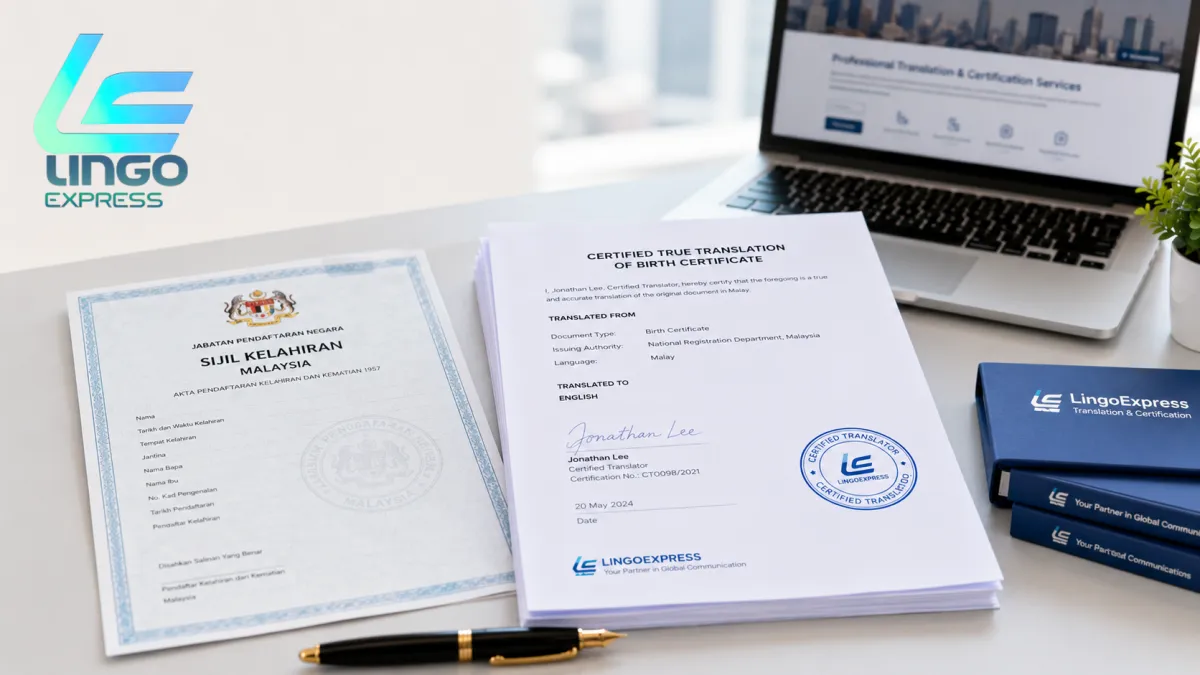
A translation is not just the words — it is the document. When a Form A is rearranged into a loose paragraph that bears no resemblance to the source, an officer cannot map it back to the original at a glance, and that friction invites rejection. The fields should sit in their original order, the registrar's stamp where it appears on the source, so the two read as mirror images. This visual fidelity is one of the clearest markers separating a professional certified translation from a quick DIY effort — LingoExpress formats each one to track the structure of the source so officers can verify it without hunting.
How to avoid it: Ask for a layout that mirrors the original — same field order, stamp and signature in their real positions — then lay the two side by side before submitting. If your eye can jump from a field in the source to the same field in the translation instantly, an officer's can too.
✅ Your 60-second pre-submission tick-list
Run through this before the certificate goes anywhere. One minute now can save weeks later:
- ✅ Both parents' IC numbers are present and correct, digit for digit, against the source.
- ✅ The child's and parents' names match the passport — including "bin", "binti", "a/l" and "a/p" — character for character.
- ✅ The registrar's stamp and signature appear in the translation, noted in place, with nothing on the page skipped.
- ✅ Malay field labels and terms are rendered precisely, not loosely approximated.
- ✅ The layout mirrors the original Form A, fields in order and the stamp in its real position.
- ✅ You've confirmed whether your application needs certified or notarised, and chosen the right tier.
- ✅ The source scan is 300 DPI or higher, full-page, sharp, and correctly oriented.
Clear all seven and you have eliminated the vast majority of reasons a Malaysian birth certificate translation is handed back. With a pass, school place, or PR timeline on the line, getting it right the first time beats discovering a dropped IC number weeks later. For a tailored assessment of what your document needs, request a quote from LingoExpress and have the requirements confirmed before you commit.
📣 Contact LingoExpress for a free quote!
📧 Email: [email protected]
🌐 Website: https://lingoexpress.com.sg