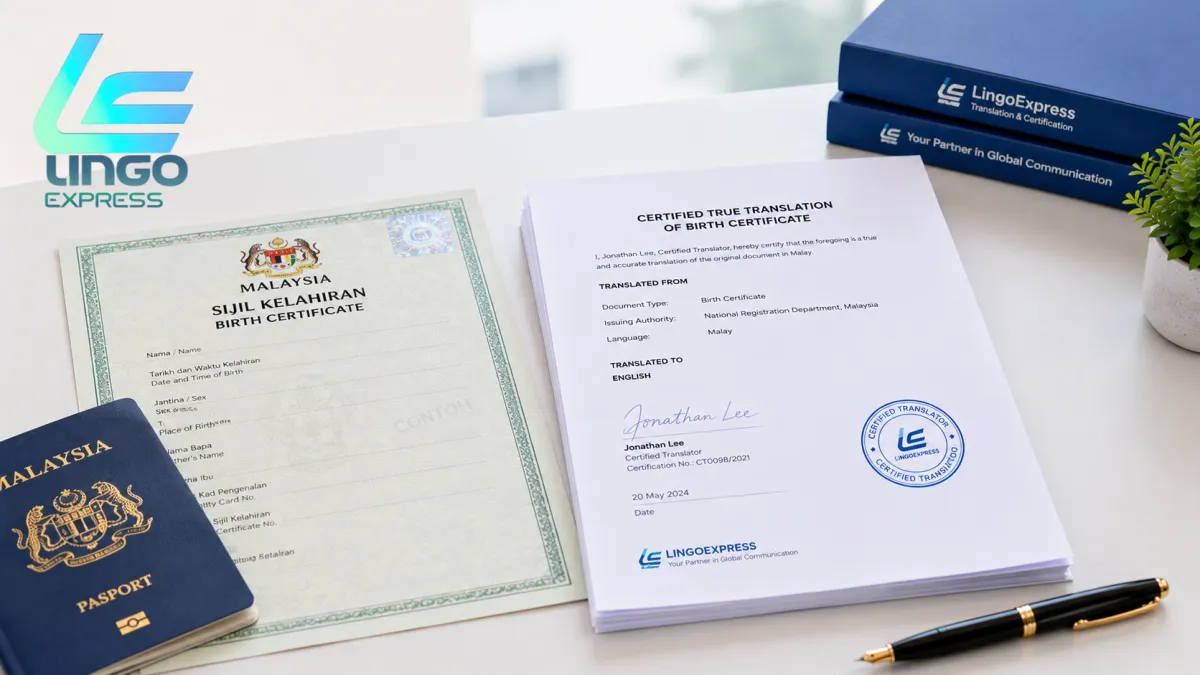
Common Mistakes in Indonesian-to-English Official Document Translation
When a Singapore authority returns an Indonesian document, the timeline doesn't pause — it resets, and a single rejection can cost weeks on a pass, PR, marriage, or study application. The reassuring part is that almost every rejection traces back to a handful of issues you can check in advance. Below are the five that surface most often with Bahasa Indonesia documents, each paired with a fix and grounded in the real anatomy of the records that cross a translator's desk.
❌ 1. Skipping stamps, seals, and official marks
This is the single most common reason an Indonesian translation bounces. Applicants — and budget translation shops — focus on the body text and quietly skip everything around it: the issuing office's stamp, a registry seal, an embossed mark, a watermark, a handwritten annotation in the margin. To a Singapore officer these are not decoration; they are part of the document's legal content, and each one needs to be read in English. If a mark is illegible in the source, that has to be stated rather than silently dropped.
- The civil-registry stamp on an Indonesian birth certificate (Akta Kelahiran) — rendered in place as [Official stamp: Civil Registration Office] with any reference number beside it.
- The issuing office's seal and signatures on a family card (Kartu Keluarga) — each shown where it sits, not omitted.
- The registrar's signature and seal on an academic transcript — noted as [Seal: issuing institution] in its real position on the page.
How to avoid it: insist that every visible mark is rendered in its correct position with a bracketed annotation, then photocopy your original and tick off each mark against the finished translation before you hand anything over.
❌ 2. Names that don't match the passport
Your name should appear in the translation exactly as printed in your passport — same spelling, same order, including any compound or single-name convention common in Indonesian records. Indonesian naming throws up its own traps: mononyms, patronymics, and spellings that have shifted across older and newer civil documents. A translator who reproduces an outdated spelling, or quietly "tidies" a single-name entry into a first-and-last format, hands an officer a reason to ask whether the certificate and the applicant are the same person.
The same applies to parents, spouses, and children across the bundle. A Kartu Keluarga lists every household member with their details, and those names have to reconcile with the passports and every other certificate in the set — or an officer issues a request for re-submission.
How to avoid it: Give your translator a clear scan of your passport bio page — and your family members' where relevant — and ask that all names be matched to it precisely, with any older document spelling reconciled rather than reproduced blindly. LingoExpress builds this passport check into its certified workflow so names stay consistent across an entire document set.
❌ 3. Mangled dates, places, and number formats
Indonesian documents carry conventions that go wrong in careless hands. Month names in Bahasa Indonesia, date orders, regional place names, and administrative divisions such as provinsi, kabupaten, and kelurahan all need to be carried into clear, unambiguous English — not transliterated half-heartedly or left in the source language. A birth date that flips day and month, or a birthplace rendered so loosely an officer cannot match it to other records, is enough to stall verification.
How to avoid it: Ask that dates be written in an unambiguous format, place names and administrative levels rendered consistently throughout the document set, and any figures or reference numbers reproduced exactly as they appear — so every date and place reconciles cleanly across the bundle.
❌ 4. Official terms guessed at or left untranslated
Indonesian civil and academic documents are full of institution-specific terminology — the names of issuing authorities, document titles, status terms, and qualification descriptors. A translator unfamiliar with the source format may guess at a meaning, render an official body's name inconsistently, or leave a key term in Bahasa Indonesia and hope an officer fills in the gap. Each of those creates doubt at exactly the point where clarity matters: an assessor needs to know precisely which authority issued the document and what it certifies.
How to avoid it: Use a translator who knows Indonesian official documents, so issuing bodies and document types are rendered accurately and consistently across the whole set — not approximated differently from one page to the next. Consistency of terminology is one of the clearest signs an officer is reading professional work rather than a guess.
❌ 5. A layout that no longer mirrors the original
A translation isn't just the words — it's the document. When an Akta Kelahiran or a transcript is rearranged into a loose paragraph that bears no resemblance to the source, an officer can't map it back to the original at a glance, and that friction invites rejection. Tables should stay tables: a transcript's grade grid or a family card's structured entries must keep their shape rather than be flattened into prose, and each stamp should sit where it does on the source so the two read as mirror images. This visual fidelity is one of the clearest markers separating a professional certified translation from a quick DIY effort — LingoExpress formats each one to track the structure of the source so officers can verify it without hunting.
How to avoid it: Ask for a layout that mirrors the original — same order, same table structure, seals and signatures in their real positions — then lay the two side by side before submitting. If your eye can jump from a field in the source to the same field in the translation instantly, an officer's can too.
✅ Your 60-second pre-submission tick-list
Run through this before anything goes to a Singapore authority. One minute now can save weeks later:
- ✅ Every stamp, seal, watermark, and handwritten note appears in the translation — none skipped, illegible ones noted.
- ✅ Your name and family members' names match your passports exactly, with older spellings reconciled.
- ✅ Dates, birthplaces, and administrative divisions are rendered unambiguously and consistently across the set.
- ✅ Issuing authorities and document titles are translated accurately, not guessed at or left in Bahasa Indonesia.
- ✅ You've confirmed whether your application needs certified or notarised, and chosen the right tier.
- ✅ Source scans are 300 DPI or higher, full-page, sharp, and correctly oriented, with every seal legible.
- ✅ The translation's layout mirrors the original — tables stay tables, fields and seal positions all line up.
Clear all seven and you've eliminated the vast majority of reasons an Indonesian document gets handed back. With an application timeline on the line, getting a certified translation right the first time beats discovering a missing seal weeks later. For a tailored assessment of what your documents need, request a quote from LingoExpress and have the requirements confirmed before you commit.
📣 Contact LingoExpress for a free quote!
📧 Email: [email protected]
🌐 Website: https://lingoexpress.com.sg