Common Errors in Marriage Certificate Translation
When an authority returns a marriage certificate, it rarely explains much beyond "translation not accepted" — and the timeline keeps running while you work out what went wrong. The reassuring part is that the failures cluster around a handful of recurring mistakes, almost all of them visible before submission if you know where to look. Below are the five that surface most often, each paired with a fix and grounded in the real anatomy of the certificates that land on a translator's desk.
❌ 1. A spouse's name that doesn't match the passport
This is the error that sinks the most marriage-certificate translations. The document exists to prove two named people are married, so the names are the first thing an officer reconciles against the passports. When a name is transliterated phonetically from Chinese, Arabic, Korean or another script and lands on a spelling that differs from the travel document — even by a single letter or a swapped given-and-family order — the officer is left unsure the certificate and the applicant are the same person. Romanised names are especially prone to this, since one set of characters can be rendered several defensible ways, but only the passport spelling counts.
How to avoid it: hand your translator a clear scan of each spouse's passport bio page and ask that both names be matched to it character for character. LingoExpress builds this passport check into its certified workflow so the names stay consistent across the whole document set.
❌ 2. Seals, stamps and endorsements left out
A marriage certificate is more than its sentences. The registry's embossed seal, the officiant's stamp, witnesses' signatures, a revenue stamp, a back-page endorsement added later — to an authority these are part of the legal record, and an officer expects to read every one in English. Budget translation shops focus on the body text and quietly skip the marks around it, and that omission alone reads as an incomplete document.
- The registry or religious-authority seal, shown in place as [Official seal: Marriage Registry] rather than left as a blank space.
- The registrar's and witnesses' signatures, noted where they appear on the page.
- Any later endorsement or handwritten annotation — a correction or a stamp an authority added afterwards — carried across in its position.
How to avoid it: insist every visible mark is rendered with a bracketed note in its correct spot, and if one is illegible in the scan, have that stated explicitly rather than omitted. Then photocopy the original and tick each mark off against the finished translation.
❌ 3. The wrong certification tier
A certified translation and a notarised one are not the same thing, and confusing them costs time. A certified translation carries the translator's signed accuracy statement; a notarised one adds a Singapore Notary Public attesting to that certification. For many routine purposes certified is enough — but for higher-stakes matters such as PR and citizenship, notarisation is commonly required. Submitting a certified translation when the authority wanted it notarised means doing the job twice.
How to avoid it: settle the tier before you translate. The receiving authority's own checklist is the source of truth, and requirements can change, so confirm rather than assume. LingoExpress can advise whether your marriage certificate is likely to need notarisation and arrange it in the same job.
❌ 4. A misread or ambiguous date
Dates are a quiet trap on marriage certificates. Numeric formats differ by country — a day-month-year original can be misread as month-day-year, turning a March wedding into a December one — and some certificates carry a date in a lunar or non-Gregorian calendar that has to be converted and noted, not copied blindly. A marriage date that contradicts the rest of your file, or that an officer cannot interpret with certainty, invites a query just as readily as a misspelt name.
How to avoid it: ask for dates rendered in an unambiguous form, with any calendar conversion clearly indicated, and check the marriage date against your other documents so everything reconciles.
❌ 5. A layout that no longer mirrors the original
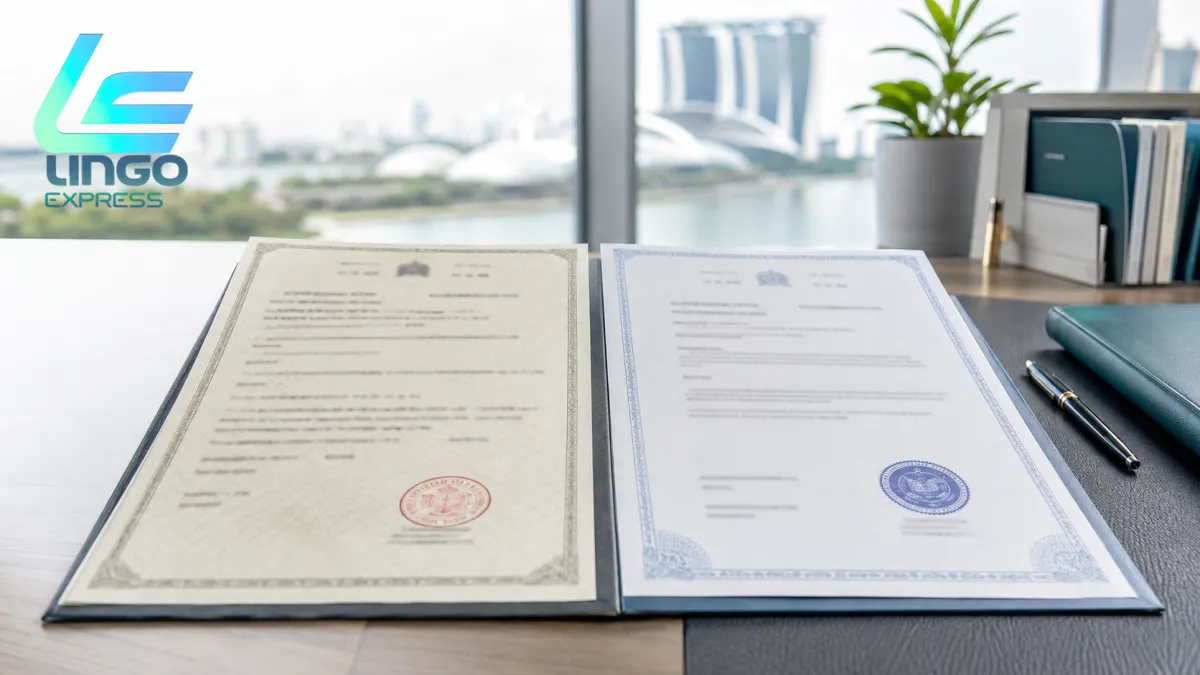
A translation is the document, not just its words. When the certificate is flattened into a loose paragraph that bears no resemblance to the source, an officer cannot map the English back to the original at a glance, and that friction invites rejection. The names should sit where they sit, the seal in its real position, any tabular details kept in shape — so the two pages read as mirror images. This visual fidelity is one of the clearest markers separating a professional certified translation from a quick DIY effort.
How to avoid it: ask for a layout that tracks the original — same order, seals and signatures in their real places — then lay the two side by side before submitting. If your eye can jump from a field on the source to the same field in the translation instantly, an officer's can too. LingoExpress formats each marriage certificate to track the structure of the source for exactly this reason.
✅ Your 60-second pre-submission tick-list
Run through this before the certificate goes to the Registry of Marriages (ROM), ICA or any other authority. One minute now can save weeks later:
- ✅ Both spouses' names match their passports character for character, in the right order.
- ✅ Every seal, stamp, signature and endorsement appears in the translation — illegible ones noted, none skipped.
- ✅ The marriage date is unambiguous, with any calendar conversion shown, and reconciles with your other documents.
- ✅ The certificate number, place of marriage and issuing authority are all present.
- ✅ You've confirmed whether your application needs certified or notarised, and chosen the right tier.
- ✅ The layout mirrors the original, with fields and seals in their real positions.
- ✅ You've checked a translation is actually needed (a Singapore-issued certificate is already in English).
Clear all seven and you've eliminated the vast majority of reasons a marriage certificate is handed back. With a pass or PR timeline on the line, getting the translation right the first time beats discovering a missing seal weeks later. For a tailored assessment of what your certificate needs, request a quote from LingoExpress and have the requirements confirmed before you commit.
📣 Contact LingoExpress for a free quote!
📧 Email: [email protected]
🌐 Website: https://lingoexpress.com.sg