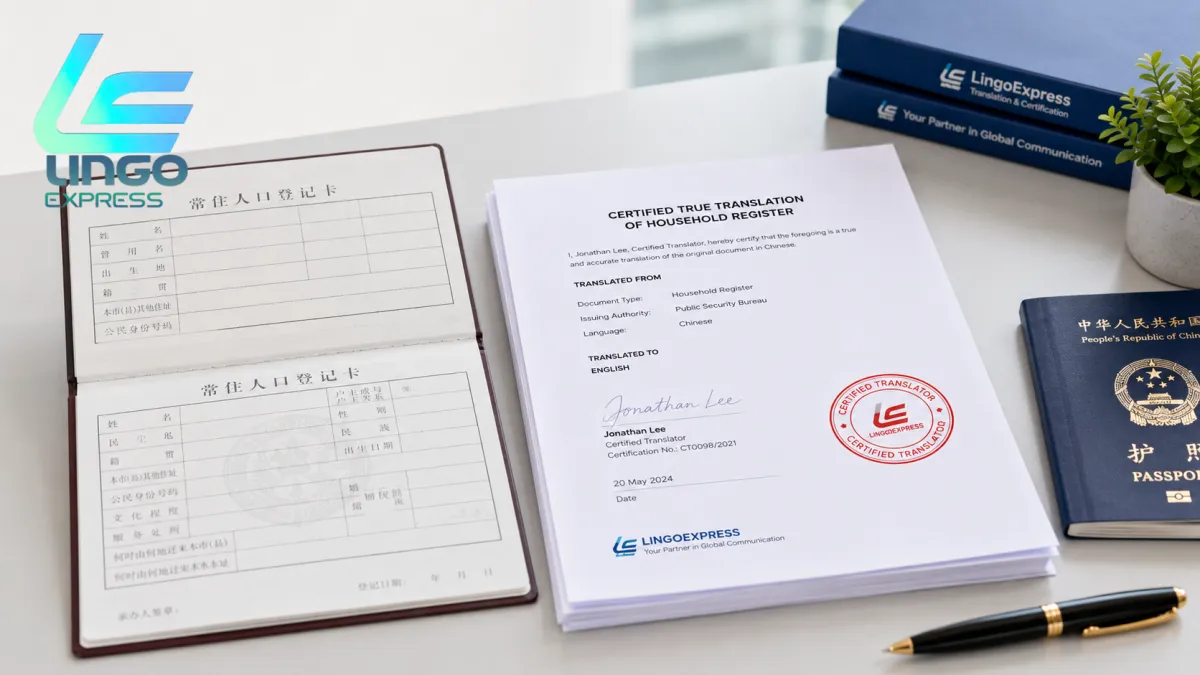
Common Errors in Chinese-to-English Official Document Translation
When an authority returns a translation, the clock does not pause — it resets, and a single rejection can cost weeks on a Permanent Residence, citizenship or visa timeline. The encouraging part is that nearly every rejection of a Chinese-to-English document traces back to a handful of avoidable issues. Below are the six that surface most often, each paired with a fix and grounded in the real anatomy of the documents that cross a translator's desk.
❌ 1. Names romanised differently from the passport
This is the error that sinks the most Chinese documents. A single Chinese name can be romanised several defensible ways — Hanyu Pinyin, an older spelling, a dialect-based form — and only one of them matches your passport. A translator who transliterates phonetically and lands on a different spelling, even by one letter, hands an officer a reason to ask whether the certificate and the applicant are the same person. The same applies to parents, spouses and children across the bundle; on a birth certificate each parent is listed with a name and an ID number, and both have to reconcile with their passports and every other certificate.
The fix: Give your translator a clear scan of the passport bio page for everyone named — and ask that all names be matched to it exactly. LingoExpress builds this passport check into its certified workflow so names stay consistent across an entire set.
❌ 2. Untranslated seals, chops and stamps
Chinese documents are heavy with red seals, and they carry legal weight — they are not decoration. The hospital chop on a birth record, the Public Security Bureau seals across a household register, an institutional seal on a degree, a notarial stamp: an officer needs to read each one in English. Budget translations and machine tools focus on the body text and quietly walk past the seals, which is exactly what reads as an incomplete document.
- The red hospital stamp and certificate number on a "Medical Certificate of Birth" — shown as [Round seal: ... Maternity & Child Health Hospital] with the number beside it.
- The multiple Public Security Bureau seals across a "Resident Household Register" (hukou) — each noted page by page, e.g. [Red seal: ... Public Security Bureau, Household Registration Office].
- The Traffic Police / Public Security Bureau issuing seal on a Chinese driving licence — rendered rather than dropped.
The fix: Insist that every visible mark is rendered in its correct position with a bracketed annotation — and that any illegible seal is noted as such, not silently omitted. Photocopy the original and tick off each seal against the finished translation before you hand anything over.
❌ 3. Dates flipped or mis-ordered
Chinese dates are written year-month-day, and a careless rendering into English can flip the day and the month — turning, say, the 6th of December into the 12th of June. On a birth, marriage or divorce record, a wrong date does not just look sloppy; it contradicts the other documents in the file and invites a query. Machine tools are particularly prone to this because they reformat dates confidently and invisibly.
The fix: Have dates written unambiguously — spelling the month out where it helps — and cross-check every date against the rest of the bundle so they all agree. A translator who knows the source format reads the order correctly the first time.
❌ 4. Addresses and place names rendered loosely
A "place of origin" on a hukou, an issuing authority's location, a hospital's name — these are not free text to paraphrase. An administrative division rendered loosely, or a place name guessed at, can fail to match the address shown elsewhere in the application. Chinese administrative hierarchies (province, city, district, sub-district) need to carry across in a consistent, recognisable form, not a casual approximation.
The fix: Ask for place names and administrative units to be rendered consistently throughout the set, with the original retained alongside where that aids verification — so an officer can map each location back to the source without ambiguity.
❌ 5. Tables flattened, and pages left out
Two layout failures travel together on Chinese documents. The first is flattening a table into prose — the class-code table on a driving licence, or the grade grid on an academic transcript, rearranged into loose paragraphs an officer cannot map back to the original at a glance. The second is dropping pages: a hukou translated only on its cover, a certificate whose reverse side carried a seal, a licence missing its supplementary renewal page. A multi-page document rendered as a single page reads as incomplete the moment the officer turns to page two.
The fix: Ask for a layout that mirrors the source — tables stay tables, seals sit where they sit — and confirm that every page is included. LingoExpress formats each translation to track the structure of the original so an officer can verify it field by field.
❌ 6. Wrong certification tier for the application
Even a flawless translation can be the wrong kind of document. A certified translation carries the provider's signed accuracy statement; a notarized one adds a Singapore Notary Public attesting to that certification. For many routine uses certified is enough — but for higher-stakes routes such as PR and citizenship, notarization is commonly required. Paying for certified only to be told it needs notarizing means a second round and a longer wait.
The fix: Settle the tier before you translate — the relevant authority's checklist is the source of truth, and requirements can change. LingoExpress can advise whether your documents are likely to need notarization and arrange it within the same job, so the tier is right the first time.
✅ Your 60-second pre-submission tick-list
Run through this before anything goes in. One minute now can save weeks later:
- ✅ Every name — yours, parents', spouse's — matches the passport spelling, with one consistent romanisation.
- ✅ Every seal, chop, stamp and handwritten note appears in the translation; illegible ones are noted, not skipped.
- ✅ Every date reads in the correct order and agrees across the whole bundle.
- ✅ ID numbers reconcile across the birth certificate, household register and every other record.
- ✅ Addresses and place names are rendered consistently and recognisably throughout.
- ✅ Tables keep their structure and every page is present — nothing flattened, nothing dropped.
- ✅ You have confirmed whether your application needs certified or notarized, and chosen the right tier.
Clear all seven and you have eliminated the vast majority of reasons a Chinese document is handed back. With a PR or citizenship timeline on the line, getting a certified translation right the first time beats discovering a missing seal weeks later. For a tailored assessment of what your documents need, request a quote from LingoExpress and have the requirements confirmed before you commit.
📣 Contact LingoExpress for a free quote!
📧 Email: [email protected]
🌐 Website: https://lingoexpress.com.sg