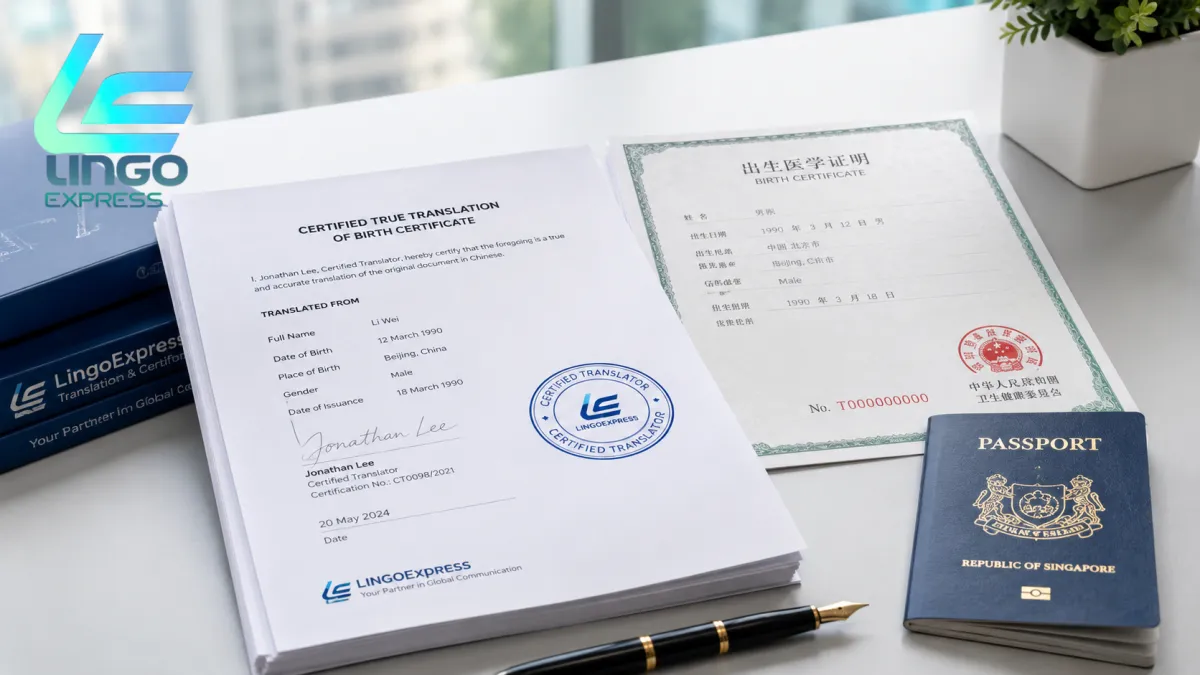
Common Birth Certificate Translation Mistakes and How to Avoid Them
A birth certificate looks like one of the simplest documents to translate — a name, two parents, a date, a place. That apparent simplicity is exactly the trap. Because so much of an immigration file rests on this single page, an officer cross-checks every detail on it, and a small slip an applicant would never notice is enough to hold the whole submission. Here are the mistakes that recur most often on birth-certificate translations, each with the fix, drawn from the real anatomy of the documents that cross a translator's desk.
❌ 1. Names that drift from the passport
A foreign name can usually be romanised several defensible ways — but only one spelling matters, the one printed in the passport. When a translator transliterates a Chinese or Malay name phonetically and lands even one letter away from the travel document, an officer is handed a reason to ask whether the certificate and the applicant are the same person. The order of given and family names, hyphens and spacing all count too.
How to avoid it: Give your translator a clear scan of the passport bio page — the child's and both parents' — and ask that every name be matched to it exactly, rather than transliterated from scratch.
❌ 2. Skipping the hospital seal or registrar stamp
The marks around the text are part of the document's legal content, not decoration — yet they are the first thing a rushed or budget translation drops. A Chinese "Medical Certificate of Birth" carries a red hospital stamp with a certificate number; a Malaysian "Form A" under the Births and Deaths Registration Act 1957 carries the registrar's signature and stamp. Leave either out and the translation reads as incomplete the moment it is laid beside the original.
How to avoid it: Insist every visible seal, stamp and handwritten note is rendered in its correct position with a bracketed annotation such as [Round seal: ... Maternity & Child Health Hospital] — and if a mark is illegible in the source, that should be stated, not silently omitted.
❌ 3. Parents' ID numbers that don't reconcile
A birth certificate doesn't just name the parents — it ties each to an ID number. On a Chinese certificate both parents appear with nationality and ID/passport numbers; on a Malaysian one, with their IC numbers. Those have to match the parents' own documents and every other certificate in the bundle. A digit transposed here, or a number that disagrees with the marriage certificate there, and an officer issues a request for re-submission.
How to avoid it: Have the translator carry every ID number across precisely and check it against the source and the rest of the set, rather than treating the numbers as background detail.
- A Chinese "Medical Certificate of Birth": neonatal name and gender, gestational age, birth weight and length, both parents' nationality and ID numbers, the issuing hospital, and the red stamp with its certificate number.
- A Malaysian "Form A": the registration area and sub-district, the father's and mother's IC numbers and occupations, and the registrar's signature and stamp.
Miss any single one — a stamp, an ID, an occupation line — and the translation stops being a faithful mirror of the page.
❌ 4. A layout that ignores the original
A translation isn't just the words — it's the document. When a birth certificate is rearranged into a loose paragraph that bears no resemblance to the source, an officer can't map it back at a glance, and that friction invites rejection. The seals should sit where they sit on the original, and the fields should follow the same order, so the two read as mirror images.
How to avoid it: Ask for a layout that tracks the original — same order, seals and signatures in their real positions — then lay the two side by side. If your eye can jump from a field in the source to the same field in the translation instantly, an officer's can too.
❌ 5. The wrong certification tier
A certified translation and a notarised one are not the same, and confusing them is costly. Certified carries the translator's signed statement of accuracy; notarised adds a Singapore Notary Public attesting to that certification. For many routine uses certified is enough, but for higher-stakes routes such as PR and citizenship, notarisation of a birth certificate is commonly required — whether it applies to your exact case depends on the scheme, so confirm it rather than assume.
How to avoid it: Settle the tier before you translate, using the receiving authority's own checklist as the source of truth, so you don't pay for a certified translation only to be told it needs notarising — or pay for notarisation a routine use never required.
✅ Your 60-second tick-list
Run through this before a birth certificate goes to the Immigration & Checkpoints Authority (ICA) or any other authority. One minute now can save weeks later:
- ✅ The child's and both parents' names match their passports character-for-character, in the right order.
- ✅ Every stamp, seal and handwritten note appears in the translation — illegible ones noted, none skipped.
- ✅ Both parents' ID or IC numbers carry across exactly and reconcile with the rest of the document set.
- ✅ All the fields are present — gestational age, weight, occupations, issuing body — not just the headline name and date.
- ✅ The layout mirrors the original, with seals and fields in their real positions.
- ✅ You've confirmed whether your application needs certified or notarised, and chosen the right tier.
- ✅ Your source scan is 300 DPI or higher, full-page and sharp, with the stamp legible.
Clear every line and you've eliminated the vast majority of reasons a birth-certificate translation comes back. With a family application on the line, getting it right the first time beats discovering a missing seal weeks later. For a tailored assessment of what your certificate needs, request a quote from LingoExpress and have the requirements confirmed before you commit.
📣 Contact LingoExpress for a free quote!
📧 Email: [email protected]
🌐 Website: https://lingoexpress.com.sg