Chinese-to-English Translation Checklist for Official Documents
Chinese civil documents are some of the densest you can hand a translator. A single household register can run to several pages, each crowded with names, ID numbers and red seals; a birth record packs a dozen fields and a stamp onto one sheet. When the destination is a Singapore authority that lays the translation beside the original and checks them line by line, anything dropped — a seal, a page, a number — reads as an incomplete document. This checklist is built around the documents that actually cross a desk, so you know exactly what has to carry across into English before you submit.
One definition first. A certified translation carries a signed accuracy statement from the provider. For higher-stakes routes such as Permanent Residence and citizenship, that certified translation is commonly also notarized by a Singapore Notary Public — whether it applies to your exact documents is something to confirm against your own application page rather than assume.
🪪 Category 1: Identity and family records
These establish who you are and how your family connects, so they anchor most applications — and they are where small inconsistencies cause the largest delays. Every name and ID number on them has to reconcile across the whole set before anything goes in.
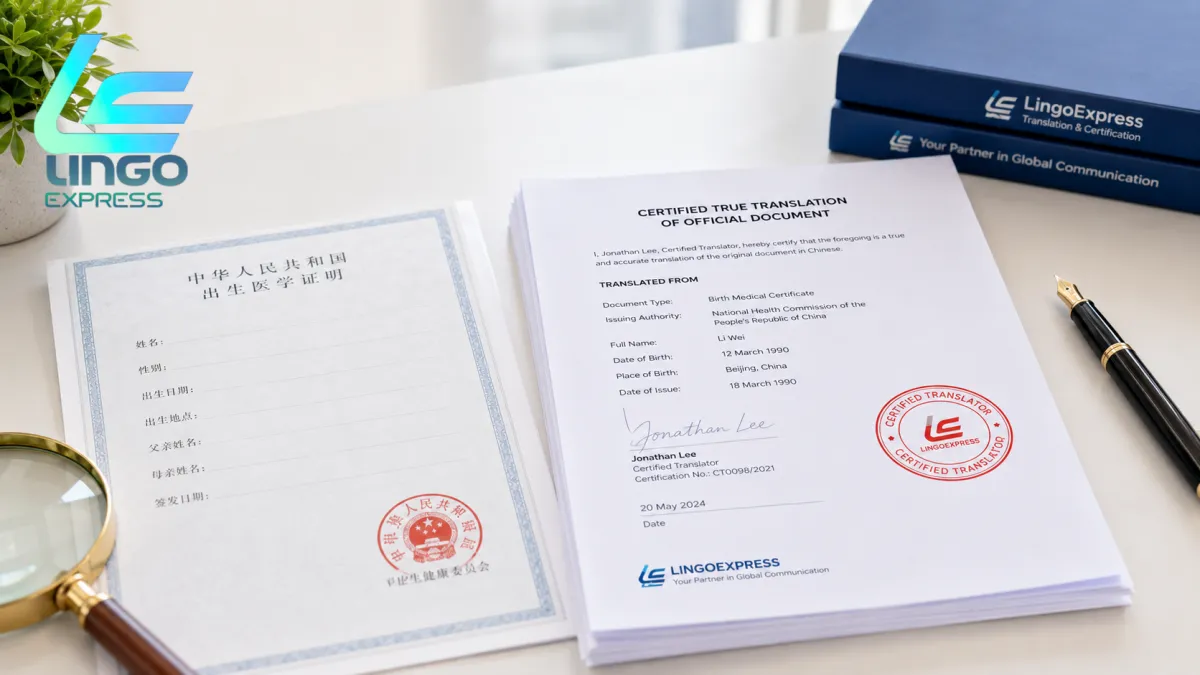
- Birth certificate ("Medical Certificate of Birth"): carries the neonatal name, gender, gestational age, birth weight and length, both parents' nationality and ID numbers, the issuing hospital, and a red hospital stamp with a certificate number. Every field and the seal must appear in English.
- Household register (hukou, "Resident Household Register"): states the household type (Agricultural or Non-Agriculture), the householder and household number, then a per-person "Permanent Resident Registration Card" listing relationship, ethnicity, place of origin, ID number, education and marital status — sealed throughout with Public Security Bureau marks. Every page and every seal is rendered, not just the cover.
- Marriage certificate: needed where a spouse is involved. Watch how each surname is romanised — a mismatch against the passport is among the most frequent queries an officer raises.
- Driving licence (when used for conversion or identity): shows the licence number and class (such as C1D), the Traffic Police / Public Security Bureau issuer, and a class-code table from A1 to P, often with a supplementary page of renewal dates. The class-code table has to be reproduced, not summarised.
A "Resident Household Register" is one of the densest documents in any file. The cover names the household type, the householder and the household number; each member then has a registration card carrying their relationship to the householder, ethnicity, place of origin, ID number, education and marital status; and Public Security Bureau seals appear across the booklet. A translation that captures only the first page — a classic shortcut — reads as incomplete the moment an officer turns to the second. Every sheet and every seal has to be present, each seal noted in its place, for example [Red seal: ... Public Security Bureau, Household Registration Office].
🎓 Category 2: Education and qualification records
Qualifications speak to your contribution, so this set rewards care. Academic wording is technical and institution-specific, and it should be rendered faithfully rather than loosely paraphrased, so an assessor reads the exact qualification you hold.
- Degree and graduation certificates: Chinese institutions often issue a separate graduation certificate and degree certificate — both may be required, and each carries its own institutional seal that has to be rendered.
- Academic transcripts: the subject-by-subject grade record, and the most layout-heavy document you will submit. The translation should mirror the original's table structure column for column so cross-checking is straightforward.
- Professional and training certificates: where they support a work-pass or skilled-employment route, the awarding body and any grading or classification need to carry across precisely.
📎 Category 3: Supporting and supplementary documents
Beyond identity and education, an authority may ask for supporting evidence — and these are the documents most likely to arrive heavy with official stamps, registration numbers and disclaimers. Every one of those marks has to be translated or noted, not left as an untranslated smudge.
- Police clearance / certificate of no criminal record: increasingly requested to confirm good standing, and usually issued only in Chinese — translate it in full, including any printed disclaimer.
- Divorce certificate or court judgment: needed where a previous marriage has ended, to clarify current marital status and any custody arrangements affecting dependants.
- Employment, income or service records: letters and statements that substantiate work history when they are not already in English, each official chop rendered in place.
- Notarial certificates (gongzheng): Chinese notarial booklets that bind an original and its details together carry their own seals and pages — all of which must be reproduced.
🚫 What you usually do NOT need to translate
Not everything in the folder needs a translator, and translating a document an authority already accepts is wasted effort. Two exceptions are worth knowing before you gather the set.
- Documents already issued in English: if a Chinese institution issued your transcript or certificate bilingually or in English, submit it as-is — no translation needed.
- Singapore-government documents in Chinese: official documents issued by Singapore authorities in Chinese are generally accepted without an English translation, since Chinese is one of Singapore's official languages.
One distinction trips people up: notarization and legalisation are not the same step. For documents submitted to an authority inside Singapore, a notarized certified translation is typically the ceiling of what is asked for. Authentication by the Singapore Academy of Law (SAL) or an apostille generally applies to documents heading overseas. If your matter has an overseas leg, confirm the apostille genuinely belongs in the chain before paying for it.
✅ Your pre-submission tick-list
Run through this before anything is submitted. It captures the checks that keep a Chinese-to-English set clean on first review — the same checks the LingoExpress team applies before delivery. Tick every line and your translations are submission-ready.
- ✅ Every name matches your passport — yours, your parents', your spouse's — with one consistent romanisation throughout the set.
- ✅ Every seal and stamp is rendered in its place, each as a bracketed note, with illegible marks stated rather than skipped.
- ✅ Every page is present — the whole hukou, both sides of a certificate, supplementary licence pages — none omitted.
- ✅ ID numbers reconcile across the birth certificate, household register and other records in the bundle.
- ✅ The layout mirrors the original — transcript and class-code tables keep their grid rather than becoming prose.
- ✅ Each translation is certified with a signed accuracy statement — and notarized where your application calls for it.
- ✅ Scans are clear and high-resolution (300 DPI or higher), full-page, with every fine seal legible.
Because every applicant's set differs, the safest move is to have your specific list reviewed before you start — so nothing essential is missed and nothing unnecessary is translated. LingoExpress has handled Chinese civil and academic documents for years, and returns a transparent, itemised quote once it has seen your documents and the application they are for.
📣 Contact LingoExpress for a free quote!
📧 Email: [email protected]
🌐 Website: https://lingoexpress.com.sg