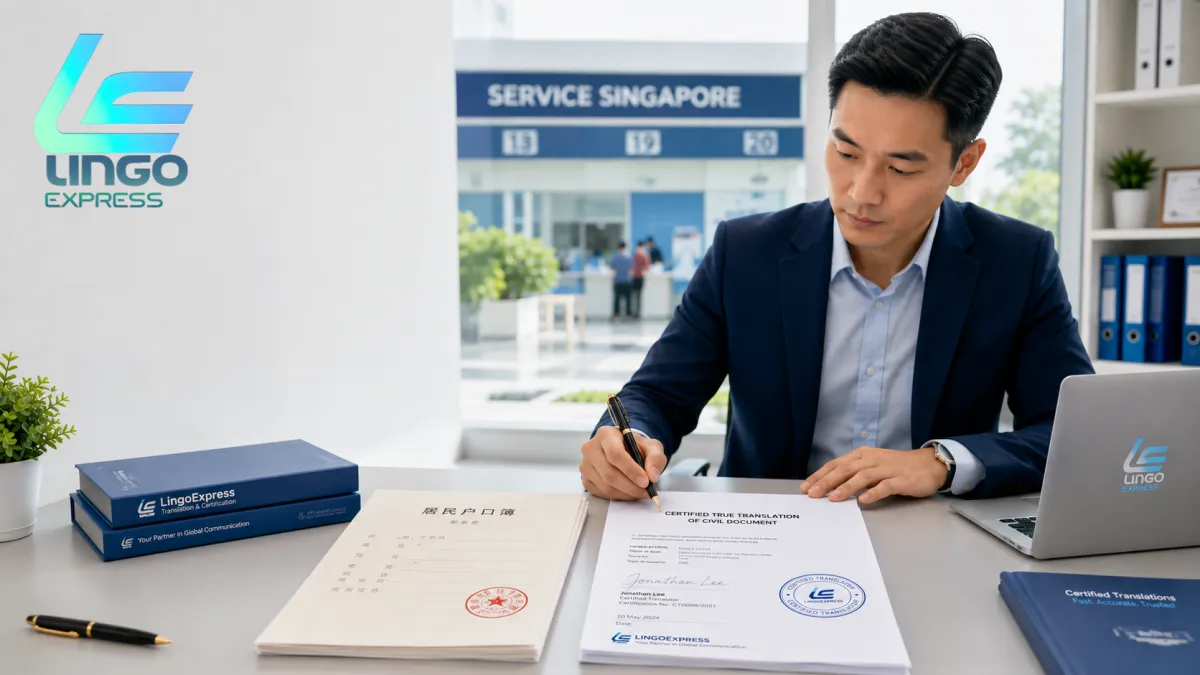
Chinese Documents Translation Guide for ICA Applications
For applicants with documents from China, an ICA submission is rarely a single sheet. Chinese civil records are dense — multi-page, heavily stamped, full of fields that have no obvious English equivalent — and the Immigration & Checkpoints Authority (ICA) reads them closely. This guide explains what an ICA-ready Chinese translation actually means, why the bar is set where it is, and how the most common documents are handled.
📘 What an ICA translation actually is
A translation that satisfies ICA is not just an accurate English version of the words. It is a complete rendering — meaning nothing on the source page is left out — backed by a signed certification statement from a qualified translator declaring the English is a true and faithful copy of the Chinese original. "Complete" is the operative word: a stamp, a margin note, a serial number, a seal half-overlapping the text all count as part of the document and all have to appear. A translation that captures the body text but skips a Public Security Bureau seal is, in an officer's eyes, an incomplete document.
🇸🇬 Why ICA is strict about Chinese records
Civil documents are the foundation an immigration decision rests on — they establish identity, parentage, marital status and family composition. Because so much eligibility depends on them, an ICA officer cross-references every name, date and ID number against your passport and your other filings. Chinese records add an extra layer of difficulty: names romanise in more than one way, the same document type can vary by province, and the seals carry real legal weight. Any gap or inconsistency in the translation gives an officer a reason to pause the file rather than wave it through.
🗂️ The Chinese documents you'll most often translate
A few document types account for the bulk of Chinese-language ICA submissions. Knowing what each one contains helps you see why a translator who recognises the source format matters so much.
- The "Medical Certificate of Birth" lists the neonatal name, gender, gestational age, birth weight and length, both parents' nationality and ID numbers, the issuing hospital, and a red hospital stamp with a certificate number.
- The "Resident Household Register" (hukou) states the household type (Agricultural or Non-Agriculture), the householder and household number, then a per-person "Permanent Resident Registration Card" with relationship, ethnicity, place of origin, ID number, education and marital status — stamped throughout with Public Security Bureau seals. Every page and seal has to be rendered, not just the cover.
- A marriage certificate carries both spouses' details, the registration date and the civil affairs seal.
The household register is the one that catches people out: it is a booklet, not a page, and submitting a translation of only the first sheet is a guaranteed query. Driving licences come up too — a Chinese licence shows its number, class code (such as C1D), the Traffic Police or Public Security Bureau issuer and a class-code table — though these usually surface for licence conversion rather than an ICA civil filing.
🧭 How the process runs
The path from document to submission is straightforward once you know the steps. Move through them in order and there are few surprises.
- Scan every page in colour at 300+ DPI — including the inside pages of a booklet like the hukou — so no seal or serial number is lost.
- Confirm the tier your case needs — certified for many uses, notarised commonly on top for PR and citizenship (verify against your application).
- Send the documents to LingoExpress for a quote, with the passport spelling of every name supplied up front.
- Review the draft for name and date consistency across all your documents.
- Receive the certified (and if required notarised) translation, formatted to mirror the original page for page.
- Submit to ICA with the originals available, as the authority may ask to sight them.
🔒 Getting it right the first time
The two failures that most often send a Chinese document set back are an untranslated seal — usually buried inside a multi-page register — and a name or ID that does not reconcile across the birth, marriage and household documents. Both are entirely avoidable with a complete, passport-matched translation prepared before you open the portal.
A certified translation from LingoExpress arrives on company letterhead with a signed certification statement from a qualified translator — the format ICA and other Singapore authorities expect — and where your application calls for it, notarisation by a Singapore Notary Public is arranged in the same job. Because Chinese document formats are handled regularly, the source layout is familiar and your submission goes in complete.
📣 Contact LingoExpress for a free quote!
📧 Email: [email protected]
🌐 Website: https://lingoexpress.com.sg