Chinese Document Translation for MOM Work Pass Applications
Hiring from China, or moving here on a work pass yourself, means feeding paperwork into two different machines. The Ministry of Manpower (MOM) assesses your qualifications and the job; the Immigration & Checkpoints Authority handles the family passes that travel alongside it. Both expect to read your supporting documents in English, and a certificate that arrives only in Simplified or Traditional Chinese cannot simply be uploaded as-is. The translation is not a formality bolted on at the end — it is the version an officer actually reads when deciding whether your file is complete.
The good news is that the document types repeat. Once you understand what a Chinese degree, a marriage certificate or a hukou contains, you know exactly what an English rendering has to carry — and where applications usually snag. This guide walks through the Greater China documents that come up most in work-pass files and what each one needs.
🎓 The qualification documents MOM looks at first
For an Employment Pass or S Pass, your academic credentials sit at the centre of the assessment. A Chinese degree certificate carries the awarding university, the conferral date, the field of study and the official institutional seal; the accompanying transcript breaks the study down course by course with a grading scale that does not map one-to-one onto Singapore conventions. Both have to cross into English faithfully — degree titles and grading bands rendered precisely rather than loosely paraphrased — so an assessor reads the qualification you genuinely hold, not an approximation of it.
Transcripts are the most layout-heavy item in the set. The English version should mirror the original's table structure so an officer can lay the two side by side and follow them line for line. Where a qualification has been verified through a credential-checking body, that report tends to reference the document in its original language, which is another reason the translated certificate needs to match the source faithfully.
👪 Family documents for dependants travelling with you
A work pass rarely moves alone. If your spouse and children are joining you on a Dependant's Pass or Long-Term Visit Pass, their civil records come into the picture, and Chinese-issued ones each have their own anatomy to reproduce.
- A Chinese "Medical Certificate of Birth" for a child lists the neonatal name, gender, gestational age, birth weight and length, both parents' nationality and ID numbers, the issuing hospital, and a red hospital stamp with its certificate number.
- A Chinese marriage certificate records both spouses' names, identity numbers and the registration authority, alongside the official registration seal that makes the record valid.
Every one of those fields — and the seal itself — has to appear in the English translation. A stamp left as an untranslated mark on the page reads as an incomplete document, and incomplete is precisely what holds a dependant's pass while the rest of the family's status moves ahead.
🗂️ The household register and other supporting records
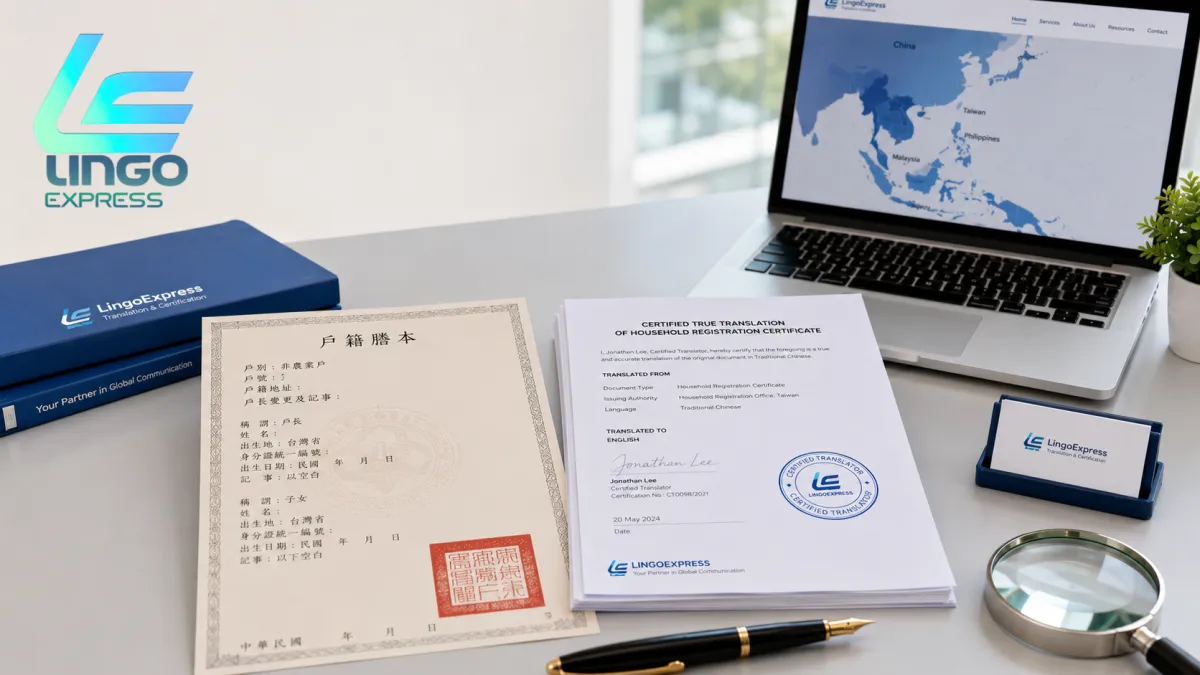
Some applications reach further into your home-country paperwork. A Chinese household register — the "Resident Household Register", or hukou — sometimes appears to establish family composition, and it is one of the densest documents you can submit. The cover states the household type (Agricultural or Non-Agriculture), the householder's name and the household number; each member then has a "Permanent Resident Registration Card" recording their relationship to the householder, ethnicity, place of origin, ID number, education and marital status, with Public Security Bureau seals stamped throughout. Every page and every seal has to be rendered, not just the opening sheet.
A police clearance or certificate of no criminal record can also be requested. These are typically issued only in Chinese and must be translated in full, including any official disclaimers printed on them. The principle is constant across the whole file: if it is on the original, it belongs in the translation.
🛂 Simplified, Traditional, and where each comes from
"Chinese" is not a single source format. Documents from mainland China usually arrive in Simplified characters; those from Taiwan, Hong Kong and Macau in Traditional, often with different field layouts and authority names. A translator who recognises which jurisdiction issued the document reads the seals and institutional wording correctly the first time, rather than guessing at an unfamiliar layout. LingoExpress works across both scripts and the wider region, so whichever Greater China authority issued your certificate, the source format is familiar.
✅ What you receive and how to confirm the tier
A certified translation from LingoExpress arrives on company letterhead with a signed certification statement from a qualified translator, declaring the rendering true and accurate against the original — the format MOM, ICA and other Singapore authorities expect. For most work-pass supporting documents, that certified tier is the complete answer. Where an application reaches into PR or citizenship territory later, notarisation by a Singapore Notary Public is sometimes layered on top — commonly required for those routes, though you should confirm what your own case calls for rather than assume. Send the documents with the name of the pass you are filing, and the right scope can be confirmed before any page is signed.
📣 Contact LingoExpress for a free quote!
📧 Email: [email protected]
🌐 Website: https://lingoexpress.com.sg