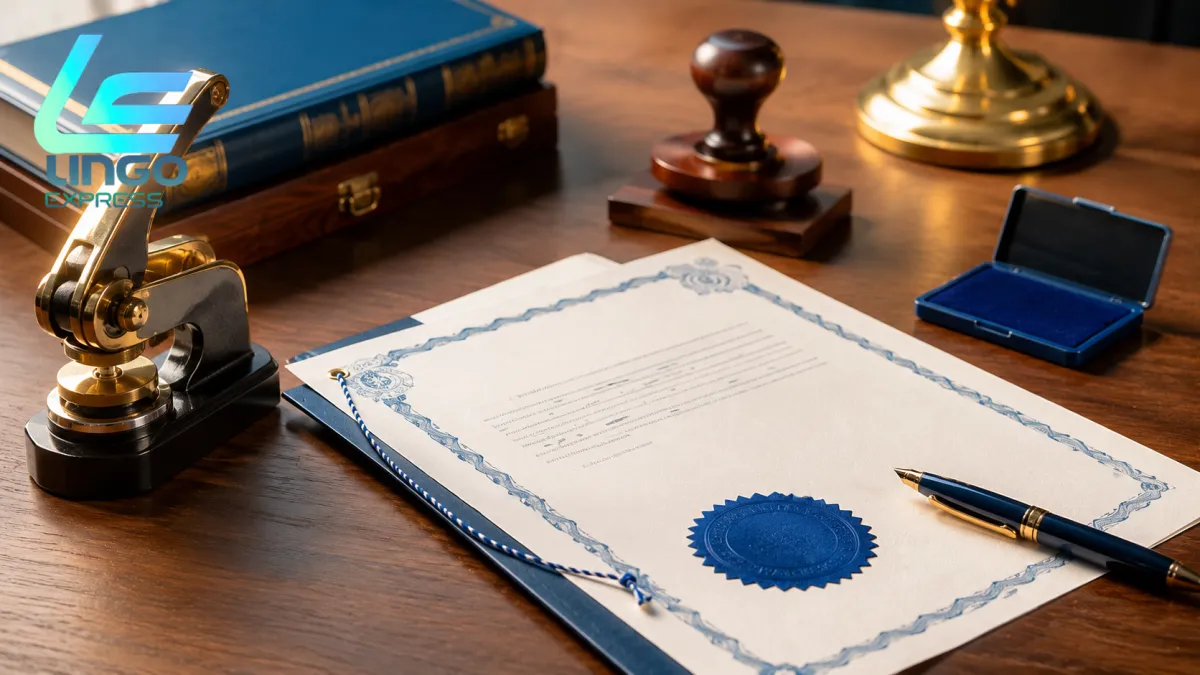
Checklist for Marriage Certificate Translation: Everything You Need
A marriage certificate is one of those documents that looks deceptively simple — a single page, a few names, a date — yet it underpins a surprising range of applications: a Dependant's Pass, a spousal PR sponsorship, a name change, an inheritance matter, registering a subsequent marriage. Because so much rests on it, the receiving officer reads it line by line, and a translation that drops a seal or spells a name differently from the passport gets the whole file queried. This checklist walks through everything a thorough marriage-certificate translation needs, so nothing is left for an officer to question.
💍 The core fields every translation must carry
These are the load-bearing details — the facts an officer cross-checks against the rest of your file. Each one has to appear in the English version, worded faithfully rather than loosely summarised.
- Both spouses' full names: rendered exactly as they appear in each passport — same spelling, same order of given and family names. This is the field most prone to a mismatch, especially where names are transliterated from Chinese, Arabic or another script.
- Date and place of marriage: the event date and the city, district or registry where it was solemnised, in an unambiguous format an officer can read at a glance.
- Certificate or registration number: the unique reference the issuing authority assigned, which ties the document back to the official record.
- Issuing authority and officiant: the registry, religious body or court that issued the certificate, and the registrar or officiant named on it.
- Dates of birth or ID numbers, where shown: many certificates list each spouse's date of birth or national ID; these must reconcile with the passports and any other documents in the bundle.
🔖 Stamps, seals and the parts people forget
The body text is only half the document. The marks around it carry legal weight too, and they are exactly what a rushed translation tends to skip.
- The official seal or embossed stamp of the registry or religious authority — rendered in place as a bracketed note, e.g. [Official seal: Marriage Registry], never left as a blank.
- The registrar's or witnesses' signatures, noted where they sit on the page rather than silently omitted.
- Any back-page endorsements, revenue stamps or handwritten annotations — corrections, later notes, or stamps added by an authority — all of which form part of the record.
If a mark is illegible in your scan, the translation should say so explicitly rather than ignore it — an officer reading a clean source beside a translation that quietly omits a stamp treats the document as incomplete.
📐 Formatting and certification to include
Beyond the content, the shape and backing of the translation matter. The English version should mirror the original's layout so an officer can lay the two side by side and follow them field for field — the marriage date sitting where it sits on the source, the seal in its real position. And the translation must arrive with a signed certification statement from a qualified translator, on company letterhead, declaring it a true and accurate rendering. Where your application calls for it, a Singapore Notary Public attests to that certification on top. LingoExpress formats each marriage certificate to track the source and certifies it in the form Singapore authorities expect.
🚫 What you do NOT need to translate
Not everything needs a translator, and translating a document an authority already accepts is wasted effort and money. Two clear exceptions are worth knowing before you start.
- Certificates already issued in English: if your marriage certificate was originally in English, submit it as-is — no translation needed.
- Singapore-issued certificates: a marriage registered in Singapore comes in English already, and Singapore-government documents in Chinese, Malay or Tamil are generally accepted without translation.
One distinction that catches people out: notarisation and apostille are not the same step. For a certificate you submit to an authority inside Singapore — say the Registry of Marriages (ROM) or ICA — a certified, and where required notarised, translation is usually the ceiling. An apostille generally applies only when a Singapore document is heading overseas. If your matter has a foreign leg, confirm the apostille genuinely belongs in the chain before paying for it.
✅ Your pre-submission tick-list
Run this final pass before anything is submitted. Each line is a check the LingoExpress team applies before releasing a marriage-certificate translation — clear them all and your document is submission-ready.
- ✅ Both spouses' names match their passports exactly, with consistent spelling and order throughout.
- ✅ The marriage date, place and certificate number are all present and unambiguous.
- ✅ Every stamp, seal and signature is rendered in its position — illegible ones explicitly noted, none dropped.
- ✅ Any ID numbers or dates of birth reconcile with the passports and the rest of the document set.
- ✅ The layout mirrors the original so the two can be read side by side.
- ✅ The translation is certified with a signed accuracy statement — and notarised where your application calls for it.
- ✅ Your scan is high-resolution (300 DPI or higher), full-page and sharp, including any back-page endorsements.
Because every couple's paperwork is a little different — a religious certificate here, a court-issued one there, sometimes a prior marriage to account for — the safest move is to have your specific document reviewed before you commit. LingoExpress gives you a transparent quote once it has seen the certificate and the application it is for, so nothing essential is missed and nothing unnecessary is translated.
📣 Contact LingoExpress for a free quote!
📧 Email: [email protected]
🌐 Website: https://lingoexpress.com.sg