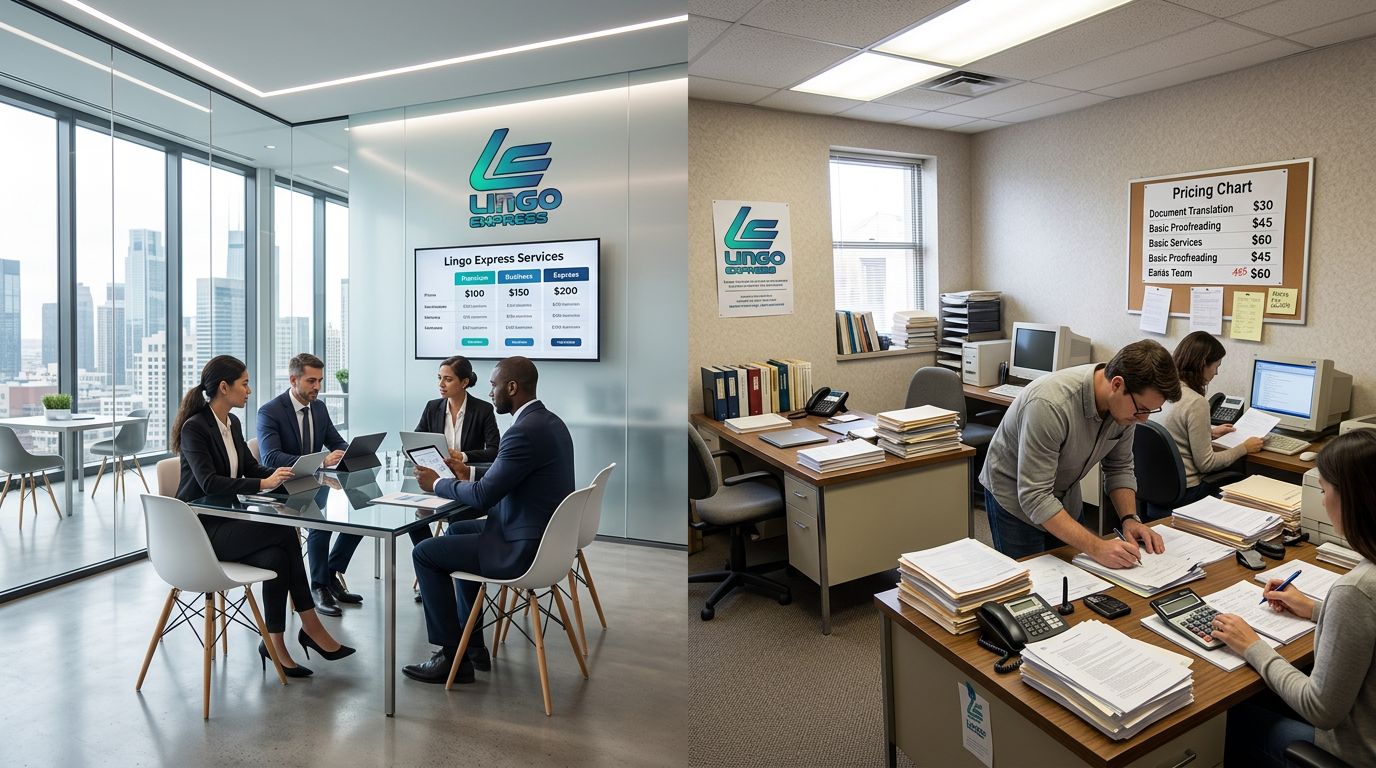
Cheap Translation vs Professional Translation: Is It Worth the Risk?
It is a fair question to ask. When two providers will translate the same certificate, why not take the cheaper one? For a casual, for-information translation, that instinct is reasonable. But for a document heading to an immigration officer, a registrar or an admissions board, "cheap" and "professional" are not two prices for the same thing — they are often two different things wearing the same name. The gap rarely shows up on the day you pay. It shows up weeks later, when a file comes back. This guide unpacks what actually drives the cost of a certified translation, and where cutting it quietly cuts the parts that keep your submission clean.
🔍 Why "cheap" usually means "less was done"
A certified translation is priced around effort, and the steps that protect you are the same ones a bargain operation tends to trim. Matching every name to your passport takes care. Rendering each stamp and seal in its correct position takes time. Mirroring a table so an officer can read translation against original takes skill. Putting a named, qualified translator and a signed certification behind the work carries real accountability. Strip those out and the price drops — but so does the chance the document survives review. The lowest quote is often not a better deal on the same job; it is a smaller job priced to look like the same one.
📄 What genuinely shapes the cost
Understanding the real drivers lets you read any quote with confidence and tell a fair price from a false economy.
Document type and density. A short, single-field certificate is straightforward; a page thick with tables, codes and specialised terminology is not. A document ruled into a dense grid takes careful work to render so every cell lines up with the source.
Length and the seals to render. It is not just page count but how much sits on each page. Every seal and signature has to be described in the translation — an untranslated stamp reads as an incomplete document — so the number of seals genuinely adds to the work.
Certification tier. A certified translation comes with a signed accuracy statement. A notarised one is that work witnessed by a Singapore Notary Public — commonly required for PR applications, though you should confirm what your case needs. For documents bound for use overseas, authentication by the Singapore Academy of Law or an apostille is a separate step again. Each layer is more handling.
Language pair. Common pairs such as Chinese, Malay or Tamil into English draw on a deep pool of qualified linguists. Rarer combinations — Burmese, Khmer, Japanese, Korean or various European tongues — rely on a smaller pool of specialists, which naturally affects the cost. The breadth a provider handles matters here, and LingoExpress covers a wide range.
Turnaround. A standard timeline in business days lets the team translate, check and certify properly. Compressing that into a rush means rearranging schedules, and that priority handling carries a premium. If your deadline has give, a normal turnaround is the gentler option.
- A Chinese "Resident Household Register" (hukou) runs several pages and carries multiple Public Security Bureau seals. A bargain job translates the cover and stops; a professional one renders every page and every seal — the difference an officer spots instantly.
- A Chinese driving licence looks trivial but includes a class-code table that must be reproduced accurately. Skipping the table to save time leaves the document looking unfinished.
- An SPM certificate carries a subject-and-grade grid that has to line up with the original. Flatten it into a list and an assessor can no longer map result to source.
📋 How to compare quotes honestly
The fastest way to a number you can trust — and a fair comparison between providers — is to give each one the same information and ask for it broken out.
- Send clear, complete scans. Legible images or PDFs of every page, including the reverse where stamps and signatures appear, let a provider see exactly what they are pricing — and stop a low quote that simply ignored the back page.
- Name the purpose and receiving authority. Tell them whether it is for the Immigration & Checkpoints Authority (ICA), MOM, a university, a bank or use overseas. The recipient determines whether certification alone is enough or a further tier is in play.
- Ask for an itemised breakdown. A trustworthy quote shows the base translation, any notarisation and any further authentication as separate lines. A single opaque figure — high or low — tells you nothing about what is actually included.
With those in hand, LingoExpress returns a transparent, itemised quote once it has seen the document and the purpose — so you can compare like with like and know exactly what each step covers before any work begins.
🌏 Saving sensibly, without taking the risk
Keeping costs reasonable is not about hunting for the lowest sticker — it is about not paying for things your situation does not call for, while never trimming the parts that protect the submission.
- Match the tier to the need. Confirm with the receiving authority whether certification suffices before adding a notary step. Notarisation is commonly required for PR — but for many submissions, certification alone is accepted. Pay for the level your case needs, not the highest available.
- Bundle related documents. Submitting a family's certificates and transcripts together is usually more efficient to handle than sending them one at a time.
- Plan ahead to avoid the rush. If your timeline has any give, a standard turnaround sidesteps priority handling — often the simplest saving available.
So, is cheap translation worth the risk? For a document that simply needs to be understood, perhaps. For one going to a Singapore authority, the right question is not "what is the lowest price" but "what does this job actually require, and who will stand behind it." Send your documents with the application you are filing, ask for an itemised quote, and choose the provider whose price reflects the work that keeps your file clean the first time.
📣 Contact LingoExpress for a free quote!
📧 Email: [email protected]
🌐 Website: https://lingoexpress.com.sg