Certified Translation vs Regular Translation: What Clients Should Know Before Ordering
Before you place a translation order, there is one fork in the road that decides almost everything else: do you need a certified translation, or will a regular one do? Order the wrong one and you either overpay for formality you will never use, or — far worse — you submit a document an authority hands straight back. The two products look similar on the surface and differ entirely in what they are for. This guide draws the line clearly, shows who stands behind each, and helps you pick correctly before any work begins.
📝 What a regular translation is
A regular translation — sometimes called a standard or informational translation — exists to carry meaning from one language into another. You use it when the goal is comprehension: understanding a letter you received, getting the sense of an article, sharing a draft internally, or following the content of a document that no official body will scrutinise. The work can still be skilled and accurate, but it comes with no formal declaration attached, no signatory standing behind it, and no letterhead. Nothing about it asserts to a third party, "this is a true and complete rendering you may rely on." That is by design — a regular translation is not trying to be evidence.
🖋️ What a certified translation is
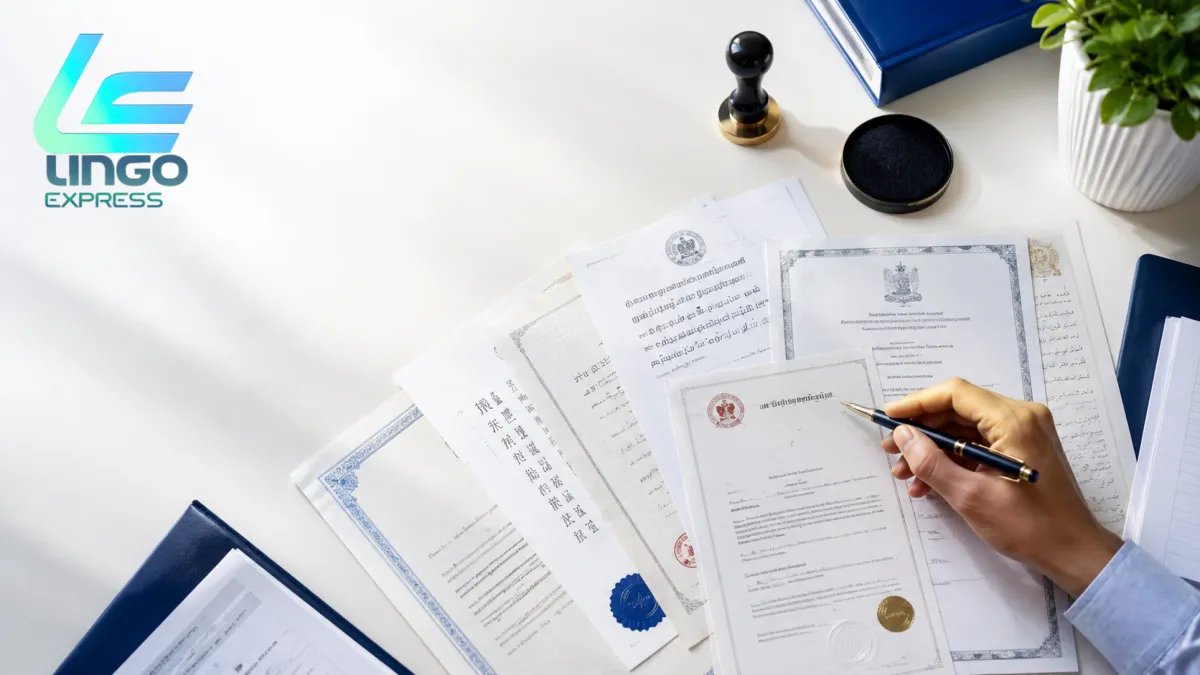
A certified translation is built to be trusted by someone who was not in the room. It is a complete, faithful rendering of the original — every field, every stamp, every number — accompanied by a signed statement of accuracy on the provider's letterhead. At LingoExpress (registered UEN 53491103W) that statement reads in substance: "We, LingoExpress, a professional translation service provider, hereby certify that the attached document(s) have been translated by our team of qualified and professional translators…" — followed by the named translator and the date. The difference from a regular translation is not mainly the words on the page; it is the accountability wrapped around them. A real entity and a named person are formally vouching for the rendering, which is exactly what a receiving officer needs to see.
📊 Side by side: how they differ
The clearest way to choose is to set the two against the questions that actually decide your order — what each is for, what comes with it, and where it is accepted.
| Regular Translation | Certified Translation | |
|---|---|---|
| Main purpose | Understanding and internal or reference use. | Official proof a third party can rely on. |
| What comes with it | The translated text only — no formal sign-off. | A signed accuracy statement on company letterhead, named translator, date. |
| Completeness | May summarise or skip stamps and boilerplate. | Every field, stamp, seal and number rendered or noted. |
| Layout | Often reflowed for easy reading. | Mirrors the original so the two compare side by side. |
| Typically used for | Emails, articles, drafts, internal documents. | ICA, MOM, MOE, ROM, courts, banks, universities. |
🧭 Which one you actually need
The deciding question is simple: who is going to read this, and do they need to trust it? If the answer is "just me, my team, or a reader who only needs the gist," a regular translation is the sensible, efficient choice. If the answer is "a government body, a court, a school, a bank, or any institution that will treat the document as evidence," you need certified — and often nothing less will be accepted. Submissions to the Immigration & Checkpoints Authority (ICA), the Ministry of Manpower (MOM), the Registry of Marriages (ROM), and the like sit firmly in the certified column.
One layer sits beyond certified, worth knowing so you are not blindsided. For some higher-stakes matters — Permanent Residence and citizenship being the common ones — a notarised translation is requested, where a Singapore Notary Public attests to the certification. This is commonly required rather than universal, so confirm it against your own application before assuming you need it.
If you are unsure which side of the line your document falls on, you do not have to guess. Tell LingoExpress what the translation is for and who will receive it, and the team will point you to the right tier — regular where that genuinely suffices, certified where it is needed — and give you a transparent, itemised quote built around the actual work rather than an upsell.
📣 Contact LingoExpress for a free quote!
📧 Email: [email protected]
🌐 Website: https://lingoexpress.com.sg