Certified Translation vs Notarized Translation: What's the Difference?
The two terms get used interchangeably in conversation, and that loose habit causes real cost. Treat them as the same thing and you might pay for a notary you never needed — or, worse, hand in a certified-only translation to an office that wanted the notarized version, and lose weeks resubmitting. The distinction is not cosmetic; it changes who stands behind the document and which authorities will accept it. Let us separate the two cleanly, look at who signs each, and lay out how to tell which one your situation actually calls for.
📝 What "certified" actually means
A certified translation rests on a single, accountable act: a qualified translator signs a formal statement of accuracy declaring the English text a faithful, complete rendering of the source. With LingoExpress, that statement goes out on company letterhead under registered UEN 53491103W and reads, in essence: "We, LingoExpress, a professional translation service provider, hereby certify that the attached document(s) have been translated by our team of qualified and professional translators…" — followed by the translator's name and the date. The value sits in that accountability: a named signatory and a real registered company the receiving officer can identify and trace.
🖋️ What "notarized" adds on top
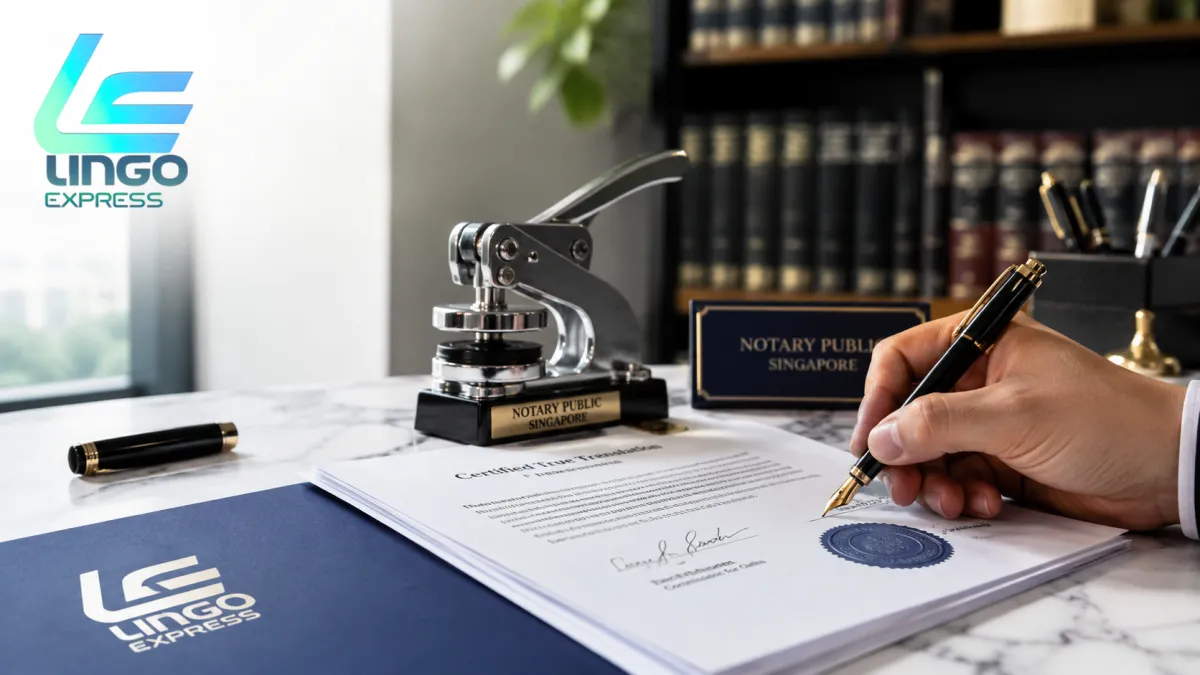
A notarized translation is a certified translation with one more layer bolted on: a Singapore Notary Public formally attests to the certification — confirming the translator's identity and witnessing the signed declaration — and then applies the notarial seal. Hold on to exactly what the notary is attesting to, because this is where most of the confusion sits: the notary confirms that the certification was properly made and signed, not that they personally re-read and re-checked every translated line. The translation still has to be accurate on its own merits; notarization simply layers an official witness over the certifying step. LingoExpress arranges this with a Notary Public inside the same job, and it is the level most often requested for PR and citizenship — though your own scheme is what settles it.
📊 The two side by side
Set against the questions that actually decide a case — what it is, who stands behind it, when it is needed, and who accepts it — the gap between the two becomes easy to read. Hold your own checklist next to this and your level usually reveals itself.
| Certified Translation | Notarized Translation | |
|---|---|---|
| What it is | A signed accuracy statement from a qualified translator, on company letterhead. | That same certified translation, additionally attested and sealed by a Notary Public. |
| Who stands behind it | The qualified translator or translation agency. | A Singapore Notary Public, layered over the agency's certification. |
| What the signer vouches for | That the translation is complete and accurate. | That the certification was properly made and signed — not a re-check of every word. |
| When you need it | Most everyday uses — work passes, enrolment, banking, many ICA submissions. | When an office asks for a notary's attestation — commonly PR and citizenship. |
🧭 How to tell which one you need
Three quick questions usually settle it. Who receives the document, and what does their checklist literally say — "notarized", or just "translated"? Take the wording at face value. Which route are you on — a routine pass tends to sit at certified, while permanent residence and citizenship lean toward notarized. Is another country involved — because a document heading overseas can need a further step beyond notarization, such as authentication by the Singapore Academy of Law (SAL) or an apostille, which is rarely part of a purely local submission. Answer those and the level generally falls out by itself.
The thread running through all of it is simple: the right level beats the highest level every time. Rather than guessing, send your document to LingoExpress with the name of the application you are filing, and have the correct scope confirmed before a single page is signed or sealed — so each step is one you actually need.
📣 Contact LingoExpress for a free quote!
📧 Email: [email protected]
🌐 Website: https://lingoexpress.com.sg