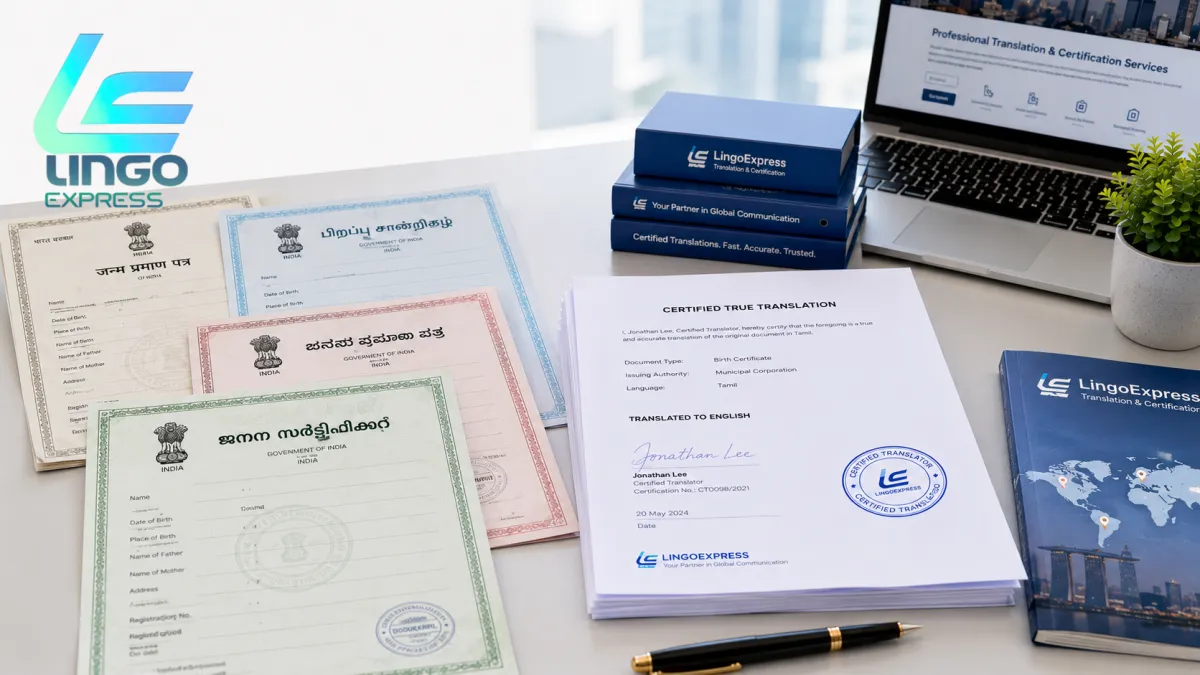
Certified or Notarized Translation for Indian Documents: How to Decide
India issues documents in a remarkable spread of languages, and a single family's paperwork can arrive in two or three scripts. Once you are standing in front of a Singapore checklist with those certificates in hand, the same fork appears: do they need to be certified, or notarized? The labels feel interchangeable until you realise they describe different things and carry different costs. This guide separates the two, shows who puts their name to each, and gives you a plain way to land on the right answer for Indian records specifically.
📝 What a certified translation actually is
A certified translation is one where a qualified translator puts a formal statement of accuracy behind the work, confirming the English version is a complete and faithful rendering of the source. At LingoExpress, that statement goes out on company letterhead under registered UEN 53491103W, naming the translator and carrying the date. The value is in the accountability: an officer reading an Indian marriage certificate or a Tamil-medium transcript can see precisely who stands behind the translation and that a real, registered entity issued it. For a large share of everyday uses, this tier is the whole answer.
🖋️ What notarization adds on top
A notarized translation is a certified translation plus one further layer: a Singapore Notary Public formally attests to the certification — verifying the translator's identity and witnessing the signed declaration — before applying the notarial seal. The point worth holding onto is what the notary is vouching for: that the certification was properly made, not a fresh word-by-word recheck of the translation. The English rendering still has to be accurate on its own merits; notarization simply layers an official witness over it. LingoExpress coordinates this with a Notary Public inside the same job, and it is the tier most often requested for PR and citizenship — though your specific application is the only reliable source of truth on whether it applies.
📊 Side by side, with Indian documents in mind
Read the two tiers against the questions that actually settle your case — what each is, who verifies it, and when an Indian document typically calls for it — and your answer usually surfaces quickly.
| Certified Translation | Notarized Translation | |
|---|---|---|
| What it is | A signed statement of accuracy from a qualified translator, on company letterhead. | That same certified translation, additionally attested and sealed by a Notary Public. |
| Who stands behind it | The qualified translator or translation agency. | A Singapore Notary Public, on top of the agency's certification. |
| When Indian docs need it | Work passes, school and university enrolment, banking, many routine ICA uses. | PR and citizenship civil records — commonly, though confirm your case. |
| Typical extra step | None — the certification is the deliverable. | Notary scheduling, so allow a little more lead time. |
Sitting above both tiers is legalisation, issued as an apostille through the Singapore Academy of Law (SAL), which confirms that the notary who signed is genuine. For Indian documents this almost always matters only when a Singapore-issued document is heading back overseas — to an Indian authority or a third country — rather than for a local submission to the Immigration & Checkpoints Authority (ICA). If your matter has an India-facing leg, that is the moment to check whether an apostille genuinely belongs in the chain.
🧭 How to decide for your Indian documents
Three questions usually settle it. Who receives the document — a Singapore authority, or a body back in India or overseas? Overseas points toward an apostille; local rarely does. What does the checklist literally say — "notarized", or just "translated into English"? Take the wording at face value. Which route are you on — a routine pass and most enrolment cases lean certified, while PR and citizenship lean notarized. There is also an India-specific check worth doing first: confirm the document genuinely needs translating, since many Indian certificates are already in English.
The principle underneath is simple: the right tier, not the highest, is what keeps an application moving. Rather than guessing, send your Indian documents with the name of the application you are filing and have the correct scope confirmed before anything is signed or sealed. With years of certified and notarized work for applicants from across India and South Asia, the LingoExpress team can usually point you to the right tier on first read — and flag the documents you do not need to translate at all.
📣 Contact LingoExpress for a free quote!
📧 Email: [email protected]
🌐 Website: https://lingoexpress.com.sg