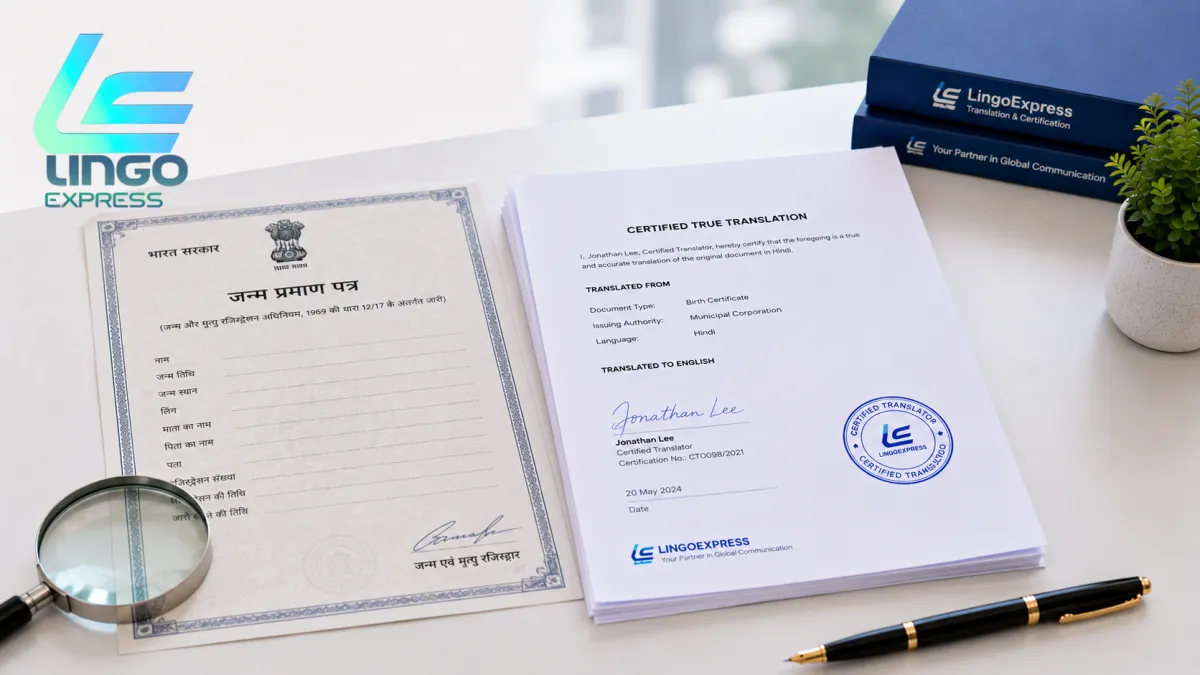
Certified Indian document translation
India produces some of the most varied official documents you will ever hand to a Singapore officer. A single birth or marriage record can carry a state language on the left, an English column on the right, a registrar's seal at the bottom and a handwritten endorsement in the margin — sometimes all on a form that has been re-issued three times since the original event. When that document supports a work pass, a school place, a dependant application or a marriage registration here, the receiving body needs to read it in clean, certified English, with nothing dropped along the way.
The good news is that the source formats repeat. Once a translator has worked through enough Indian certificates, the layout of a particular state's record, the wording of its declarations and the position of its seals all become familiar — which is precisely why the format matters as much as the language. This guide walks through the Indian document types that come up most, the quirks that catch applicants out, and how a certified translation from LingoExpress is built to clear review on the first pass.
🗂️ The Indian documents that come up most
Indian records split into roughly three buckets: identity and civil documents, academic qualifications, and supporting records that prove a particular relationship or status. Each carries its own conventions, and each has a field an officer will look for before anything else.
- Birth and death certificates: Issued by a municipal corporation or a state registrar under the Registration of Births and Deaths Act. They name the registration district, the registration number and date, the parents, and a registrar's seal and signature — and the regional-language version often differs subtly in spelling from any English copy attached.
- Marriage certificates: Issued under either the Hindu Marriage Act or the Special Marriage Act, depending on the route. They state the place of solemnisation, both spouses and their fathers, the registrar, and the registration particulars — and surname transliteration here is the single most common source of a query.
- Academic records: Degree certificates, consolidated mark sheets and provisional certificates from a named university or examination board, often with grading scales, division classifications and a string of subject rows that must carry across exactly.
- Aadhaar, PAN and other ID documents: Frequently bilingual already, but still requiring a faithful rendering of the regional-language portions and every printed field.
🌐 Languages, scripts and the transliteration trap
India's document languages run far wider than Hindi. You may be holding Tamil, Telugu, Kannada, Malayalam, Marathi, Gujarati, Bengali, Punjabi, Odia or Urdu — each in its own script — and the same person's name can be spelled several legitimate ways once it crosses from one script into the Latin alphabet. That flexibility is exactly where applications stumble, because the officer reading your file is comparing the name on the certificate against the one printed in your passport.
A Tamil birth certificate might render a father's name in a way that could be romanised as "Krishnan", "Krishnaan" or "Kirushnan" depending on who types it. If your passport says "Krishnan" and the translation says "Kirushnan", an officer cannot be certain the two documents describe the same family without further proof. A translator working from your passport spelling locks the name to one form across every certificate in the set, so the file reconciles cleanly.
The same care applies to place names, caste or community fields where they appear, and the names of issuing authorities — all of which should be rendered consistently rather than guessed at line by line.
🏛️ Where these translations are used in Singapore
Indian applicants in Singapore typically need certified translations for a familiar set of touchpoints. The Immigration & Checkpoints Authority (ICA) asks for them when you file for a Dependant's Pass, Long-Term Visit Pass, Permanent Residence or citizenship. The Ministry of Manpower (MOM) may request supporting civil documents alongside an Employment Pass or S Pass. Schools and universities ask for translated transcripts and certificates at enrolment, and the Registry of Marriages (ROM) needs translated marriage or divorce records where a previous marriage is involved.
Each body publishes its own requirement, and the tier it expects can differ — which is why it pays to read the checklist on your specific application before you commit to anything beyond a certified translation.
🛠️ How the process works end to end
Getting an Indian document translated and accepted is mostly a matter of doing the preparation in the right order.
- Scan each document in full colour at high resolution so every seal, regional-language field and faint endorsement is legible.
- Note the passport spelling of every name that appears — yours, your spouse's, your parents' — so the translation can be anchored to it.
- Send the set to LingoExpress for a quote, naming the application you are filing, so the right scope and turnaround can be confirmed up front.
- Review the draft against your originals, checking names, dates and registration numbers before sign-off.
- Receive the certified translation on company letterhead, formatted to mirror the source, with notarisation arranged if your case calls for it.
⚠️ The pitfalls worth avoiding
Most rejections of Indian document translations trace back to a handful of recurring problems: a seal or registrar's endorsement left untranslated, a name that shifts spelling between certificates, or a mark sheet whose subject rows have been summarised rather than reproduced in full. Notarisation, where a Singapore Notary Public attests to the certification, is commonly requested for PR and citizenship matters — but treat that as something to confirm for your route rather than assume across the board.
✅ What you receive
A certified translation from LingoExpress arrives on company letterhead with a signed certification statement from a qualified translator, confirming the English version is a true and accurate rendering of the original Indian document — the format Singapore authorities expect to see. Where your application route calls for notarisation, that step is coordinated with a Singapore Notary Public in the same job, so you are not stitching the process together across two providers. Send the documents with the name of the application attached, and you will know the scope before any page is signed.
📣 Contact LingoExpress for a free quote!
📧 Email: [email protected]
🌐 Website: https://lingoexpress.com.sg