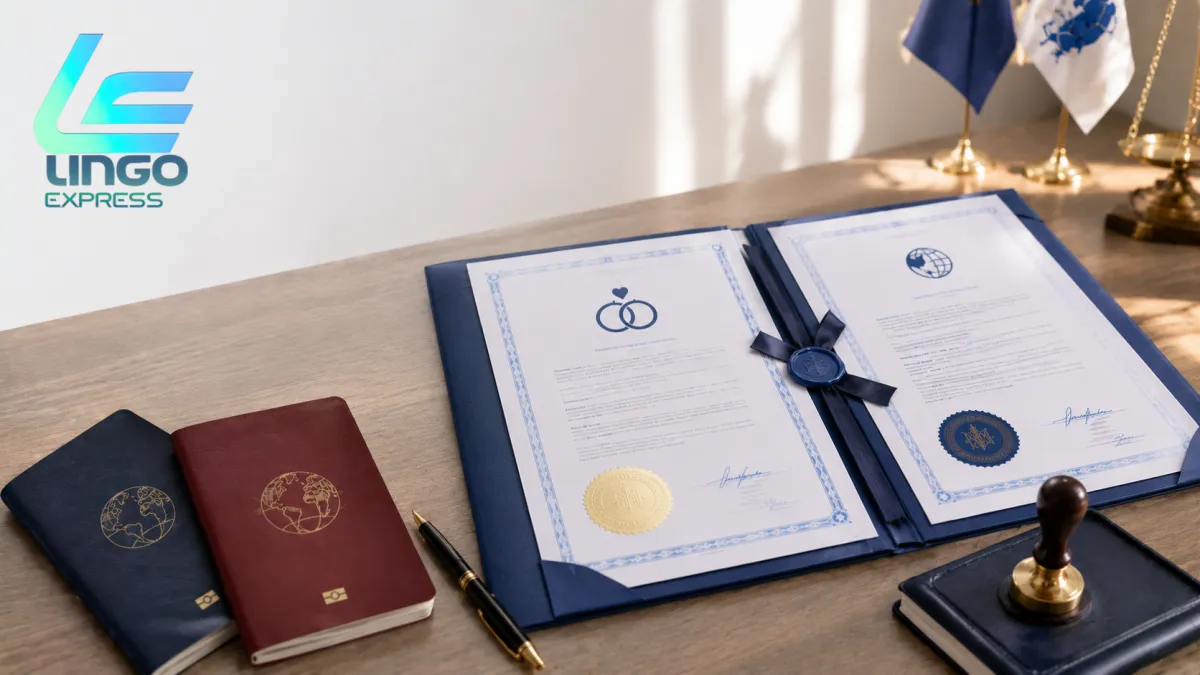
Case Study: Translating Marriage and Divorce Documents for Family Applications
The illustrative scenario below is a composite — drawn from the kinds of family files that come through routinely, not a specific client — chosen because it shows the moving parts clearly. Picture a household applying for dependant status in Singapore: one spouse holds a foreign-language marriage certificate, and one of them was previously married and divorced overseas. On paper it looks simple. In practice, three separate documents have to agree with each other and with two passports before an officer will accept the family link. That is the real work, and it is what a service built for these cases is designed to handle.
👪 Who this service is for
This is for families whose marital history crosses a language border. You might be applying for a Dependant's Pass or Long-Term Visit Pass, sponsoring a spouse, or building a Permanent Residence or citizenship file with the Immigration & Checkpoints Authority (ICA) — and somewhere in the stack sits a marriage certificate, a divorce decree, or both, issued in a language other than English. A foreign marriage may also need translating when registering with the Registry of Marriages (ROM). Whenever a prior marriage is part of the picture, the divorce record stops being optional: it is what proves the current marriage is valid.
📄 What the documents actually contain
These certificates pack a lot of legally significant detail into a small space, and every element has to survive into the English version. Knowing the source format is what keeps the translation complete.
- A marriage certificate (for example a Chinese one) carries both spouses' names and ID details, the date and place of registration, the marriage registration number, and official registration seals.
- A Malaysian divorce record, formally an "Update of Marriage Record" issued through the National Registration Department (JPN), shows the divorce petition number, the date of the court order, the issuing High Court, the husband's and wife's names and IC numbers, and the original marriage registration number.
Every seal, stamp and number on those documents has to be rendered or noted in brackets — an untranslated court seal or a missing petition number reads as an incomplete record. And the legal status terms matter: the translation must make clear that a divorce is finalised, with the effective date carried across exactly, because that date is what establishes when the person was free to remarry.
🔗 How the documents have to agree
The defining feature of a family case is consistency across documents. An officer reads the divorce record and the new marriage certificate together: the name on the divorce decree must match the name on the marriage certificate, which must match the passport. In the scenario above, the snag is almost always a name — a spouse who appears under a maiden name on the divorce record and a married name on the marriage certificate, or a surname romanised differently across two countries' paperwork. Left unexplained, that looks to an officer like two different people, and the file is queried.
🛠️ How the service works
- Send clear colour scans of every document — the marriage certificate and the divorce record — at 300 DPI or higher, full page, including all seals and reverse sides.
- Provide the passport spelling of every name involved, and flag any name that differs across the documents so it can be handled consistently from the start.
- State the application the set is for, so the scope and any notarisation needs are confirmed before work begins.
- Receive a quote and turnaround based on the actual documents — their length, complexity and number of seals.
- Review the drafts together, checking that names and dates reconcile across the whole set, then receive the certified translations formatted to mirror each original.
✅ What you receive
Each document comes back from LingoExpress as a certified translation on company letterhead, with a signed statement of accuracy from a qualified translator, formatted to mirror the original and with every seal and number accounted for. Because family submissions for PR and citizenship commonly call for notarisation by a Singapore Notary Public, that step can be arranged in the same job — though it is best described as commonly required rather than guaranteed, so confirm what your specific route needs. The result is a coherent set of documents that tell one consistent story, which is exactly what a family application has to do to satisfy the officer reviewing it.
📣 Contact LingoExpress for a free quote!
📧 Email: [email protected]
🌐 Website: https://lingoexpress.com.sg