Can AI Translate Chinese, Malay and Indonesian Certificates Accurately?
It is a fair question to ask in 2026. Machine translation has improved enormously, and for reading a foreign email or understanding a webpage it often does the job. So when you are holding a Chinese birth certificate or an Indonesian marriage record, it is natural to wonder whether you can simply run it through a tool and submit the result. The honest answer is that accuracy on official documents is not measured the way it is on everyday prose — and that is where the gap shows.
🤔 What does "accurate" even mean for a certificate?
For a casual translation, accuracy means the meaning came across. For an official certificate, accuracy is far stricter: every field must be rendered, every name must reconcile with your passport, every stamp must be accounted for, and the whole thing must be formatted so an officer can lay it beside the original and follow it line for line. A translation can read fluently and still fail this test if it paraphrases a legal field name or silently skips a seal. That is the standard a Singapore authority applies, and it is the standard AI was never designed to meet.
🈶 Where AI slips on Chinese documents
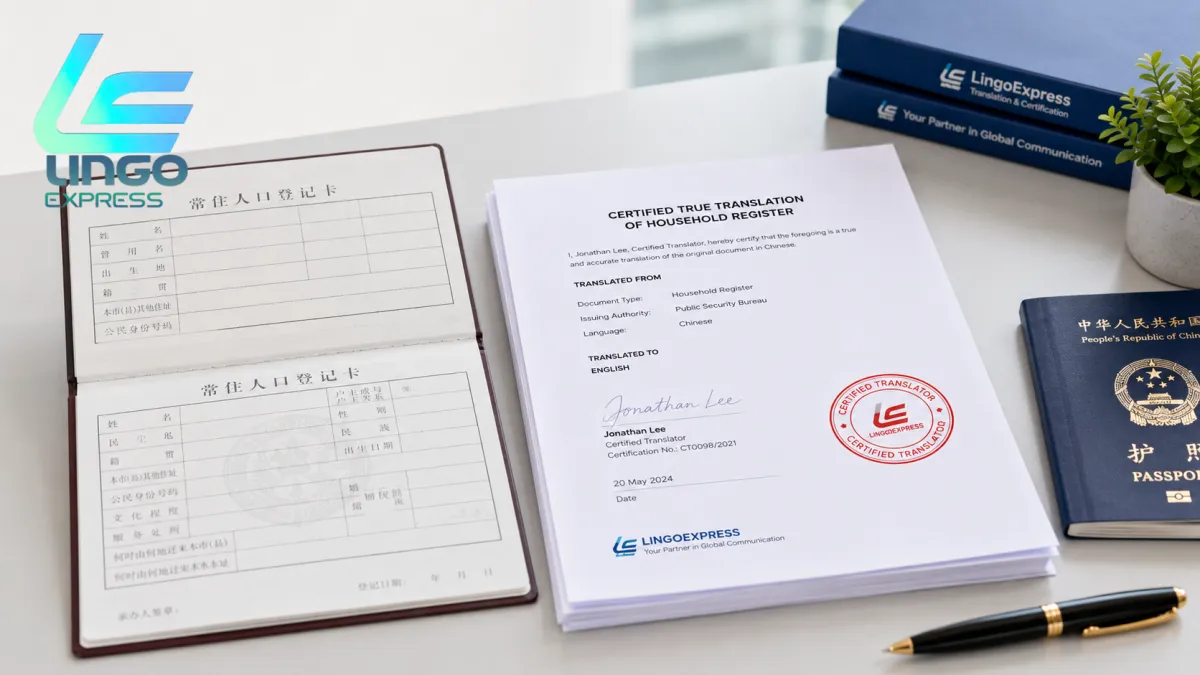
Chinese civil documents are dense and seal-heavy, and that is exactly where machine output tends to break. A Chinese name romanised one way by a tool may not match the spelling printed in the holder's passport, and an officer reads that as two different people. A red hospital stamp on a Medical Certificate of Birth, or the Public Security Bureau seals stamped through every page of a household register (hukou), are images rather than clean text — a machine routinely ignores them, yet an untranslated seal is treated as an incomplete document. Fixed terms such as household type, "place of origin" or a specific bureau name also have established renderings that a general model may approximate rather than get right.
🇲🇾 Where AI slips on Malay documents
Malay-language certificates carry their own traps. A Malaysian birth certificate, the Form A issued under the Births and Deaths Registration Act 1957, has specific fields — registration area, sub-district, the father's and mother's IC numbers, the registrar's particulars — that need their exact official equivalents, not a loose paraphrase. A Malaysian school-leaving certificate carries subject and grade tables set against a recognised standard, and a machine can quietly misalign a grade or a subject label in a way that changes how a qualification is read. Handwritten registrar annotations and stamps are, once again, where automated tools tend to give up entirely.
🇮🇩 Where AI slips on Indonesian documents
Indonesian records add a structural wrinkle: the same document type can take more than one form. A marriage may be recorded as a Buku Nikah booklet through the Office of Religious Affairs, or as a Kutipan Akta Perkawinan extract through the civil registry, and a tool that does not recognise which is which can mislabel the document or miss the registration details on its inner pages. Indonesian naming conventions — a single given name, or spellings that vary across documents — compound the name-matching problem, and the registering office's seal is, predictably, the part a machine leaves untranslated.
📝 The part AI cannot supply: certification
Even setting aside every accuracy concern, there is one thing a machine simply cannot produce — a signed certification statement from an accountable translator. A certified translation reads, in substance: "We, LingoExpress, a professional translation service provider, hereby certify that the attached document(s) have been translated by our team of qualified and professional translators…" — followed by a named translator and a date, on company letterhead. That accountability is the point. The Immigration & Checkpoints Authority (ICA) and other Singapore bodies want a real person and a real entity standing behind the rendering, which is something no automated output carries.
✅ So what should you do?
If your Chinese, Malay or Indonesian certificate is destined for a Singapore authority, treat the translation as part of the legal document, not as a convenience task. Send a clear, complete colour scan to LingoExpress with the passport spelling of the names involved, and you receive a certified translation that renders every field and seal, mirrors the original's layout, and carries the signed statement an officer expects. Where your application calls for it, notarisation can be arranged in the same job — though whether your case needs it is worth confirming first. That is the difference between a document that is read and acted on, and one that comes back with a query.
📣 Contact LingoExpress for a free quote!
📧 Email: [email protected]
🌐 Website: https://lingoexpress.com.sg