Can AI Translate Academic Records for Student Pass Applications?
Free translation tools are genuinely good now, and it is fair to ask whether they are good enough for the paperwork behind a Student Pass. After all, a transcript is just a table of subjects and grades — surely software can handle that? The honest answer is that the obstacle is not raw fluency. It is what an official translation has to be, and that turns out to be something quite different from a quick on-screen rendering.
🤔 Why isn't a good AI translation enough?
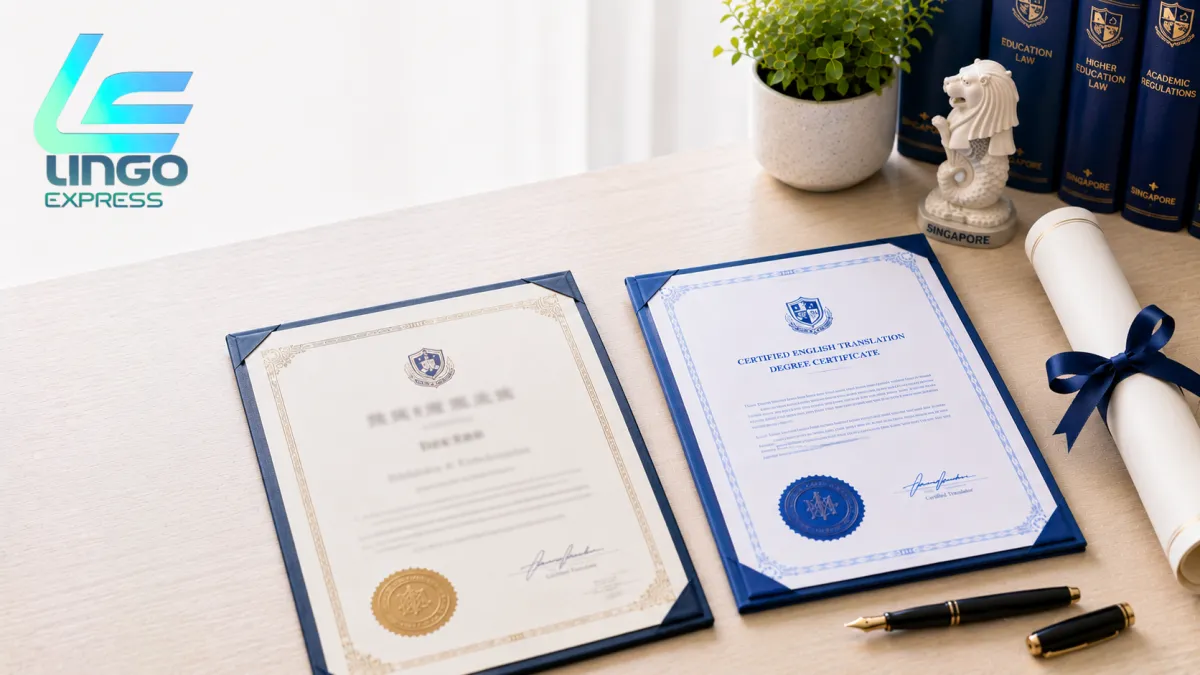
Because acceptance does not turn on fluency alone — it turns on accountability. A certified translation carries a named translator's signed declaration that the English version is a complete and faithful rendering of the original, issued on a real company's letterhead. That signature is the point: it gives the reviewing officer someone identifiable to hold responsible for accuracy. An AI output has no signatory, no letterhead, and no entity that can certify anything, so it falls outside the definition of what is being asked for, however clean the wording reads.
📊 Where does AI actually stumble on a transcript?
Academic records are deceptively hard. They are dense with institution-specific terms — degree titles, honours classifications, grading scales — that do not map cleanly between education systems. A machine tends to translate a grade label literally rather than render what it means against the home system, and it has no judgement about whether a course title corresponds to a recognised qualification. It also struggles with the things around the words: official seals, the registrar's signature block, watermarks, and the table structure that an assessor relies on to read the document at a glance.
There is a subtler problem too: confident errors. A machine rarely flags uncertainty — it produces fluent, authoritative-sounding English even when it has misread a faded stamp or guessed at an abbreviation it did not recognise. To an applicant who cannot read the source language, that output looks finished and trustworthy, so the mistake travels all the way to the submission desk undetected. A qualified translator, by contrast, knows when a mark is ambiguous and resolves it deliberately rather than papering over it. On a document where a single wrong grade or a misread institution name can change how an assessor reads your qualification, that difference in judgement is the whole game.
🧩 Can I use AI to draft, then have it checked?
You can use AI privately to understand a document — to see roughly what a transcript covers before you send it off. That is a reasonable use. What does not work is treating the machine output as a finished translation that a human merely glances at and rubber-stamps. A qualified translator certifying a document is attesting to a complete, accurate rendering they stand behind, which means working from the source itself, not signing off someone else's draft sight unseen. The certification has to mean something, and that only holds when the translator has genuinely done the work.
🎓 What does a Student Pass application actually need?
For study in Singapore, the institution and the relevant authorities expect any non-English academic record — transcripts, diplomas, school-leaving certificates — to come with a certified English translation. Where a record was issued in English, you submit it as-is. The translation should mirror the original's layout column for column, with every seal and signature accounted for, so the document reads as a faithful twin of the source rather than a loose summary. This is exactly the kind of education paperwork LingoExpress handles for incoming students.
✅ The practical takeaway
Lean on AI as a preview tool if it helps you understand your own documents — there is no harm in that. But the version that goes into a Student Pass application should be a certified translation from a qualified translator. A certified translation from LingoExpress comes on company letterhead with a signed certification statement, the translator named and the work dated, in the form Singapore institutions are used to receiving. Send your transcripts and certificates for a transparent quote, and you submit knowing the academic file will read the way an assessor needs it to.
📣 Contact LingoExpress for a free quote!
📧 Email: [email protected]
🌐 Website: https://lingoexpress.com.sg