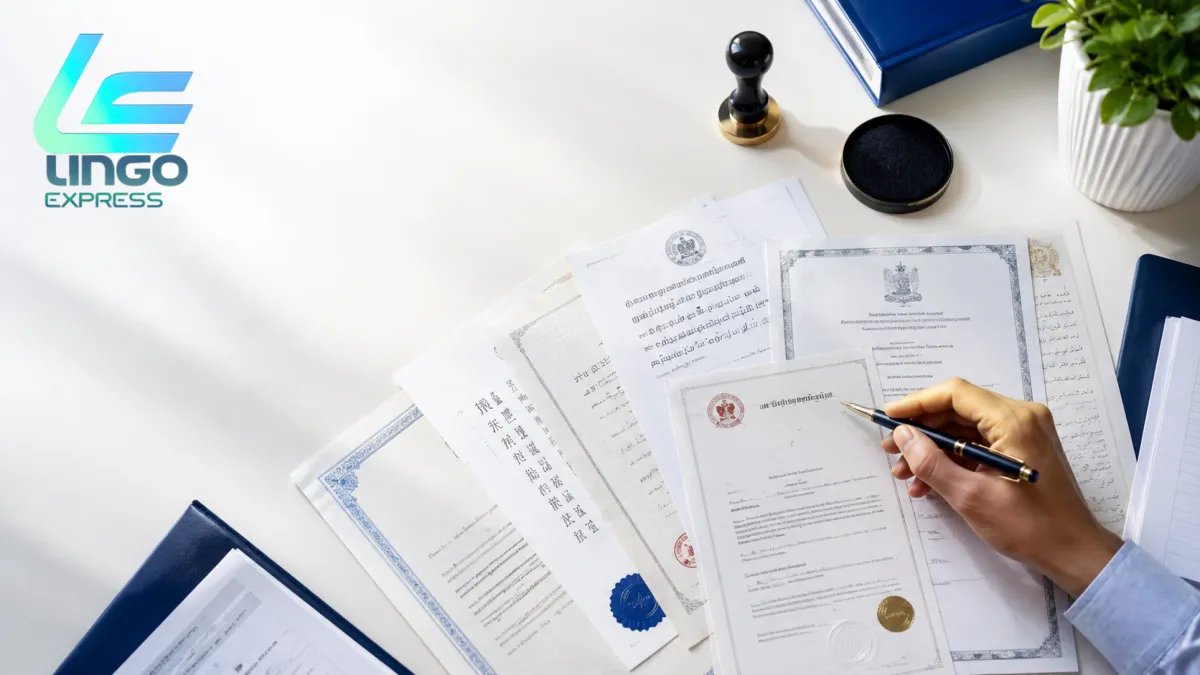
Can AI Replace Certified Translators in Singapore?
It is a fair question to ask in 2026. Machine translation has genuinely improved, and for understanding the gist of a foreign email or menu it is often good enough. So it is natural to wonder whether the same tools can handle a birth certificate or academic transcript bound for a Singapore agency, especially when speed and convenience are tempting. The answer turns less on raw linguistic quality and more on something AI structurally cannot supply — so it is worth unpacking the real questions underneath, rather than settling for a flat yes or no. The distinction that matters is not how human the output sounds, but whether the output can be made official.
🖊️ What does "certified" actually require?
A certified translation is defined by accountability, not by which software produced the words. It carries a signed statement of accuracy from a qualified translator, on company letterhead, naming the person who stands behind the rendering. The certification reads in substance: "We, LingoExpress, a professional translation service provider, hereby certify that the attached document(s) have been translated by our team of qualified and professional translators…" — followed by a named translator and a date. That is a declaration a real, identifiable party is willing to put its name and reputation to. An algorithm cannot make that declaration, because there is no one to hold responsible if the rendering is wrong.
🤖 So where does AI actually fall short?
Beyond the certification gap, official documents expose the exact weaknesses machine translation is worst at. They are dense with proper nouns, regional name conventions, official terminology and non-text elements — the parts a statistical model is least reliable on.
On a Chinese "Medical Certificate of Birth", an engine may transliterate a parent's name in a spelling that does not match their passport, or render the red hospital stamp and its certificate number as unreadable noise instead of a described seal. On a Malaysian SPM, it can mangle the grade legend so an 8E loses its meaning. On a household register (hukou), it routinely ignores the Public Security Bureau seals stamped across every page. Each of those silent gaps is precisely what an officer flags as an incomplete document.
📋 Will a Singapore authority accept an AI translation?
For an official submission, no. When the Immigration & Checkpoints Authority (ICA) asks for a certified translation, it is asking for that accountable signed statement — something a raw machine output simply does not carry. The same expectation runs through MOM work-pass files and university enrolment. An unsigned export from a translation app is not a certified document, however fluent it reads, so it does not meet the requirement on its face.
🧩 Is there any role for AI in the process?
Yes — just not the role of final signatory. Machine tools can help someone privately understand a document before they send it, give a translator a rough first pass to refine, or speed up the handling of long, repetitive passages. The decisive distinction is between comprehension and certification: AI can help you read, but it cannot vouch. A qualified human still reconciles every name against the passport, carries across every seal, mirrors the original's layout, weighs how an official term should land in English, and then signs. The technology assists the human; it does not replace the accountable person at the end of the chain. Think of it the way a calculator sits beside an accountant — useful for the arithmetic, but it is still the accountant who signs off the books and answers for them.
⚠️ The risk of getting this wrong
Treating an AI export as a finished certified translation usually costs more than doing it properly the first time. A subtle name mismatch or a dropped seal does not announce itself; it surfaces weeks later as a query, a held file, or a request to resubmit — sometimes after a deadline has already passed.
The short version: AI is a useful assistant and a poor signatory. For a document a Singapore agency must accept, the value sits in the qualified translator who reconciles the details and certifies the result. LingoExpress keeps a human at that final step for exactly that reason — send your document with the application you are filing, and you get a certified rendering an authority can rely on.
📣 Contact LingoExpress for a free quote!
📧 Email: [email protected]
🌐 Website: https://lingoexpress.com.sg