Bengali to English Document Translation for Singapore Use
Bengali is one of the most widely spoken languages in the world, and a large share of the documents that cross our desks for Singapore use are written in it — Bangladeshi birth records, national identity cards, school and university certificates, marriage records, and police clearances, alongside Bengali-language papers from eastern India. When you bring any of these to a Singapore office, the first thing you will be told is that an English version is required. Not just any English version: a translation that is certified, complete, and consistent with the rest of your file.
This guide walks through the Bengali documents you are most likely to need translated, the details an officer actually checks, and how the process works in practice — grounded in the kinds of certificates LingoExpress translates for Singapore submissions week in and week out.
🌏 Bengali documents come from more than one country
The first thing to settle is where your document was issued, because the format changes with it. A Bengali document from Bangladesh follows Bangladeshi government layouts and is usually issued bilingually or fully in Bengali, while a Bengali-language certificate from West Bengal or Tripura follows Indian state formats. The translator needs to recognise both — the registry names, the seal wording and the numbering systems are not the same — so the English rendering reflects the true source rather than a generic template. Getting this right from the outset is what keeps your translation aligned with the issuing authority an officer may later verify.
📄 The Bengali documents most often translated for Singapore
Foreign records carry far more than a name and a date, and every element has to appear in the English version. These are the Bengali documents that come up most, and what each one contains:
- A Bangladeshi birth registration certificate carries a 17-digit registration number, the child's name, date and place of birth, both parents' names and nationalities, the issuing union or city registry, and the registrar's signature and official seal.
- A National Identity Card (NID) shows the holder's name in Bengali and English, father's and mother's names, date of birth, the NID number, and a government hologram or seal that has to be described, not ignored.
- An academic certificate or marksheet from a board or university lists the candidate's name, roll and registration numbers, the institution, and a subject-by-subject grade table — each row of which must be carried across faithfully.
- A marriage record (Nikah Nama / kabin nama) records both spouses' names and fathers' names, the registration number, the date, and the registrar's stamp and signature.
Notice the pattern: each document is anchored by an official seal, a registry number and a set of names. Every one of those — including the stamp itself — must be rendered or clearly described in the translation. An untranslated seal reads to an officer as an incomplete document, no matter how accurate the rest of the page is.
🏢 Where you will be asked for them in Singapore
Different documents surface at different counters. A birth registration certificate is commonly requested by the Immigration & Checkpoints Authority (ICA) for family-related passes, Permanent Residence and citizenship, where it establishes the parent–child link an application rests on. Academic certificates and transcripts are needed for education applications and for professional or work-pass purposes, while employment-related paperwork often goes to the Ministry of Manpower (MOM). Marriage records appear in spouse-related applications. In each case the office is matching your translated document against your passport and your other submissions, so internal consistency matters as much as accuracy.
📋 How the translation process works
The path from a Bengali original to a submission-ready English translation is straightforward once you know the steps:
- Scan the original in colour at 300+ DPI, full page, so every seal, hologram and number is legible. A sharp scan prevents avoidable queries about an illegible stamp.
- Confirm what the receiving office needs for your case — a certified translation at minimum, and for some PR or citizenship submissions a notarised one as well.
- Send it to LingoExpress with the passport spelling of every name — yours and any family members named on the document — so the English version matches your travel document character for character.
- Review the draft against your original, checking that the seals, registry numbers and the grade table (if any) are all present and correctly carried over.
- Receive the certified translation, formatted to mirror the layout of the source, with notarisation arranged in the same job where your application calls for it.
- Submit the translation together with the original to the relevant Singapore authority.
🤝 Why the right translator matters for Bengali
Bengali is not a script you can run through a generic tool and trust for an official submission. Calligraphic seals, handwritten registrar entries, and the difference between Bangladeshi and Indian registry formats all need a translator who reads the source properly and knows what a Singapore officer is checking for. That is the difference between a translation that mirrors the original — same structure, every field accounted for — and one that quietly drops a stamp and stalls your application.
✅ What you receive
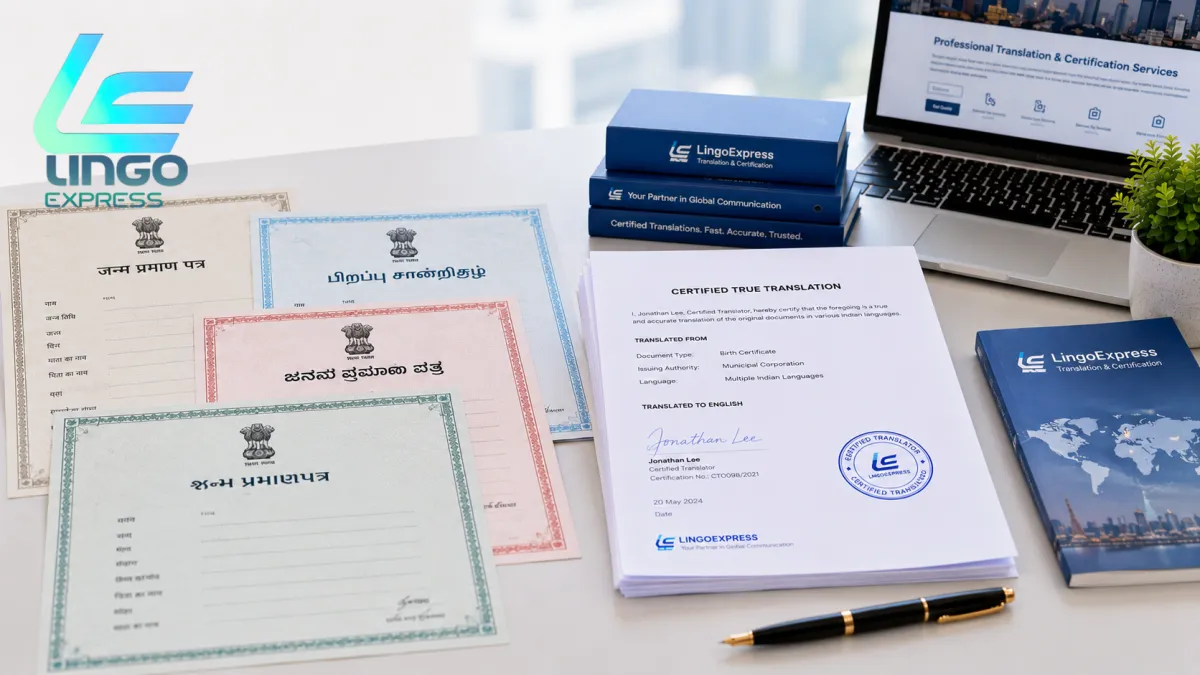
A certified translation from LingoExpress comes on company letterhead with a signed certification statement from a qualified translator, declaring the translation to be a true and accurate rendering of the original — the format ICA, MOM and other Singapore authorities expect to see. Where notarisation is commonly required for PR or citizenship, it is arranged by a Singapore Notary Public within the same job, so you are not chasing two providers; confirm what your specific case needs before you submit. From Bangladesh to West Bengal, Bengali is one of the 45+ languages and 30+ source countries handled, so your document is in familiar hands.
📣 Contact LingoExpress for a free quote!
📧 Email: [email protected]
🌐 Website: https://lingoexpress.com.sg