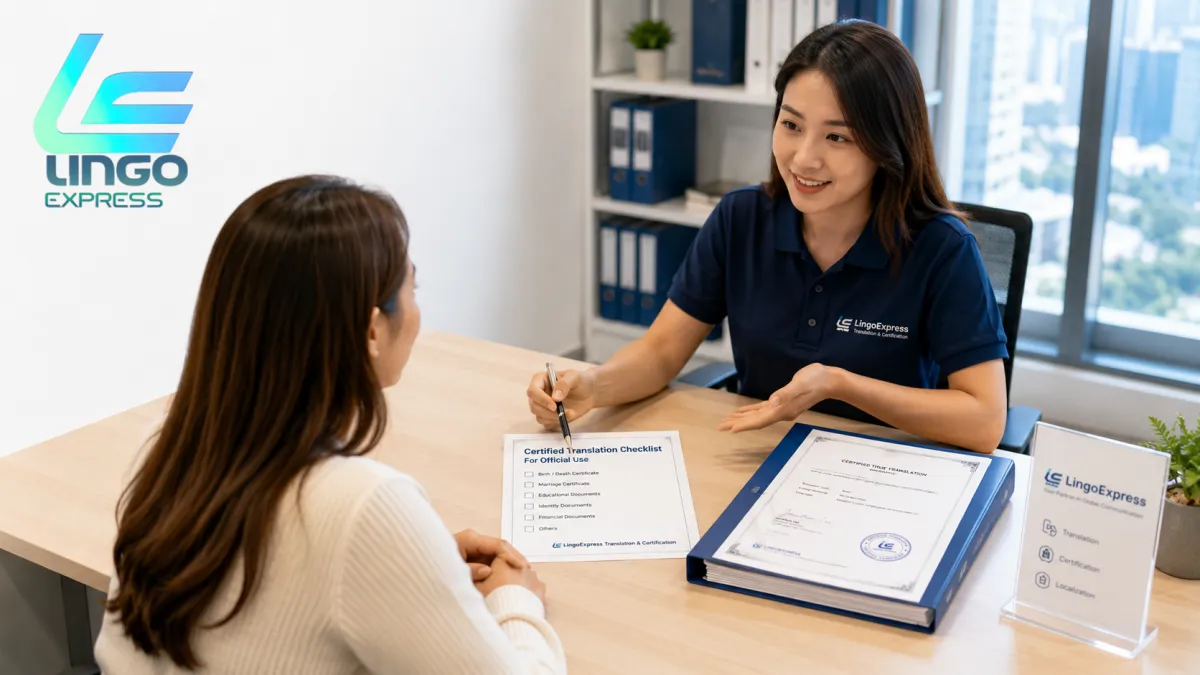
Beginner’s Guide to Certified Translation
If you have just been told you need a "certified translation" and you are not entirely sure what that means, you are in good company — it is one of those phrases that sounds more complicated than it is. The good news is that the idea is straightforward once it is laid out plainly, and getting one is a simple, well-trodden process. This guide starts from zero and takes you through everything a first-timer needs to understand, without jargon and without assuming you have done this before.
By the end you will know what the service actually is, whether you need it, what gets covered, and the steps from sending your document to receiving the finished translation — the way LingoExpress handles it for newcomers every week.
📝 What certified translation is — and who needs it
A certified translation is a faithful, complete English rendering of a document originally written in another language, accompanied by a signed declaration that the translation is true and accurate. That declaration — the certification — is what distinguishes it from an ordinary translation. It names the translator, carries a date, and sits on the provider's letterhead, so the authority receiving it knows an accountable, qualified party stands behind the work.
You typically need one when an official body in Singapore requires a non-English document in English. That covers a wide range of everyday situations: applying for a work pass through the Ministry of Manpower (MOM), lodging an immigration or residence matter with the Immigration & Checkpoints Authority (ICA), registering a marriage with a foreign-language certificate, enrolling at a school or university, or opening certain accounts. If your document is not in English and an institution needs to read it, certified translation is usually the answer.
📄 What a certified translation covers
A common surprise for first-timers is just how much of a document has to be translated. It is not only the obvious text — names and dates — but everything on the page, including the parts that are easy to overlook.
- A Chinese "Medical Certificate of Birth" brings its full contents — the newborn's details, both parents' ID numbers, the issuing hospital — plus its red hospital stamp and certificate number, all rendered in English.
- A Malaysian birth certificate ("Form A") carries the registration area, the father's and mother's IC numbers and occupations, and the registrar's signature and stamp.
- An academic transcript reproduces its subject-and-grade table column for column, so the qualification reads exactly as the original states it.
The principle is simple: a certified translation is a mirror of the source, not a digest of it. Every seal, signature and field appears in the English version, and the layout follows the original so the two can be read side by side.
🧭 How the process works, step by step
The workflow is reassuringly simple, and most of the effort is on the provider's side, not yours.
- Scan your original in colour at high resolution, capturing the full page so every stamp and number is legible.
- Send it to LingoExpress with a note on what the translation is for, and give the passport spelling of every name involved.
- Receive a transparent quote and turnaround once the document and its purpose have been seen.
- Review the draft so you are happy with how names and details read.
- Receive the certified translation on letterhead, formatted to mirror the original and ready to submit.
🖋️ Do you need notarisation too?
This is the question most beginners ask next. Notarisation is an extra layer where a Singapore Notary Public attests to the certification — it sits on top of a certified translation rather than replacing it. For many everyday uses, a certified translation on its own is the complete answer. For permanent residence and citizenship, a notarised version of key civil documents is commonly expected, though whether it applies to your exact case is something to confirm against your own application rather than assume. Where notarisation is needed, LingoExpress arranges it within the same job, so you are not chasing two providers.
That is certified translation from start to finish. It is a small, well-defined service that removes a real obstacle between your foreign-language document and the Singapore process that needs it. When you are ready, send your document with a note on what it is for, and the team at LingoExpress — experienced with documents from 30+ countries — will confirm the scope and a transparent quote before any work starts.
📣 Contact LingoExpress for a free quote!
📧 Email: [email protected]
🌐 Website: https://lingoexpress.com.sg