AI Translation Risks for Legal and Government Documents
There is a clear line between documents where a rough AI translation is harmless and documents where it is a genuine liability. Legal and government documents sit firmly on the wrong side of that line. They are the records that decide cases, grant statuses and bind parties — and they are built out of precisely the elements an automated tool struggles with most. This is a look at where the risk actually lives, and the certified service that exists to keep these documents on solid ground.
⚖️ Who needs this and why it is high-stakes
If you are filing with a Singapore authority, going before a court, incorporating a company or submitting civil records for an immigration matter, you are handling legal or government documents — and the cost of an error is not a clumsy sentence but a rejected filing, a delayed status, or a clause that no longer means what it should. These documents are read by people whose job is to scrutinise them, against other documents, with the original in hand. That is the environment a machine translation has to survive, and it is one it was never designed for.
It helps to be honest about what makes the stakes so unforgiving here. An ordinary translation can absorb a small slip without consequence — the reader still understands. A legal or government document cannot, because its value comes from being exact and from being backed by someone who certifies it. Strip away either of those and you no longer have a usable document; you have text that resembles one. That distinction is the entire reason a separate, certified service exists for this category, rather than treating these records like any other piece of writing.
🚩 Where AI translation breaks down
The risks are specific and repeatable. An AI engine predicts natural-sounding phrasing; it does not safeguard the features that make a legal or official document valid.
- Altered terms of art. Words with settled legal meanings get rendered as everyday language, quietly changing what a clause or provision does.
- Corrupted numbers and identifiers. ID numbers, case numbers, dates and sums can be transposed, merged or dropped — fatal on a document where the data is the substance.
- Lost stamps and seals. A tool reads text, so an official seal, a registrar's stamp or a court mark simply disappears, leaving a record that looks incomplete to an officer.
- Broken structure. Clause numbering, cross-references and defined terms collapse, so the framework an official or lawyer relies on no longer aligns with the original.
- No certification. Most decisively, no machine can issue a signed statement that the translation is true and accurate — and that statement is what an authority requires.
🛡️ What a certified legal translation service covers
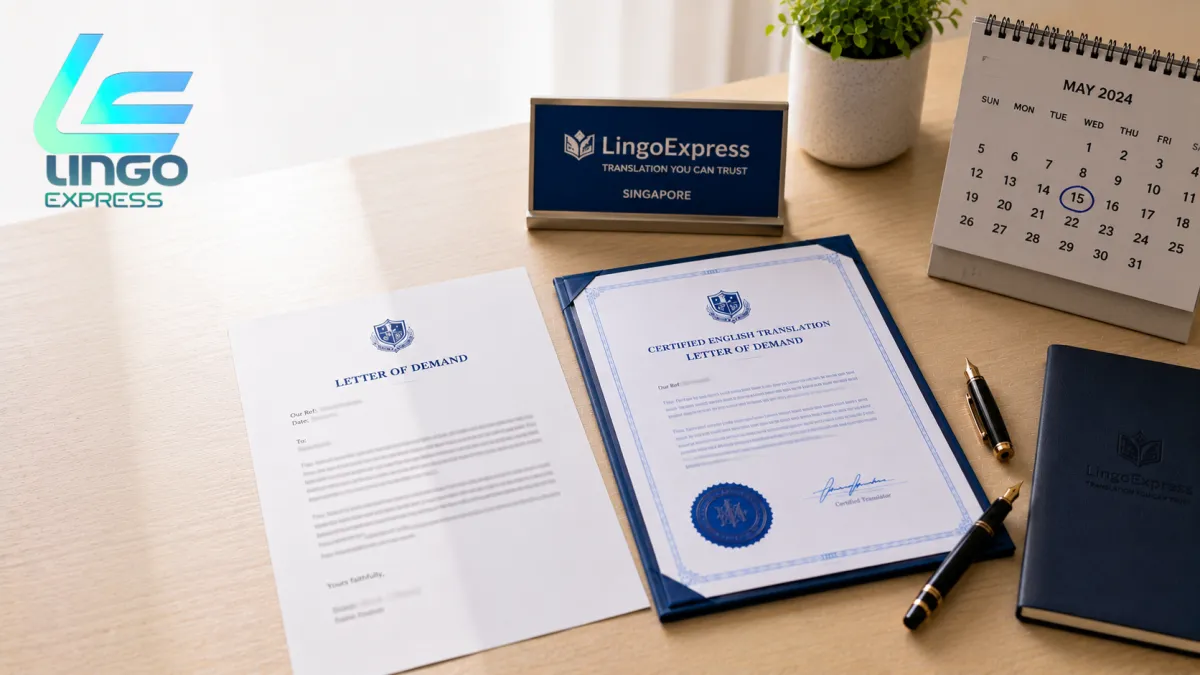
A certified service is built to do the things a machine cannot. The translation is handled by a qualified translator who recognises legal terminology, preserves the logic of clauses and conditions, keeps every number and party name exact, and mirrors the document's structure so it can be read against the source. It is then issued on company letterhead with a signed certification statement declaring it a true and accurate rendering — the format Singapore authorities, the Immigration & Checkpoints Authority (ICA), the courts and corporate registries expect. Where a matter calls for it, notarisation by a Singapore Notary Public is arranged in the same job.
🔄 How the process works
Engaging the service is straightforward, and following the steps keeps the result clean:
- Scan each document in colour at 300+ DPI, full page, so every clause, number, stamp and seal is legible.
- Send it to LingoExpress with the context — what the document is, which authority or court will receive it, and the passport spelling of any personal names.
- Receive a transparent quote and timeline, with notarisation scoped in if your matter requires it.
- Review the draft, then receive the certified translation formatted to mirror the original.
- File or rely on it alongside the source document, confident a named professional stands behind it.
AI has a place for understanding a document quickly. It has no place producing the version you submit. When the document is legal or government-facing, send it to LingoExpress and start from a certified translation built to be accepted and relied on.
📣 Contact LingoExpress for a free quote!
📧 Email: [email protected]
🌐 Website: https://lingoexpress.com.sg