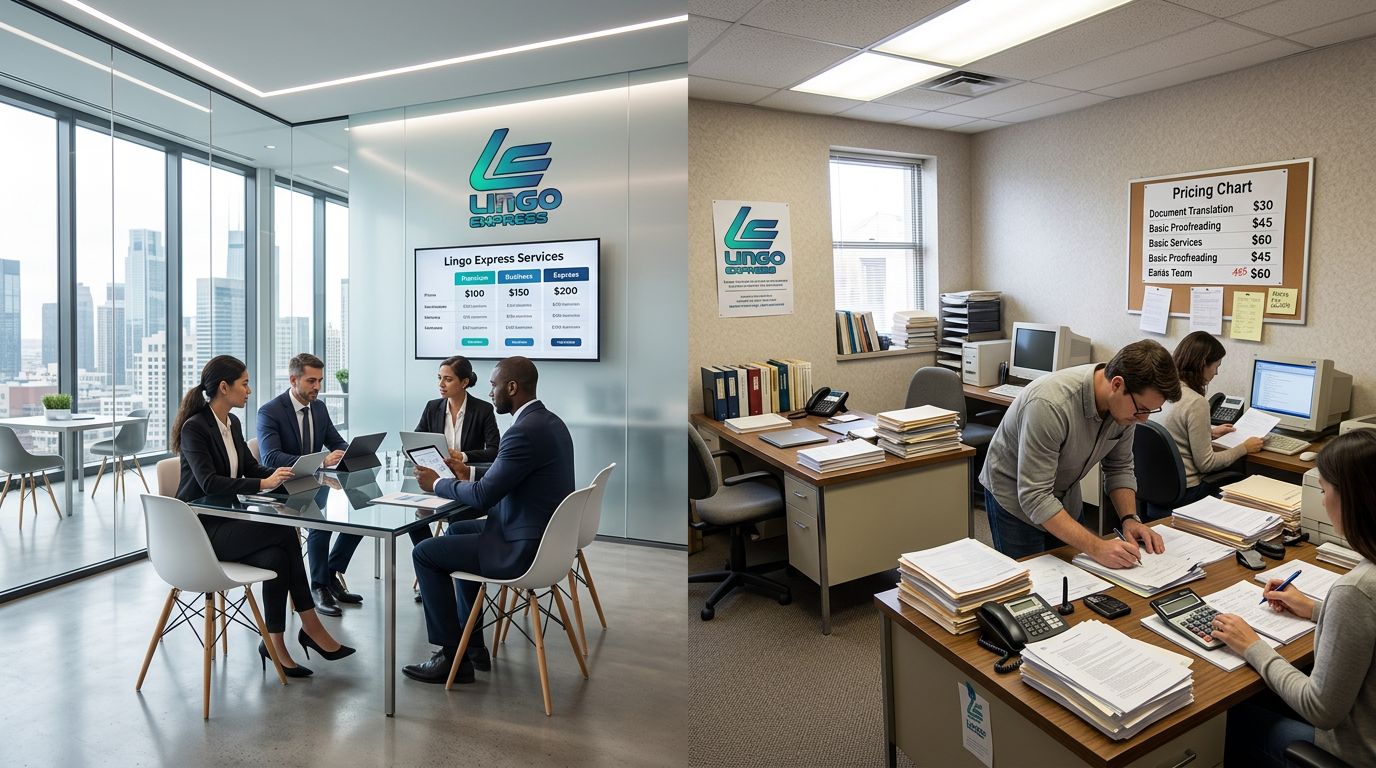
Affordable translation service with transparent quotes
Searching for an "affordable" translation service is easy; knowing whether a price is actually fair is harder. A number on its own tells you nothing — a low quote that skips a seal and gets your file rejected is the most expensive option on the table, while a transparent quote that breaks the job into parts lets you judge value for yourself. This guide unpacks what genuinely drives translation cost, so you can read any quote with confidence and recognise affordability that holds up rather than the kind that bites back.
🔍 Why a flat rate is the wrong promise
A single flat price sounds reassuring, but it usually means someone is overcharged so someone else can be undercharged. A one-page certificate with a handful of fields is a completely different task from a multi-page household register thick with names and official seals, or a stack of transcripts spanning years of subjects. Charging both the same would be unfair to one of them. A provider serious about being affordable does the opposite: it looks at the actual document and prices to the work inside it. That is also why a firm number only ever follows you sharing the files — anyone quoting an exact figure before seeing your documents is either padding for safety or setting up a surprise.
📄 The factors a fair quote is built on
Several things combine to set the effort behind a certified translation. Knowing them lets you see where a quote comes from — and where you might trim sensibly without cutting corners.
Document type and complexity. A short standard certificate is straightforward; a page ruled into dense tables, codes or specialised terms is not. A licence with a class-code table, or a transcript with a tight grid of grades, takes careful work so every cell lines up with the original.
Length and the seals to render. It is not just page count but how much sits on each page. Fine print, tables and official stamps all add weight, and every seal and signature has to be described in the translation — an untranslated stamp reads as an incomplete document — so the number of marks genuinely adds to the work.
Certification tier. A certified translation carries a signed accuracy statement. A notarised one is that work witnessed by a Singapore Notary Public — commonly required for PR, though confirm your case. Authentication for use overseas is a separate step again. Each added layer is more handling, sitting on top of the base.
Language pair. Common pairs such as Chinese, Malay or Tamil into English draw on a deep pool of qualified linguists. Rarer combinations — Burmese, Khmer, Japanese, Korean or various European languages — rely on a smaller pool of specialists, which naturally affects the figure. The breadth a provider covers matters, and LingoExpress handles a wide range.
Turnaround and volume. A standard timeline in business days lets the team translate, check and certify properly; compressing it into a rush means rearranging schedules, and that priority handling carries a premium. Submitting related documents together is usually more efficient than trickling them in one by one.
- A Chinese "Medical Certificate of Birth" packs neonatal details, both parents' nationality and ID numbers, the issuing hospital and a red seal with a certificate number onto one sheet — compact, but every field and the stamp must be rendered.
- A Malaysian "Form A" birth certificate follows a fairly standard layout — registration area, parents' IC numbers and occupations, registrar's stamp — usually lighter than a dense multi-page record.
- A Chinese household register (hukou) runs across pages, lists several family members and carries multiple Public Security Bureau seals — more entries and more stamps all add to the effort.
- An SPM certificate carries a grid of subjects and grades that must align exactly with the original — the table drives the work, not the page count.
📋 How to get an accurate, itemised quote
The fastest route to a number you can trust is giving the team what it needs to assess the job. A little preparation turns a rough guess into a precise breakdown.
- Send clear, complete scans. Legible images of every page — including the back, where stamps and signatures often sit — let the team see exactly what they are pricing, and avoid back-and-forth that slows you down.
- Name the purpose and the receiving authority. Whether it is the Immigration & Checkpoints Authority (ICA), an employer, a university, a bank, or use overseas, the recipient decides whether certification alone is enough or a further tier applies.
- State your deadline. Telling the team when you need it lets the quote reflect a standard or a priority timeline honestly, with no late surprises.
With those three in hand, LingoExpress returns a transparent, itemised quote — the base translation, any notarisation, and any further authentication broken out as separate lines, so you see what each step covers rather than one opaque sum, and know exactly what you are approving before any work begins.
🌏 How to keep your cost genuinely sensible
Affordability is rarely about chasing the lowest sticker — it is about not paying for things your situation does not call for.
- Match the tier to the need. Confirm whether certification suffices before adding a notary step; for many everyday submissions, certified alone is accepted.
- Bundle related documents. Sending a family's certificates and transcripts together is usually more efficient than piecemeal requests.
- Avoid the rush where you can. If your timeline has any give, a standard turnaround sidesteps priority handling — planning ahead is often the simplest saving available.
Real affordability, then, is a fair figure you understand, attached to work an authority will accept the first time. That is the standard LingoExpress works to — a clear breakdown, accurate translation, and certification that holds up — so the price you approve is the value you receive, with nothing buried and nothing to redo.
📣 Contact LingoExpress for a free quote!
📧 Email: [email protected]
🌐 Website: https://lingoexpress.com.sg