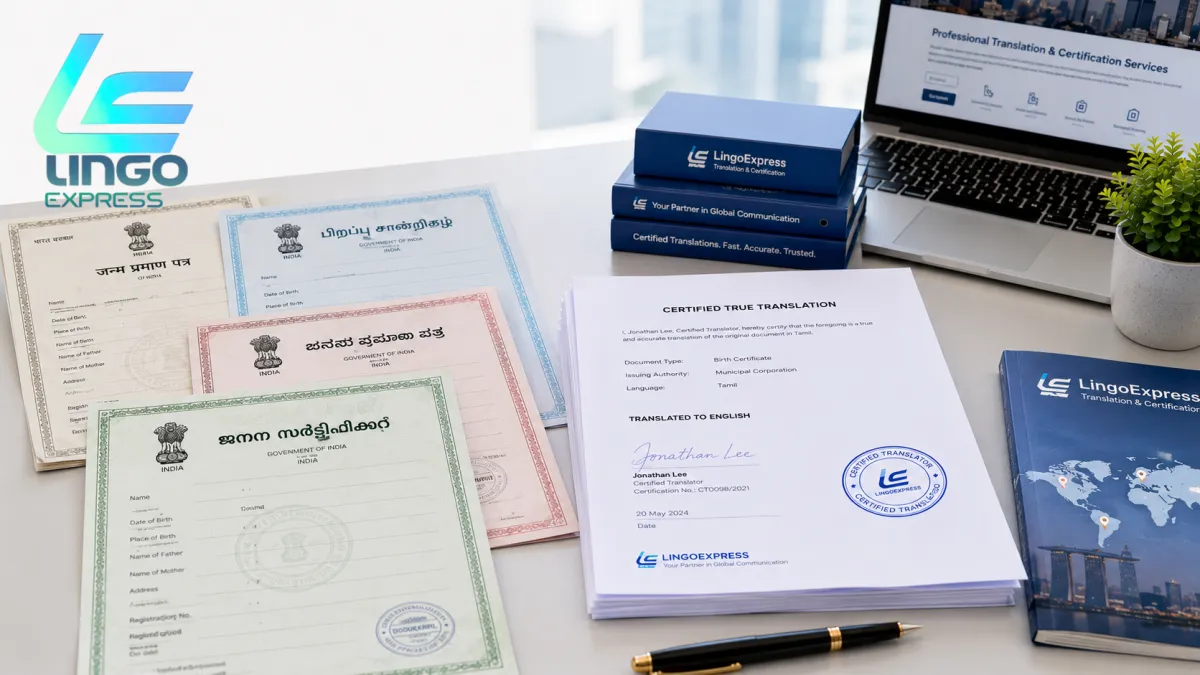
Aadhaar card translation
The Aadhaar card is one of the most common identity documents Indian nationals are asked to produce abroad. It is issued by the Unique Identification Authority of India (UIDAI) and is frequently used as proof of identity and proof of address — but when you submit it to a Singapore government department, an employer or a bank, the version printed in a regional script has to be turned into a complete, certified English document first. This page explains the Aadhaar card translation service: who needs it, what is covered, and how the process works from scan to certified copy.
🪪 What this service is — and who needs it
An Aadhaar card translation is a certified English rendering of your original Aadhaar, produced by a qualified translator and issued on company letterhead with a signed certification statement. It is not a casual transcription; it is a document an authority can rely on as a faithful copy of the original. That distinction matters, because the bodies that ask for it are checking your identity.
You are likely to need this service if you are an Indian national in Singapore and any of the following applies to you:
- You are submitting an application to the Immigration & Checkpoints Authority (ICA) — for a Long-Term Visit Pass, Dependant's Pass, Permanent Residence or citizenship — and your Aadhaar is requested as supporting proof of identity or address.
- You are completing a work-pass or dependant matter with the Ministry of Manpower (MOM) and need an English version of an Indian-language document on file.
- A bank, school, employer or insurer in Singapore has asked you to verify your identity or home address with a translated supporting document.
- You are bundling your Aadhaar alongside other Indian records — a birth certificate, marriage certificate or academic transcript — that also need translating for the same application.
If your Aadhaar card is already printed in English, you may not need a translation at all — many cards carry a bilingual layout. The service is for the version that an officer in Singapore cannot read, or where the English on the card is partial and the regional-language fields still need rendering.
📄 What's covered: every field on the card
A proper Aadhaar translation does not stop at your name. Everything printed on the card has to appear in the English version, in a layout that lets an officer match it to the original at a glance. Leaving an element out makes the document read as incomplete — and incomplete is the single most common reason a translation gets queried.
- The cardholder's full name, with the spelling matched to your passport.
- The 12-digit Aadhaar number, reproduced exactly.
- Date of birth and gender.
- The full residential address, including the father's or guardian's name where the card shows it, district, state and PIN code.
- The UIDAI emblem and wordmark, and any printed authority text, described or noted in place.
- The QR code and any reference or enrolment identifiers, marked in position so the layout mirrors the card.
Because the address block and the holder's name are the fields most often cross-checked against your other documents, they are handled with particular care. A romanised Indian name can be spelled several ways; the translation follows your passport, not a phonetic guess, so the same person reads consistently across your whole file.
⚙️ How the process works
The service is built to be straightforward, so you are not guessing at requirements. From the first scan to the certified copy in your hands, it runs in clear stages:
- Scan the original in colour at 300+ DPI, full card, front and back if both carry information — so every digit, the address and the QR code are legible.
- Tell us which authority it is for and what they have asked of you, so the translation is prepared to suit the way that body reviews documents.
- Send it to LingoExpress for a quote — you receive a clear, itemised quote and a turnaround estimate before any work begins.
- Provide the passport spelling of your name — and of any other person named on the card — so the English version matches your travel document character for character.
- Review the draft for accuracy, then receive the certified translation, formatted to mirror the Aadhaar layout.
- Submit the translation alongside the original to the authority that requested it.
🌏 Aadhaar alongside your other Indian documents
An Aadhaar card rarely travels alone. Most applications that ask for it also ask for the documents it supports — and translating them together keeps every name, date and place consistent across the set. LingoExpress regularly translates Indian birth certificates, marriage certificates, academic transcripts and other records from India for use in Singapore, so the source format is familiar and your documents read as one coherent file rather than a patchwork.
That breadth matters because India is one of more than thirty countries whose documents are handled here, across 45+ languages and scripts. Whether your Aadhaar is printed in Hindi, Tamil, Telugu, Bengali, Marathi or another regional language, the script is one the translation team works in.
📝 On notarisation and certification
A certified translation carries a signed declaration from a qualified translator stating that it is a true and accurate rendering of the original. In the words of the certification statement: "We, LingoExpress, a professional translation service provider, hereby certify that the attached document(s) have been translated by our team of qualified and professional translators…" — signed, dated and on company letterhead. That is the form Singapore authorities generally expect for supporting identity documents.
Some applications — particularly PR and citizenship matters — call for notarisation by a Singapore Notary Public on top of certification. Whether your Aadhaar needs that extra step depends on the specific application, so confirm it for your case; where it is required, the notarisation can be arranged within the same job, so you are not chasing two providers.
✅ What you receive
You receive a certified English translation of your Aadhaar card — every field rendered, the layout mirroring the original, the holder's name matched to your passport — on company letterhead with a signed certification statement from a qualified translator. Where your application requires it, notarisation is arranged in the same job. The result is a document you can submit with confidence, knowing it reads as a complete and faithful copy of your Aadhaar.
📣 Contact LingoExpress for a free quote!
📧 Email: [email protected]
🌐 Website: https://lingoexpress.com.sg